


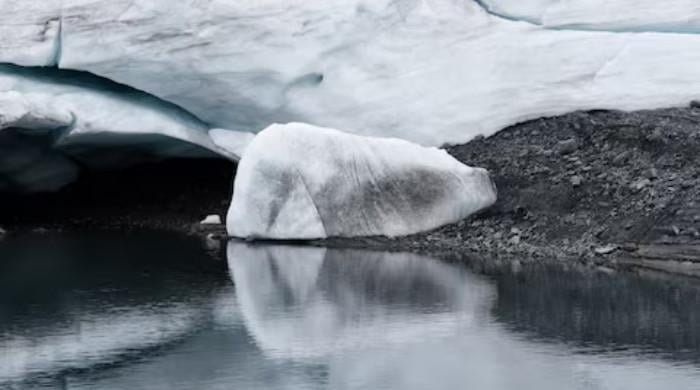

Glaciers around the globe are disappearing faster than ever, with the last three-year period seeing the largest glacial mass loss on record, according to a United Nations Educational, Scientific and Cultural Organisation (Unesco) report, opens new tab released on Friday.
The 9,000 gigatons of ice lost from glaciers since 1975 are roughly equivalent to “an ice block the size of Germany with the thickness of 25 meters,” Michael Zemp, director of the Switzerland-based World Glacier Monitoring Service, said during a press conference announcing the report at the UN headquarters in Geneva.
The dramatic ice loss, from the Arctic to the Alps, from South America to the Tibetan Plateau, opens new tab, is expected to accelerate as climate change, caused by the burning of fossil fuels, pushes global temperatures higher. This would likely exacerbate economic, environmental and social problems across the world as sea levels rise and these key water sources dwindle.
The report coincides with a Unesco summit in Paris marking the first World Day for Glaciers, urging global action to protect glaciers around the world.
Zemp said that five of the last six years registered the largest losses, with glaciers losing 450 gigatons of mass in 2024 alone.
The accelerated loss has made mountain glaciers one of the largest contributors to sea level rise, putting millions at risk of devastating floods and damaging water routes that billions of people depend on for hydroelectric energy and agriculture.
Stefan Uhlenbrook, the director of water and cryosphere at the World Meteorological Organisation (WMO), said that about 275,000 glaciers remain globally which, along with the Antarctic and Greenland ice sheets, comprise about 70% of the world’s freshwater.
“We need to advance our scientific knowledge, we need to advance through better observing systems, through better forecasts and better early warning systems for the planet and the people,” Uhlenbrook said.
Dangers and deities
About 1.1 billion people live in mountain communities, which suffer the most immediate impacts of glacier loss, due to the increasing risks with natural hazards and unreliable water sources. The remote locations and difficult terrains also make cheap fixes difficult to come by.
Rising temperatures are expected to worsen droughts in areas that rely on snowpack for freshwater, while increasing both the severity and frequency of hazards like avalanches, landslides, flash floods and glacial lake outburst floods (GLOFs).
One Peruvian farmer living downstream of a retreating glacier has taken the issue to court, suing German energy giant RWE for a portion of the glacial lake’s flood defenses proportionate to its historic global emissions.
“The changes we see in the field are literally heartbreaking,” glaciologist Heidi Sevestre, secretariat at the Arctic Monitoring and Assessment Program, told Reuters outside the Unesco headquarters in Paris on Wednesday.
“Things in certain regions are happening actually much faster than we anticipated,” Sevestre added, noting a recent trip to the Rwenzori Mountains, located in Uganda and the Democratic Republic of the Congo in East Africa, where glaciers are now expected to disappear by 2030.
Sevestre has worked with the region’s indigenous Bakonzo communities who believe a deity called Kitasamba lives in the glaciers.
“Can you imagine the deep spiritual connection, this strong attachment they have towards the glaciers and what it might mean for them that their glaciers are disappearing?” Sevestre said.
Glacial melt in East Africa has led to increased local conflicts over water, according to the new Undesco report, and while the impact on a global scale is minimal, the trickle of melting glaciers around the world is having a compounding impact.
Between 2000 and 2023, melting mountain glaciers have caused 18 millimeters of global sea level rise, about 1 mm per year. Every millimeter can expose up to 300,000 people to annual flooding, according to the World Glacier Monitoring Service.
“Billions of people are connected to glaciers, whether they know it or not, and that will require billions of people to protect them,” Sevestre said.
