 Pakistan · World · Independent Digital Newsroom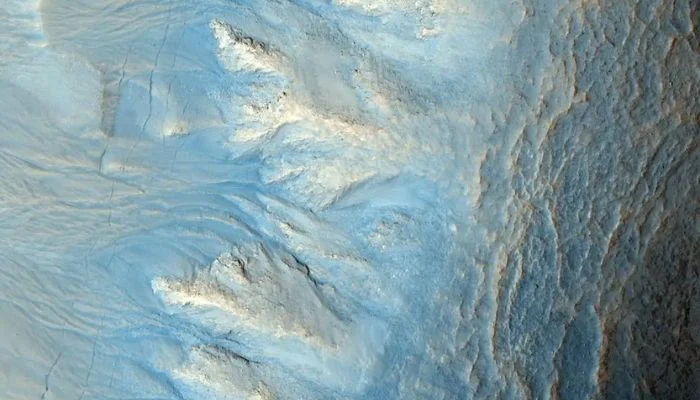
You'd see murky light-tan cliffs and almost no colour in the shadows.
That makes NASA's new blue Mars panorama a bit of a trick, though not the kind you might suspect.Curiosity captured the scene on August 11 around 8:30 a.m. local Mars time.
Its Mastcam took six images, which were stitched together after being sent to Earth.
Unlike most Mastcam images, this one skipped the usual white balancing.NASA called that "an artistic choice" that preserves the early morning appearance.
It shows wind-carved cliffs called yardangs on Mount Sharp.Martian dust tints everything the sun touches, so mission teams usually correct for it.
The goal is to make rocks look as they would in Earth sunlight.
Mike Malin, principal investigator for Curiosity's Mastcam, says the dust also hangs in the air, so the light has a colour like the sky near a forest fire.Correcting for it gives geologists a stable reference, says Mark Lemmon of Perseverance's Mastcam-Z team.
Without it, everything takes on one dusty cast.
When a global dust storm hit in 2018, the uncorrected view turned "virtually monochrome", he said.Mostly the ground, along with rocks scraped bare of dust and windswept patches of sand, appears greyish or even bluish-grey.One-fourth of the detector elements detect blue light, although there is very little of it in the Martian sun.
Calibration may compensate for this, resulting in a tendency to overdo it and give grey rocks and dark shadows a bluish tint, according to Malin.
Pictures that are calibrated result in a predominantly orange colouration, like the images produced by the Viking landers in the 1970s.Since Mars revolves 1.5 times farther away from the sun than Earth, it receives only half the amount of solar radiation.
An observer at that time would have observed a dark landscape and light tan-coloured cliffs in the distance.Over time, Lemmon says, it begins to white balance a very colourful scene, like any software will do.Both scientists prefer the corrected view for research.
Malin warns that heavy processing can make colours "garish" and distract from the rocks.