


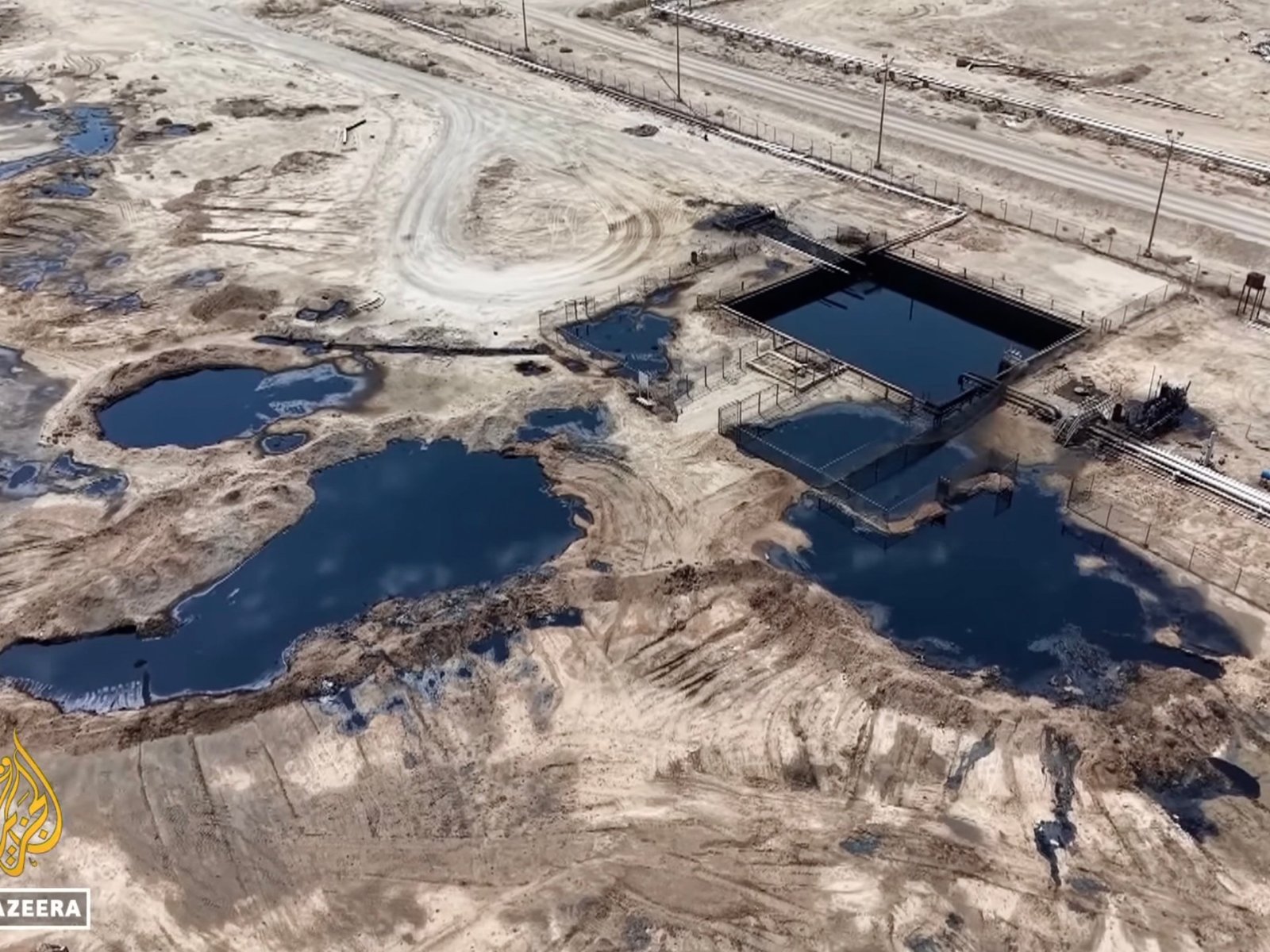
Deir Az Zor, Syria – The first thing that strikes you about the desert of eastern Syria is the vast still landscape: its silence, the unrelenting heat, and dry hot gusts of wind. The journey to Deir Az Zor feels like travelling back in time, with few markers of modernity evident as you look out from the road.
But then a vast, shimmering body of sludge emerges, a black scar through the beige desert. The smell is a thick, chemical tang of petroleum that coats the back of your throat. It looks almost beautiful, until you remember – it is a river of death.
Recommended Stories
list of 3 itemsend of list
We reached the al-Taim oilfield in Deir Az Zor province to see one of the few oil facilities in Syria controlled by the government in Damascus.
After years of war, some damage to the oilfield was to be expected, but not this – a toxic expanse testament to one of the Syrian conflict’s most poisonous and lasting legacies.
The oil spill is not the aftermath of a single battle, but the product of decades of neglect and war. What spills here is a carcinogenic mix of produced water – a byproduct of the oil and gas extraction process – and crude oil, which used to be deposited safely underground.
But years of war have destroyed the infrastructure that did that, and it has never been repaired. The mixture therefore flows unchecked, 24 hours a day, seeping into the desert soil, where it inches towards the aquifer below and snakes its way closer to the Euphrates River, the lifeblood of Deir Az Zor.
Lack of government support
The absence of proper government that led to this environmental disaster can be seen elsewhere in Deir Az Zor.
The province – located in Syria’s far east and separated from the country’s populous and fertile west by miles of desert – has long been on the margins of the Syrian state, neglected for decades even before the war.
Today, that lack of governance is evident in broken bridges, gutted villages and oilfields left to rot. Few journalists make the trip due to the drive from Damascus. It can take up to half a day – through a few checkpoints and stretches of empty road where security is never guaranteed – and journeys should be complete before it gets dark.
At the decades-old pumps that pull the oil from the ground, we found a few guards seeking refuge from the heat in their tarp-lined security post. They approached us with rifles slung casually across their shoulders, one riding a gleaming Chinese-built motorcycle, the black logo of ISIL (ISIS) emblazoned on the headlight.
One of the men laughs when I point it out.
“We bought it like that,” he says with a shrug. “No one bothered to scrape it off.” It’s a chilling reminder that the ghosts of the recent past remain etched not just in memory but into the machinery of daily life.
Mohammed al-Touma, one of the safety engineers at the pump, steered things back to the crisis at hand.
“It kills the birds instantly,” he said, as he approached to tell us about the black, hazardous sludge that we had seen. “No one cares, please tell the world about this toxic, radioactive waste.”
The oilfield’s workers had left between 2012 and 2013, when ISIL began infiltrating into Deir Az Zor before fully taking over the province in 2014.
The workers returned once the group had been defeated in the area in 2017, only to find this expanding river of oil residue no longer being pumped back into the oil table deep underground. Nothing has changed since then, even after the fall of President Bashar al-Assad in December and the end of Syria’s war.
The new Syrian government faces security and governance challenges across the country, as it attempts to turn the page after 13 years of conflict. Fighting has periodically taken place involving government forces and local militias, leading to hundreds of deaths, and Israel continues to bomb the country and seize more territory.
And with reconstruction needed across the country, this oilfield in Deir Az Zor is not at the top of the government’s priority list.
Symbol of war
Walk around the field, and the damage is like a tapestry woven by every faction that fought here.
There are bullet holes in pipelines, gaping holes in massive fuel tanks, and the mangled remains of steel structures and instruments.
ISIL drained the field to bankroll its state. The United States-led coalition and Russian jets bombed the oilfield to starve that funding.
Assad-regime forces, Iranian-backed militias and local tribes fought bloody battles for its control. The result: a poisoned inheritance for all the civilians of Deir Az Zor.
To grasp the scale of the disaster, we launched a drone. As it climbed in the air, it became clear that the oil spill was no pond.
It is a vast, dark river, stretching relentlessly. A 10-kilometre-long (six-mile) scar that is still growing. From above, the scale is staggering, so we asked for satellite imagery. And from space, the time-lapse is even starker; what began as a puddle after the first strikes has metastasised into a lagoon visible from the satellite’s orbit.
“You have to understand, before all this, that wasn’t here,” Firas al-Hamad, al-Taim oilfield’s operations manager, told me. “This water mixed with oil, we used to inject it deep underground. Protocol. [But] for years now it just poured out 24-7.”
His explanation was simple, and the science seems pretty straightforward. This is the produced water, a toxic byproduct of oil extraction. The solution is also simple: new disposal wells need to be drilled.
But this is Syria, and we’re in neglected Deir Az Zor, where hospitals run without stretchers and electricity is a few-hours-a-day luxury. Environmental repair does not even register on the list of priorities.
“We’ve asked,” one local official admitted, referring to both the current and former Syrian governments. “We’ve been promised. Nothing happens.”
When contacted, the central government in Damascus gave no response.
The greatest fear is just 15 kilometres (nine miles) away: the Euphrates River, a lifeline for millions across Syria and Iraq.
For now, the toxic slick has not reached it. But the desert is unforgiving. One heavy storm, one flash flood, and the poison could flow into the river, contaminating crops, wells and drinking water downstream.
Out in the open yet hidden, it is a lingering cost of war.
Here, in the silence of Syria’s oil heartland, a river of poison spreads unchecked.
Oil, the resource that once sustained this region, providing jobs and prosperity, now threatens to destroy it. And the people of Deir Az Zor are left waiting, caught between the ruins of yesterday and a growing catastrophe in front of their eyes.
A catastrophe that the world is paying little attention to, and a flowing testament that serves as one of the Syrian war’s unspoken legacies.
