


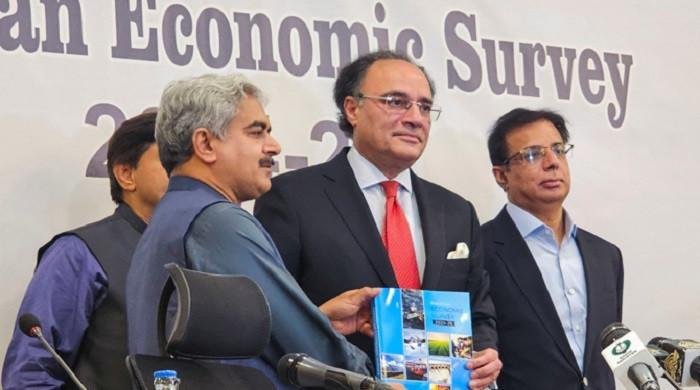
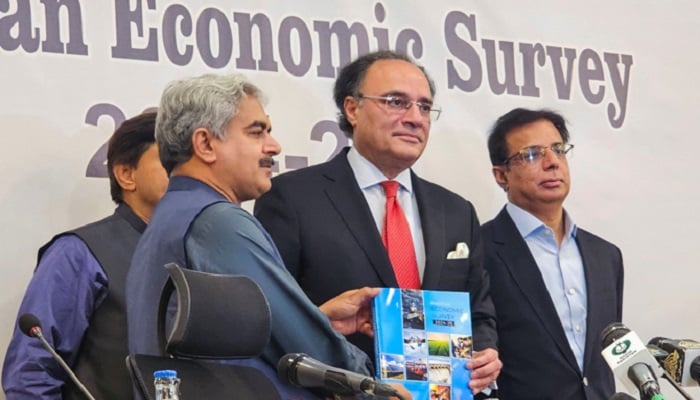
The Economic Survey 2024-25, a key pre-budget document, comes at a time when Pakistan’s economy is stabilising but remains fragile as the country navigates reforms under a $7 billion International Monetary Fund (IMF) programme.
Pakistan’s federal budget for the next fiscal year, starting July, will be released on Tuesday.
Here’s a breakdown of the survey, as analysed by brokerage firm Arif Habib Limited:
- Pakistan’s economy grew by 2.68% in FY25, showing signs of stabilisation. GDP at current prices rose by 9.1% to Rs114,692 billion, while per capita income increased by 9.7% to $1,824.
- Inflation eased sharply, with headline CPI at 0.3% in April 2025 versus 17.3% last year. Average inflation during Jul–Apr FY25 stood at 4.7%, down from 26.0% in the same period last year.
- The investment-to-GDP ratio improved to 13.8%, and the saving-to-GDP ratio increased to 14.1%.
- Agriculture posted modest growth of 0.56% in FY25, led by a 4.72% rise in livestock. However, major crops declined by 13.49% due to lower cultivation and weather challenges.
- Industry expanded by 4.77%, supported by small-scale manufacturing and slaughtering. Large-scale manufacturing contracted by 1.5% amid high costs and supply constraints.
- Services grew by 2.91% and retained the largest share of the GDP at 58.4%, supported by steady growth in retail, transport, and government services.
- Pakistan recorded a fiscal surplus of Rs1,896 billion (1.7% of GDP) in 1QFY25, the first in 24 years. The FY25 fiscal deficit narrowed to 2.6% of GDP, while the primary surplus reached 3.0%.
- The policy rate was reduced to 11% in May 2025 from a peak of 22%, reflecting falling inflation and lower energy and food prices.
- Broad Money (M2) grew by 4.5% (PKR 1,604bn) during Jul–Mar FY25, down from 7.2% growth the previous year.
- Private sector borrowing surged to Rs767.6 billion during Jul–Mar FY25, nearly triple last year’s level. Consumer financing also recovered strongly with a net increase of Rs71.4 billion.
- The KSE-100 index gained 50.2%, closing at 117,807 points in March 2025, boosted by stable macroeconomics, corporate earnings, and IMF programme progress.
- The current account posted a surplus of $1.9 billion during Jul–Apr FY25, reversing last year’s $1.3 billion deficit. Foreign exchange reserves rose to $16.64 billion in May 2025.
- Remittances hit a historic monthly high of $4.1 billion in March 2025 and grew 31% YoY to $31.2 billion during July–April FY25.
- Public debt stood at Rs76,007 billion at end-March 2025, with domestic debt at Rs51,518 billion and external debt at R24,489 billion ($87 billion).
- The government reduced short-term debt by retiring Rs2.4 trillion in Treasury Bills and introduced new instruments like a 2-year zero-coupon Pakistan Investment Bond and a 1-month Treasury Bill.
- Strategic liability management operations included repurchasing about Rs1 trillion in government securities through buybacks and exchanges.
- Pakistan issued its first Green Sukuk worth Rs30 billion, signalling progress toward green finance and sustainable investment.
- The government secured $1.4 billion under the IMF RSF to boost climate resilience, institutionalising a climate budget within its governance framework.
Outlook
- Real GDP growth is projected to grow at potential in FY26, with medium-term growth expected at 5.7%, supported by macroeconomic stability, pro-growth reforms, and URAAN Pakistan’s transformation strategy.
- Inflation is expected to remain anchored at 5–7% in the medium term, supported by global disinflation, easing energy prices, and improved domestic food production.
- The current account deficit is projected at a sustainable 0.8% of GDP over the medium term, aided by moderating energy imports, IT export growth, and skilled labour remittances from the Gulf states.
- Government focus on export diversification, regional trade linkages, and value chain integration is key to mitigating external shocks.
- Fiscal consolidation is underway through tax base broadening, energy sector reforms, and privatisation, strengthening long-term fiscal health.
- Ongoing IMF EFF & RSF support is enhancing investor confidence, facilitating public and private investment flows.
- Improving credit conditions and lower inflation support a cautiously optimistic outlook for large-scale manufacturing recovery, contingent on continued macro stability and structural reforms.
- Slowing global trade, rising risk premiums, and tighter immigration in host countries may impact exports, remittances, and investment sentiment.
- Potential return migration and global job market tightening necessitate stronger domestic labour absorption strategies.
