


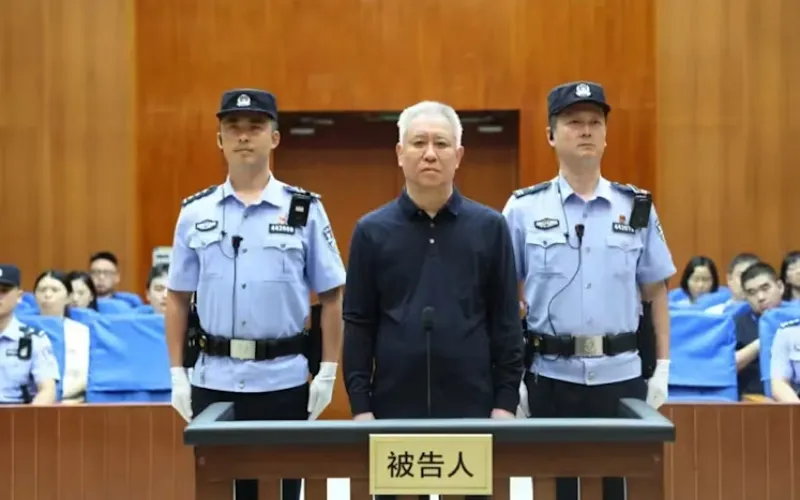
BEIJING: Hui Ka Yan, founder of China Evergrande Group and once one of Asia’s richest men, was sentenced to life in prison on Thursday by a Chinese court in one of the country’s most high-profile corporate fraud cases.
Hui, 67, pleaded guilty in April to eight charges, including misappropriation of funds, fundraising fraud, illegal collection of public funds, illegal lending, fraudulent issuance of securities and bribery. The sentence comes nearly five years after Evergrande’s debt crisis began to unravel, sending shock waves through China’s property sector and financial markets.
Evergrande, once one of China’s largest property developers, defaulted on much of its roughly $300 billion in liabilities, becoming a symbol of the prolonged crisis in the country’s real estate sector.
A court in the southern city of Shenzhen also ordered the confiscation of Hui’s personal assets. He was detained by Chinese authorities in 2023 after Evergrande failed to meet its debt obligations and has not been seen publicly since.
The ruling is unlikely to provide significant relief to Evergrande’s domestic and international creditors, many of whom have suffered substantial losses following the company’s collapse.
Court-released images showed Hui standing between two officials as the verdict was announced. He was wearing a dark blue, long-sleeved collared shirt.
The court also fined Evergrande 8.82 billion yuan ($1.31 billion) and its main subsidiary, Hengda Real Estate, 7 billion yuan. Five other senior executives received prison terms ranging from six to 18 years, along with fines.
According to state broadcaster CCTV, a total of 56 people linked to Evergrande were sentenced on Thursday.
The court said the criminal activities involving Evergrande, Hengda Real Estate and Hui involved extremely large sums and caused substantial economic and social harm, warranting severe punishment under the law.
Evergrande had previously faced protests after failing to repay billions of dollars in wealth-management products. Many ordinary investors, including low-income families, lost significant portions of their savings.
Hui was raised by his grandmother in a rural village in central China’s Henan province. He initially worked as a steel technician before founding Evergrande in 1996.
The company expanded rapidly through aggressive borrowing and eventually became China’s largest property developer by contracted sales. Hui’s wealth reached an estimated $45.3 billion in 2017, according to Forbes, making him Asia’s richest person at the time.
The company’s downfall marked a dramatic reversal of Hui’s fortunes. A Hong Kong court ordered Evergrande to be liquidated in 2024, while the Hong Kong Stock Exchange delisted the company last year, bringing an end to its turbulent rise and collapse.
