


Nearly eight decades after the establishment of Israel, the creation of a sovereign Palestinian state remains the defining question of the Arab-Israeli conflict. Wars have been fought, peace treaties signed and diplomatic initiatives launched, yet this central strategic issue remains unresolved.
Today, Saudi Arabia is at the forefront of the efforts to establish a Palestinian state and deliver a lasting peace arrangement with Israel. Its commitment to the issue is made clear by its decision to cosponsor the creation of the Global Alliance for the Implementation of the Two-State Solution in 2024, which is currently meeting in Rome.
King Salman and Crown Prince Mohammed bin Salman are following in the footsteps of successive Saudi monarchs. For more than half a century, the kingdom has maintained a remarkably consistent position. The question has never been whether peace with Israel is possible, but whether the political conditions required to make such a peace comprehensive, legitimate and irreversible were present.
Within that framework, recognition of Israel and the establishment of a sovereign Palestinian state are parallel components of a single settlement. Neither is intended to precede the other.
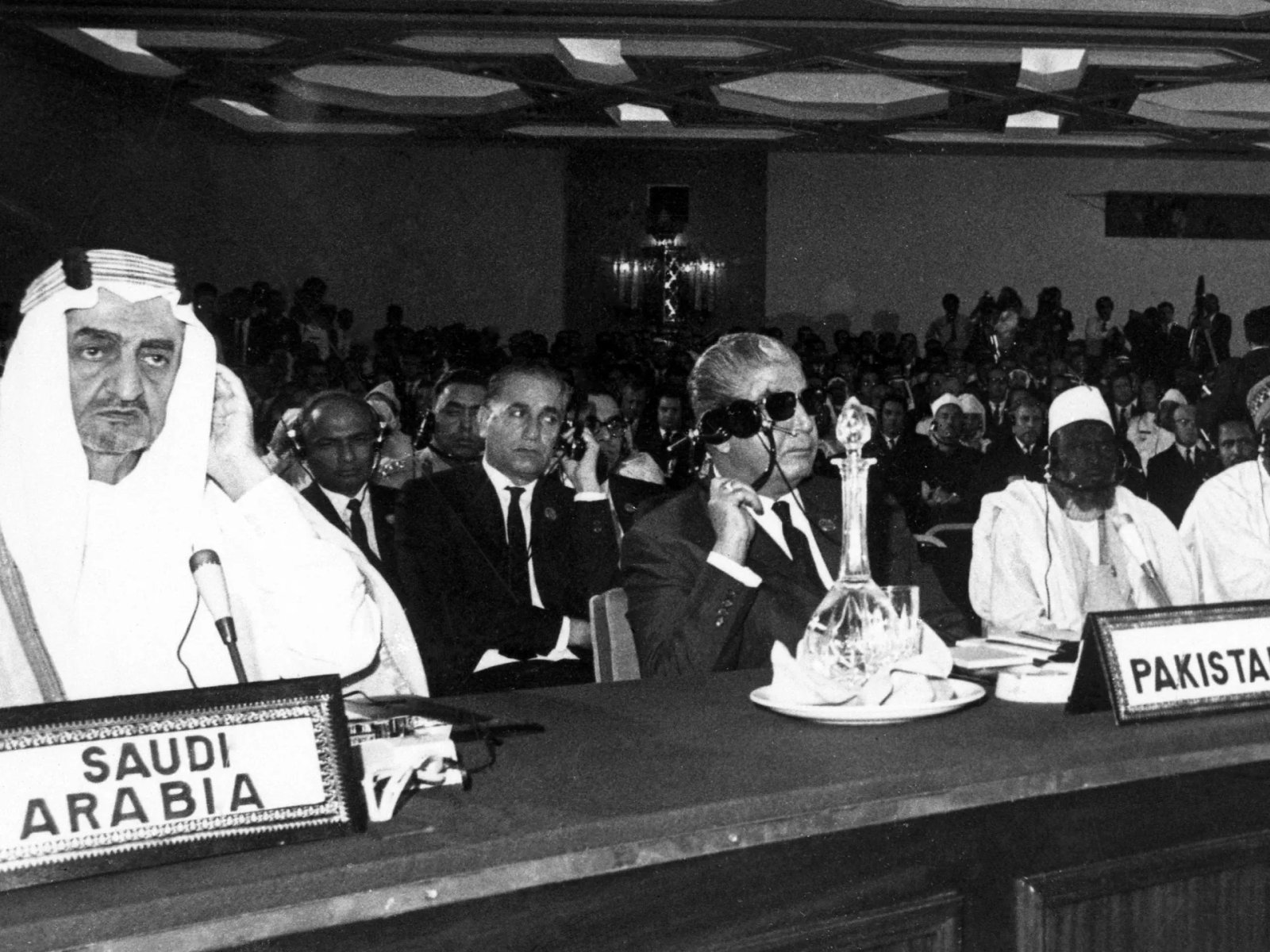
That doctrine originated under King Faisal, who made Palestinian self-determination a central pillar of Saudi national security policy. His successors preserved the principle while adapting its diplomatic expression to changing regional realities. The objective remained constant even as the diplomatic environment evolved.
The Fahd Plan of 1981 – named after King Fahd – translated that doctrine into a formal peace proposal calling for Israeli withdrawal from occupied Arab territories and recognition of Palestinian national rights. Two decades later, the Crown Prince and later King Abdullah expanded the same strategic logic through the 2002 Arab Peace Initiative. Israel was offered comprehensive peace and normal relations with the Arab world in return for withdrawal from the territories occupied in 1967 and the establishment of an independent Palestinian state.
The current Saudi leadership therefore inherits an established strategic doctrine rather than an unresolved policy debate. Their responsibility is to determine whether today’s diplomatic environment can finally satisfy conditions that have remained fundamentally unchanged for decades.
That continuity also reflects a broader question of state legitimacy. For the Saudi monarchy, support for Palestinian statehood has never been solely a matter of foreign policy. It has become one of the enduring pillars of the kingdom’s political and religious legitimacy, rooted in the monarch’s role as Custodian of the Two Holy Mosques and reinforced by the kingdom’s longstanding position within both the Arab and Islamic worlds.
The significance of that continuity became clearer after the Abraham Accords of 2020. By establishing diplomatic relations between Israel and the United Arab Emirates and Bahrain, later joined by Morocco and Sudan, the accords demonstrated that Arab-Israeli normalisation could advance without progress on Palestinian statehood. They reshaped regional diplomacy, but they neither resolved the Palestinian question nor completed the wider peace process.
Successive US administrations have regarded Saudi participation as the decisive missing element. The Abraham Accords could expand without Riyadh, but they could not acquire their full strategic significance without the kingdom’s participation.
The Trump administration has once again placed Saudi-Israeli normalisation at the centre of its regional diplomacy. But this diplomatic push has to be evaluated in the larger post-October 7 context.
The war in Gaza created an entirely new diplomatic environment. The subsequent ceasefire initiative and the establishment of the Board of Peace introduced a framework intended to end the conflict, stabilise the territory and begin reconstruction. Their significance lies not in replacing a political settlement, but in creating conditions under which one might become possible.
For the kingdom, however, the essential political requirement remains unchanged: the actual and irreversible establishment of a sovereign Palestinian state.
That position rests upon mutually reinforcing political, religious and economic foundations. The monarch governs not only as head of state but also as Custodian of the Two Holy Mosques, a responsibility carrying religious authority throughout the Islamic world. Any decision concerning recognition of Israel would therefore require both political approval and broad religious legitimacy. Such legitimacy could not credibly rest upon promises of future negotiations. It would require the establishment of a sovereign Palestinian state.
The kingdom’s wider influence reinforces that position. It is by far the Arab world’s largest economy, representing about one-third of total Arab economic output. The kingdom is the only regional member of the G20, one of the world’s leading energy superpowers and the world’s leading crude oil exporter. It is also the Middle East’s principal economic engine. Combined with its religious standing, these factors give Saudi decisions consequences extending far beyond bilateral diplomacy.
The implications would reach well beyond the kingdom itself. Several major Arab states, including Lebanon, Syria, Iraq and Algeria, have not recognised Israel. Their decisions are sovereign, but a Saudi-Israeli settlement founded upon Palestinian statehood would nevertheless transform the political environment in which those decisions are made.
Lebanon illustrates the point. Washington is encouraging Beirut to move towards formal relations with Israel as part of a broader effort to stabilise the Israeli-Lebanese frontier. The domestic political cost of such a decision, however, would look fundamentally different after a Saudi-backed settlement based upon Palestinian statehood than before one.
The same logic extends across the wider Muslim world. Major influential countries such as Pakistan, Indonesia, Bangladesh and Malaysia have withheld recognition of Israel because the Palestinian question remains unresolved. A settlement accepted by the Custodian of the Two Holy Mosques and accompanied by the establishment of a Palestinian state would compel those governments to follow. It would remove the principal political and religious obstacles to reconsidering their positions.
This is what ultimately distinguishes Saudi Arabia from the earlier Abraham Accords. Saudi Arabia’s participation would be different in kind, not merely in scale, carrying political, economic and religious significance across the Arab and Muslim worlds.
Whether the current diplomatic process can ultimately reach that point remains uncertain. Israel, the Palestinians, the United States, the European Union and certain regional governments all have indispensable roles to play. The final Saudi decision, however, rests with King Salman and Crown Prince Mohammed bin Salman.
Within the strategic framework they have inherited, Palestinian statehood and recognition of Israel are not sequential steps but parallel obligations. Neither can acquire lasting legitimacy without the other.
The views expressed in this article are the author’s own and do not necessarily reflect Al Jazeera’s editorial stance.
