


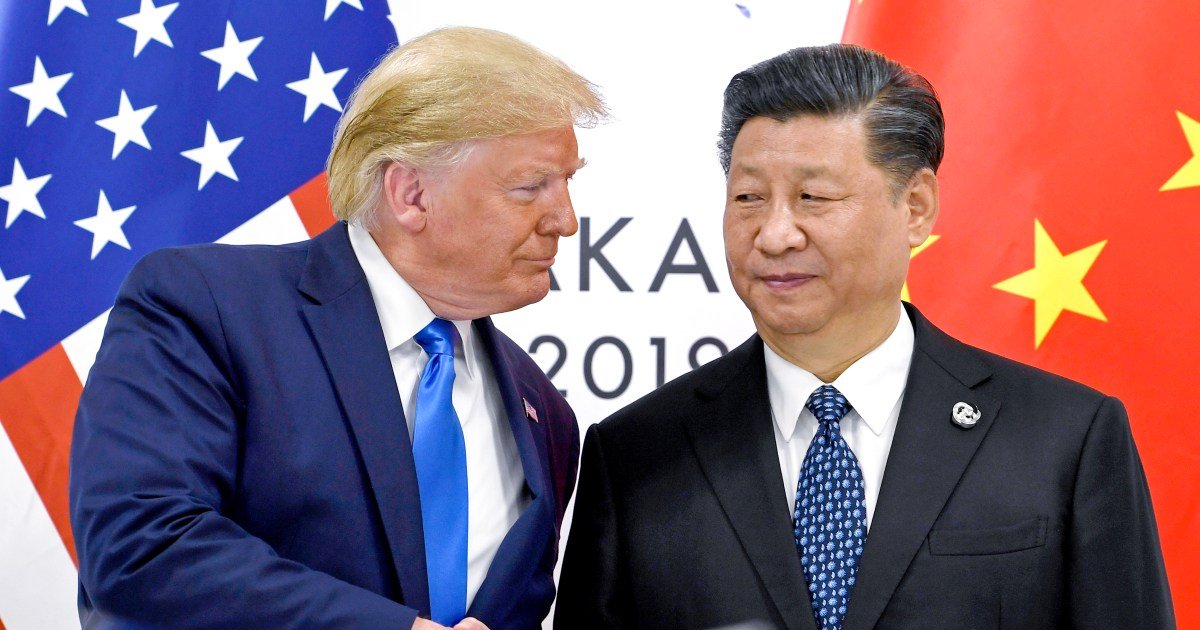
Taipei, Taiwan – As United States President Donald Trump kicks off a new trade war with China, analysts say he will face a much stronger and more prepared adversary in Beijing compared with his first term in office.
Since returning to the White House in January, Trump has already imposed a 20 percent tariff on Chinese imports, citing Beijing’s alleged failure to curb the export of the deadly opioid fentanyl to the US.
The tariff comes on top of previous duties imposed by Trump and former US President Joe Biden on more than $400bn worth of Chinese goods.
After condemning the latest US tariffs as “bullying” and “intimidation,” Beijing hit back last week by announcing tariffs of 10-15 percent on numerous US agricultural goods, including corn, beef, pork, dairy and soybeans.
The tariffs, which went into effect on Monday, followed Beijing’s announcement last month of a 10 percent tariff on crude oil, agricultural machinery, pick-up trucks, and some cars, and a 15 percent tariff on coal and liquefied natural gas.
“If war is what the US wants, be it a tariff war, a trade war or any other type of war, we’re ready to fight till the end,” Chinese Foreign Ministry Spokesperson Lin Jiang told reporters last week.
While the tit-for-tat measures recall Trump’s first trade war in 2018, both Washington and Beijing are facing very different conditions today than seven years ago.
The world’s two biggest economies have steadily decoupled in recent years, reducing their mutual dependency and blunting the impact of tariffs, according to analysts.
Christopher Beddor, a deputy China research director at the Beijing-based Gavekal Dragonomics, said the latest tariffs should be “pretty manageable” for China, and noted that they are significantly below the 60 percent rate threatened by Trump during his election campaign.
“I don’t want to understate the impact – that’s almost a tripling of the effective tariff rates for Chinese goods that are coming into the United States, so it’s big,” Beddor told Al Jazeera.
“But Chinese exports into the United States are a pretty modest share of its overall economy,” Beddor said.
Declining trade share
China’s share of total US trade – measured as the sum of exports and imports – dropped from 15.7 percent to 10.9 percent between 2018 and 2024, according to Bloomberg.
Over the same period, the US’s share of China’s total trade fell from 13.7 percent to 11.2 percent.
Lynn Song, chief Economist for Greater China at ING, said Beijing is not likely to be panicking over the tariffs – at least for now.
“While avoiding this sort of trade friction would’ve been preferable, it’s something that’s been planned for, so I wouldn’t say there’s a feeling of panic,” Song told Al Jazeera.
“With that said, with every tariff escalation, there inevitably will be parts of trade which become unviable and companies that will be impacted.”
Another factor mitigating the impact of tariffs, Lynn said, is that Chinese exporters such as Shein and Temu have found success selling low-cost goods directly to customers by taking advantage of a tariff exemption on shipments worth less than $800.
Beijing has continually rolled out measures to insulate the economy from any trade shocks.
At the “Two Sessions” meetings last week in Beijing, the National People’s Congress – the highest body of state power in China – announced several fiscal stimulus measures, including raising the debt level for local governments and issuing 1.3 trillion yuan ($179bn) in long-term treasury bonds.
Carsten Holz, an expert on the Chinese economy at the Hong Kong University of Science and Technology, said Beijing’s domestic policy moves have given it a significant buffer against US demands.
“Even the effect of a complete Trump ban on imports from China – hardly realistic in an age when, for example, the bulk of iPhones are produced in China – may not make a dent larger than a fraction of a percentage point in China’s GDP,” Holz told Al Jazeera.
“For an authoritarian leadership determined to project strength, this is unlikely to be enough to join what may look to the Chinese public like ‘peace talks’ with a foreign aggressor.”
Some analysts believe that despite its stronger position compared with 2018, Beijing still wishes to negotiate with Trump – at least for the moment.
‘Avoiding escalation’
One of the strongest signals that Chinese officials are open to talking is that their opening round of tariffs was relatively mild and restricted to a limited number of goods, suggesting a strategy of “avoiding escalation,” said Even Rogers Pay, a food and agricultural analyst at the Beijing-based research group Trivium China.
“The retaliation demonstrates that while China’s government doesn’t intend to take trade pressure lying down, they are also not going to be baited into an escalatory trade conflict where early overreaction could make striking a deal more difficult,” Pay told Al Jazeera.
“Instead, by applying moderate tariffs to a short list of key industries, Beijing is ramping up political pressure in the red states that are major exporters of corn, soybeans, sorghum and other farm products that they hope will bring Trump to the table.”
Beijing may be angling for a “phase two” deal along the lines of the “phase one” deal struck with Trump in 2020 to bring an end to the first trade war, Pay said.
Under the phase one deal, China pledged to buy $200bn in US goods and services, including agricultural products, over two years.
Beijing, however, only fulfilled about 58 percent of this amount after trade was derailed by the COVID-19 pandemic, according to the Peterson Institute for Economic Research.
John Gong, a professor of economics at the University of International Business and Economics in Beijing, agreed that China can withstand the pressure but is also ready to negotiate.
“The government in China is, of course, worried, but won’t back down in a humiliating way. They would love to negotiate a deal, but if it can’t, they would have a ‘so-be it attitude’,” Gong told Al Jazeera.
Meanwhile, some analysts believe Trump is at risk of overplaying his hand.
During the last trade war, Trump directed his focus solely on China, but since returning to office he has set his sights on other countries, too, including Mexico and Canada, in a bid to reduce the US trade deficit.
The US president has also moved at lightning speed.
In the span of about a month, Trump rolled out tariffs on goods worth $1.4 trillion, compared with tariffs on imports worth $380bn in 2018 and 2019, according to an analysis by Erica York, the vice president of federal tax policy at the Tax Foundation, a Washington-based think tank.
It is unclear, though, to what extent Trump’s tariffs will stick.
Just two days after imposing sweeping tariffs on Canada and Mexico on March 4, Trump announced that he would delay duties on many imports until April 2.
“There are a lot of things that could go wrong for Trump now, and to be honest, there’s some reasonable possibility that he is forced to retreat from a lot of these tariffs because the domestic economic consequences of the US are just so bad,” Gavekal Dragonomics’ Beddor said.
“[China’s] approach is: let’s wait and see, apply more fiscal stimulus to mitigate the impact.”
