


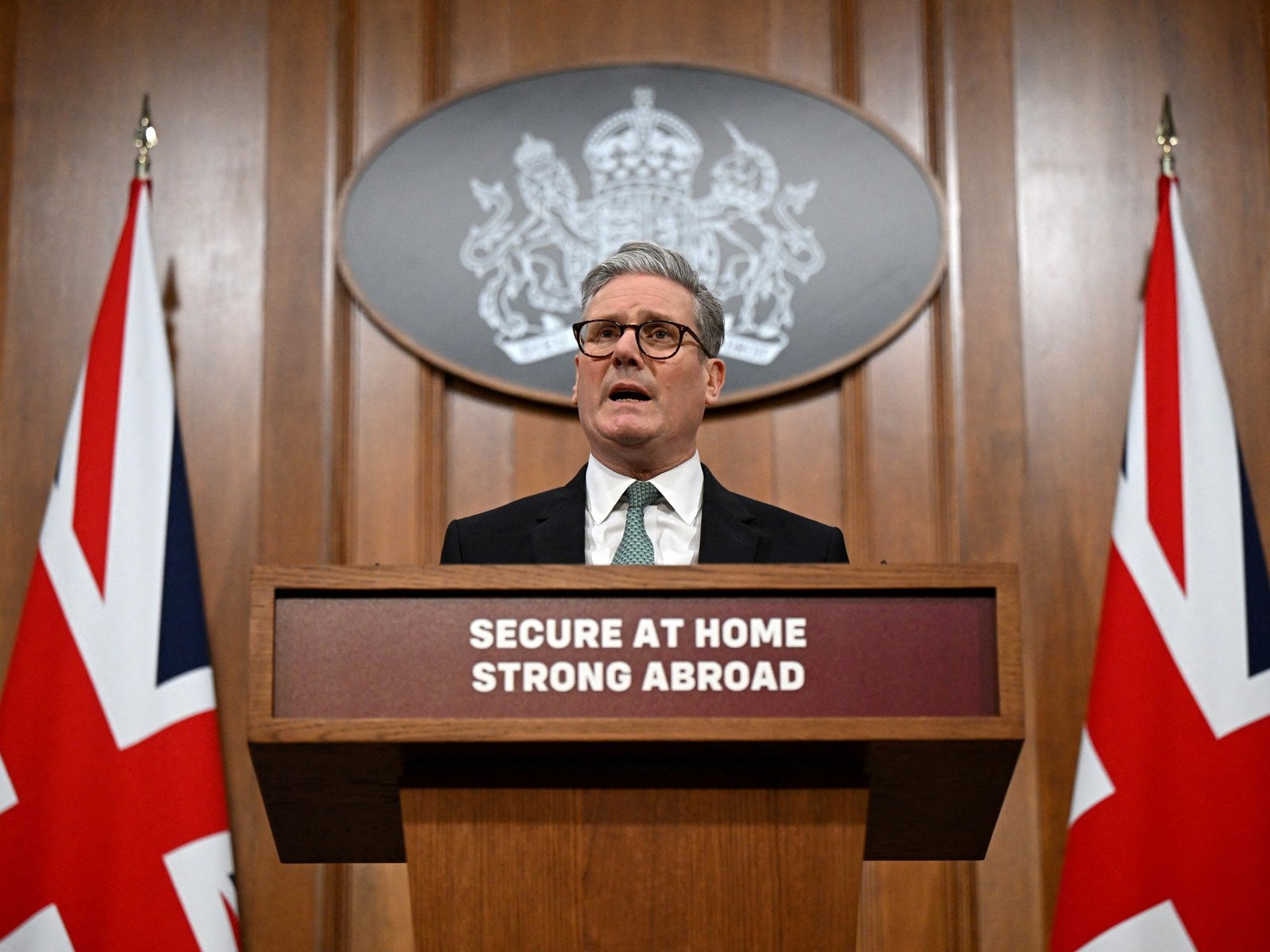
British Prime Minister Keir Starmer has announced the country will increase defence spending by cutting its foreign aid budget, a move he says is necessary as the United Kingdom faces a “dangerous new era”.
Starmer said on Tuesday that as the UK faces a “period of profound change” amid overseas conflicts, including a war in Ukraine, he has committed to increasing defence spending to 2.5 percent of gross domestic product (GDP) by April 2027, up from the current 2.3 percent rate.
He also set out a target to spend “3 percent of GDP on defence” after the next general election in 2029.
“It is my first duty as prime minister to keep our country safe. In an ever more dangerous world, increasing the resilience of our country so we can protect the British people, resist future shocks and bolster British interests is vital,” Starmer said, according to a government handout.
“By spending more on defence, we will deliver the stability that underpins economic growth and will unlock prosperity through new jobs, skills and opportunity across the country,” he added.
Starmer’s decision to announce the biggest increase in defence spending since the Cold War comes amid fears that a US decision to work closely with Russia to end the three-year war in Ukraine will sideline Kyiv and its European allies.
The decision also comes as Starmer travels to Washington, DC, to meet with US President Donald Trump on Thursday.
Here’s what we know about the increase in defence spending:
How much money does the UK spend on defence?
According to the Ministry of Defence, the UK spent 53.9 billion pounds ($68.3bn) on defence during the 2023-2024 financial year, which ended on March 31.
Starmer announced on Tuesday that the hike in defence spending will total 13.4 billion pounds ($17bn) every year after cutting overseas aid from 0.5 percent to 0.3 percent until 2027.
Trump has called on members of the NATO military alliance, which includes the UK, to commit to spending 5 percent of their GDPs on defence, a threshold that the US, which has the world’s largest military, does not meet.
While NATO guidelines call on member states to spend at least 2 percent of national output on defence, in January, Secretary-General Mark Rutte also called for the spending goal to be increased to meet the “challenges of tomorrow”.
How has Starmer justified increasing defence spending?
At a news conference on Tuesday, Starmer said increasing defence spending was “three years in the making”, referring to Russia’s war against Ukraine.
When Sky News asked if the decision had been made after Trump called for European powers to increase spending, Starmer said it was “very much my decision”.
He said he had been “arguing for some time” that Europe and the UK “needed to do more”.
Starmer added that while he was not “happy” to make the decision to cut foreign aid and would do “everything” to reinstate the funding, the “defence and security of the British people must always come first.”
However, former Foreign Secretary and current International Rescue Committee President David Miliband condemned the foreign aid cut as a “blow to Britain’s proud reputation as a global humanitarian and development leader”.
“Now is the time to step up and tackle poverty, conflict and insecurity, not further reduce the aid budget,” Miliband, who like Starmer is a member of the Labour Party, said in a statement.
What has been the response?
Benjamin Martill, senior lecturer in politics and international relations at the University of Edinburgh, told Al Jazeera that the decision to increase defence spending was “wholly unsurprising”.
“The UK has been under pressure for years along with other European allies to increase the proportion of GDP it spends on defence and the proportion within that on R&D [research and development] and genuine investment, reflecting concerns that America is still largely bankrolling European defence,” Martill said.
However, Ian Mitchell, co-director of Europe and senior policy fellow at the Centre for Global Development, told Al Jazeera that the decision was “short-sighted”.
“I don’t think there’s any doubt that there’s a need to increase defence spending, but I think that cutting that from the aid budget is self-defeating. … [As] Russia invades Ukraine, the UK’s main response is to cut its international aid budget. I think that’s a terrible look for the UK reputationally and short-sighted,” he said.
“There’s pressures on public spending, and he’s [Starmer’s] giving himself a major challenge by promising not to increase various taxes but also wanting to do more on public spending in relation to defence and health and elsewhere,” Mitchell explained.
How will the decision help bolster British defences?
Martill explained that the investment in the UK’s defence capabilities would help modernise the armed forces at a time when Starmer has indicated that the future presence of British troops in Ukraine is a possibility as part of a security guarantee in a peace deal.
“The increase in spending would contribute to the UK’s defence but also to the broader defence of Europe and would feed directly into the UK’s position in NATO and its contribution to other formats for defence cooperation,” Martill said.
But some critics have said a 2.5 percent allocation for defence two years from now isn’t enough to make Britain truly prepared militarily for the challenges it faces.
Former Defence Minister Ben Wallace of the Conservative Party called the decision a “staggering desertion of leadership”.
“Tone deaf to dangers of the world and demands of the United States,” Wallace wrote on X, adding that it is a “weak” commitment to the nation’s security.
extra 0.2% of GDP by 2027 on Defence?? A staggering desertion of leadership. Tone deaf to dangers of the world and demands of the United States. Such a weak commitment to our security and Nation puts us all at risk.
— Rt. Hon Ben Wallace (@BenWallace70) February 25, 2025
What effects will the decision have on foreign aid development?
In the autumn budget, the government allocated 13.3 billion pounds ($16.9bn) in foreign aid for the 2024-2025 fiscal year and 13.7 billion pounds ($17.4bn) in 2025-26 – about 0.5 percent of national economic output.
Data from the Foreign, Commonwealth and Development Office suggests that Africa is the biggest recipient of UK aid, followed by the Middle East and North African region and the Asia Pacific.
Starmer announced a 40 percent cut to the foreign aid budget without elaborating on which areas will face the most cuts. Mitchell said the effects will be “very substantial”.
“The UK has traditionally been quite a big humanitarian spender,” he said. “That seems impossible now in the light of the reductions.”
“The UK’s aid budget is actually focused on some of the poorest countries in the world, … supporting basic health services, reproductive rights, life-saving interventions [that] are going to have to stop and people’s lives will unfortunately be lost,” he added.
Moreover, Martill explained that foreign aid also serves as British “soft power” and is a “significant component in the UK’s relations with many Global South countries the UK has been seeking to actively co-opt into supporting its worldview”.
