
 Pakistan · World · Independent Digital Newsroom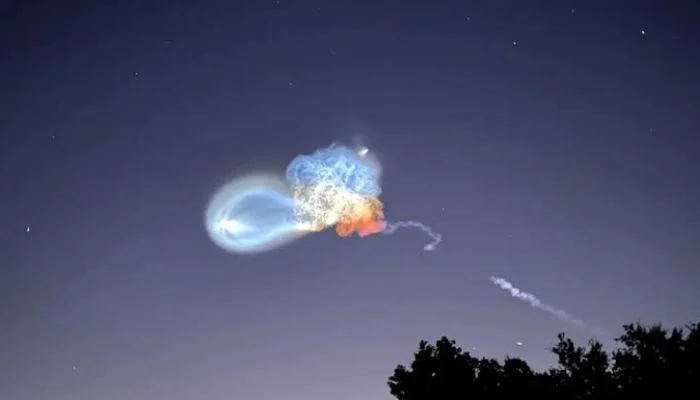
You were looking at a space jellyfish: Falcon 9 exhaust, lit by a sun that hadn't yet risen for anyone on the ground.SpaceX launched its CRS-35 cargo mission at 6:33am EDT from Space Launch Complex 40 at Cape Canaveral.
Residents around Orlando, Oviedo and Davenport reported a luminous cloud spreading across the sky.
Some sightings came from as far north as Virginia.Timing did the rest.
At that hour you're standing in shadow, but a rocket's upper stage is already high enough to catch direct sunlight.
The expanding exhaust plume lights up like a lantern.In its Astronomy Picture of the Day, NASA refers to the exhaust as mostly consisting of water vapour and carbon dioxide.
In the thin and extremely cold upper levels of the atmosphere, the vapour may even freeze into solid particles by skipping the liquid state, a process known as deposition.
These ice crystals reflect the sunlight.The second peculiarity of the cloud is that it seems to fall down.
However, it does not because the rocket is following the curvature of the Earth, which makes the plume seem to drop down.It works on the same principle as contrails.
The hot and humid exhaust gases react with the cold air and either condense or freeze.You have even performed such an experiment yourself.
Just breathe on a cold morning and you will see how the vapour in the air freezes.
It is the same effect, just on a much larger scale.The cargo being transported by the Dragon spacecraft weighs approximately 6,300 pounds, consisting of the last set of rollout solar arrays.
The craft is also carrying equipment for manufacturing retinal cells and 3-D heart tissue in space.
This is the fourth voyage of the Dragon spacecraft, and the docking will occur on Thursday, October 15.Florida launch sites always launch at dawn or dusk, so this isn't the end of jellyfish launches.