



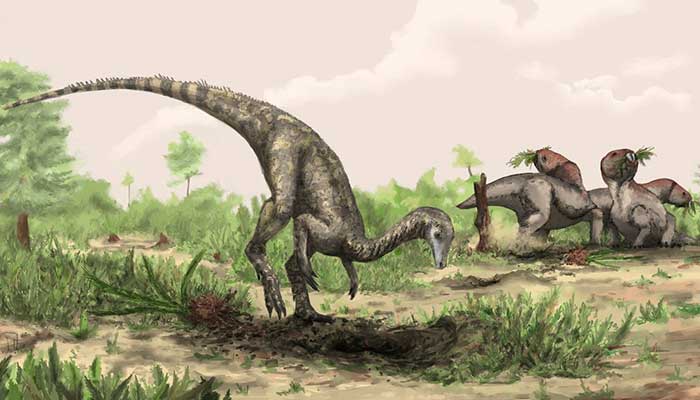
WASHINGTON: Dinosaurs long dominated Earth’s land ecosystems with a multitude of forms including plant-eating giants like Argentinosaurus, meat-eating brutes like Tyrannosaurus and weirdos like Therizinosaurus, with its Freddy Krueger-like claws.
But the origin of dinosaurs — precisely when and where they first appeared —remains a bit of a puzzle.
Researchers are now proposing a surprising location for the birthplace of dinosaurs, based on the locations of the currently oldest-known dinosaur fossils, the evolutionary relationships among these early forms and Earth’s geography during the Triassic Period.
This locale spans the modern-day Sahara desert and Amazon rainforest regions, now separated by thousands of miles and an ocean thanks to a geological process called plate tectonics.
“When dinosaurs first appear in the fossil record, all the Earth’s continents were part of the giant supercontinent Pangaea. Dinosaurs emerged in the southern portion of this landmass, known as Gondwana,” said Joel Heath, a paleontology doctoral student at University College London and the Natural History Museum in London and lead author of the study published on Thursday in the journal Current Biology.
“Our research suggests they likely originated in the low-latitude regions of Gondwana near the equator, an area that today includes northern South America and northern Africa,” Heath added.
The earliest-known dinosaur fossils date to roughly 230 million years ago, including Eoraptor and Herrerasaurus from Argentina, Saturnalia from southern Brazil and Mbiresaurus from Zimbabwe. While sharing certain traits defining them as dinosaurs, they had sufficient differences that suggest millions of years of dinosaur evolution had already occurred.
“While earlier research has focused on southern South America and southern Africa as the area of origin of the dinosaurs, based on where their fossils first appear, we suggest that significant gaps in the fossil record – particularly in regions that today include the Sahara desert and the Amazon rainforest – may hold the potential to reveal where the earliest dinosaurs were living,” Heath said.
The researchers said dinosaurs probably emerged approximately 245-230 million years ago, when these equatorial regions were extremely hot and dry.
“It likely included deserts, savannah-like habitats and possibly forested areas prone to seasonal wildfires. Previously, it was believed that dinosaurs were absent from these harsh environments,” Heath said.
Fossils from this time and region are rare. This might be because the conditions were not ideal for preserving the remains of land animals or because the rocks containing these fossils have not been discovered yet, Heath said. Regions like the Amazon and Sahara also are difficult for paleontologists to explore due to dense forests, vast deserts and logistical challenges.
Dinosaurs evolved from more primitive reptiles in the aftermath of Earth’s biggest mass-extinction event caused by extreme volcanism at the end of the Permian Period about 252 million years ago.
“Dinosaurs are unique because of certain traits in their skeletons. They stood upright, with their legs straight underneath their bodies, like pillars, which helped them walk and run efficiently. They also had special hips that made them different from other reptiles,” Heath said, noting that other reptiles possessed sprawling legs.
“Their bodies were shaped for speed and agility, and their teeth were adapted for specific diets,” Heath said of the early dinosaurs.
For example, Herrerasaurus was a 20-foot (6-metre) long predator, while Eoraptor was a dog-sized omnivore.
“These specialised traits didn’t appear overnight. They evolved gradually over millions of years from older, more primitive reptiles. However, we haven’t yet found the transitional fossils that show how these changes happened, leaving parts of their evolutionary history a mystery,” Heath said.
An enigmatic bipedal creature called Nyasasaurus from Tanzania, known from fragmentary fossils perhaps dating to 240–245 million years ago, represents what the earliest dinosaurs may have looked like, Heath said.
Dinosaurs initially were overshadowed by other animals, including large crocodile relatives – both terrestrial and semi-aquatic – and various plant-eaters including elephant-sized ones related to mammals and four-legged armoured reptiles.
“Dinosaurs started small, playing a minor role in their ecosystems during the Triassic,” Heath said. “They lived in the shadows of bigger, more dominant animals. However, dinosaurs had some advantages, like being fast, agile and adaptable to different environments. Then, about 201 million years ago, a huge extinction event wiped out many of their competitors, allowing dinosaurs to take over as the dominant land vertebrates.”
