


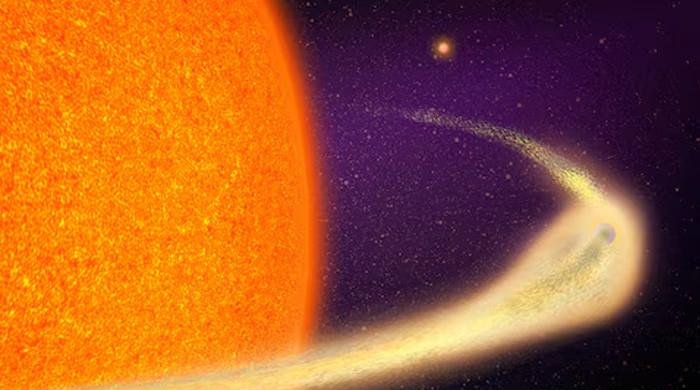
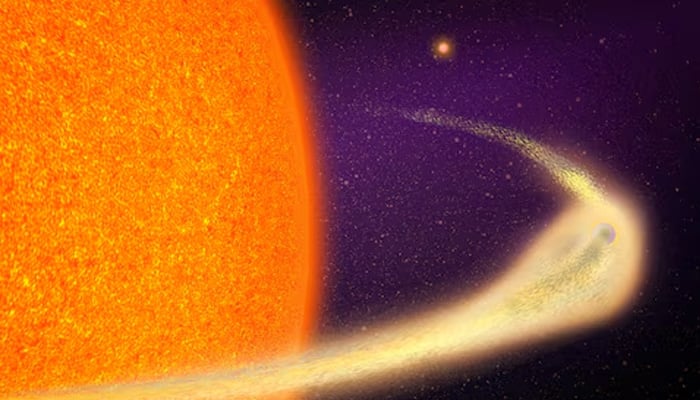
Astronomers have spotted a small rocky planet that orbits perilously close to its host star disintegrating as its surface is vaporised by stellar heat, trailed by a comet-like tail of mineral dust up to about 5.6 million miles (9 million km) long.
About 5,800 planets beyond our solar system, called exoplanets, have been discovered since the 1990s. Of those, only four have been observed disintegrating in orbit, as this one is. This planet is the closest to our solar system of the four, giving scientists a unique opportunity to learn about what happens to these doomed worlds.
The researchers observed the planet, named BD+05 4868 Ab, as it gradually crumbles into dust, shedding material roughly equal to the mass of Mount Everest with each orbit of its star.
The tail of dust trailing the planet wraps halfway around the star.
The planet is estimated as between the size of our solar system’s smallest and innermost planet Mercury and Earth’s moon.
It is located about 140 light years away from Earth in the constellation Pegasus. A light-year is the distance light travels in a year, 5.9 trillion miles (9.5 trillion km).
Its host star, a type called an orange dwarf, is smaller, cooler and dimmer than the sun, with about 70% of the sun’s mass and diameter and about 20% of its luminosity. The planet orbits this star every 30.5 hours at a distance about 20 times closer than Mercury is to the sun.
The planet’s surface temperature is estimated at close to 3,000 degrees Fahrenheit (about 1,600 degrees Celsius) thanks to its close proximity to its star. As a result, the planet’s surface has probably been turned to magma — molten rock.
“We expect the planet to disintegrate into dust within the next million years or so,” said Marc Hon, a postdoctoral researcher at the Massachusetts Institute of Technology’s Kavli Institute for Astrophysics and Space Research and lead author of the study published on Tuesday in the Astrophysical Journal Letters, opens new tab.
“This is catastrophically quick in cosmic timescales. The disintegration is a runaway process. As more material from the planet turns into dust, the disintegration process gets faster,” Hon said.
Once in space, the vaporised material cools down to form mineral dust that streams away from the planet.
“We know the dust grains in the tail can have sizes between large soot particles and fine grains of sand,” Hon said. “We don’t know the mineral composition of the tail yet.”
The researchers detected BD+05 4868 Ab using the “transit method,” observing a dip in the host star’s brightness when the planet passes in front of it, from the perspective of a viewer on Earth. It was found using NASA’s Transiting Exoplanet Survey Satellite, or TESS, space telescope.
How the planet came to have its current close-in orbit is unclear.
“The planet’s orbit is not seen to be visibly decaying from the data. It is possible that the planet initially formed farther away, and had its original orbit altered under the influence of an external body, such that the planet was sent much closer to the star,” Hon said.
This could have resulted from the gravitational influence of another planet or some other celestial object.
The researchers plan further observations in the coming months using NASA’s James Webb Space Telescope to study the composition of the material in the tail, which could give clues about the makeup of rocky exoplanets. The search for life in other solar systems focuses on rocky exoplanets orbiting stars in the “habitable zone,” a distance where liquid water, a key ingredient for life, can exist on a planetary surface.
“The tail is expected to contain minerals evaporated from the surface or interior of the disintegrating planet. So, this could be the crust, mantle or even the planet’s core. Learning about the interiors of planets is extremely challenging. Doing this even for planets within our solar system is difficult. But BD+05 4868 Ab will allow us to directly measure the mineral composition of a terrestrial planet outside our solar system,” Hon said.
“This is definitely an exceptional opportunity for exoplanet geology and to understand the diversity and potential habitability of rocky worlds beyond our solar system,” Hon said.
