

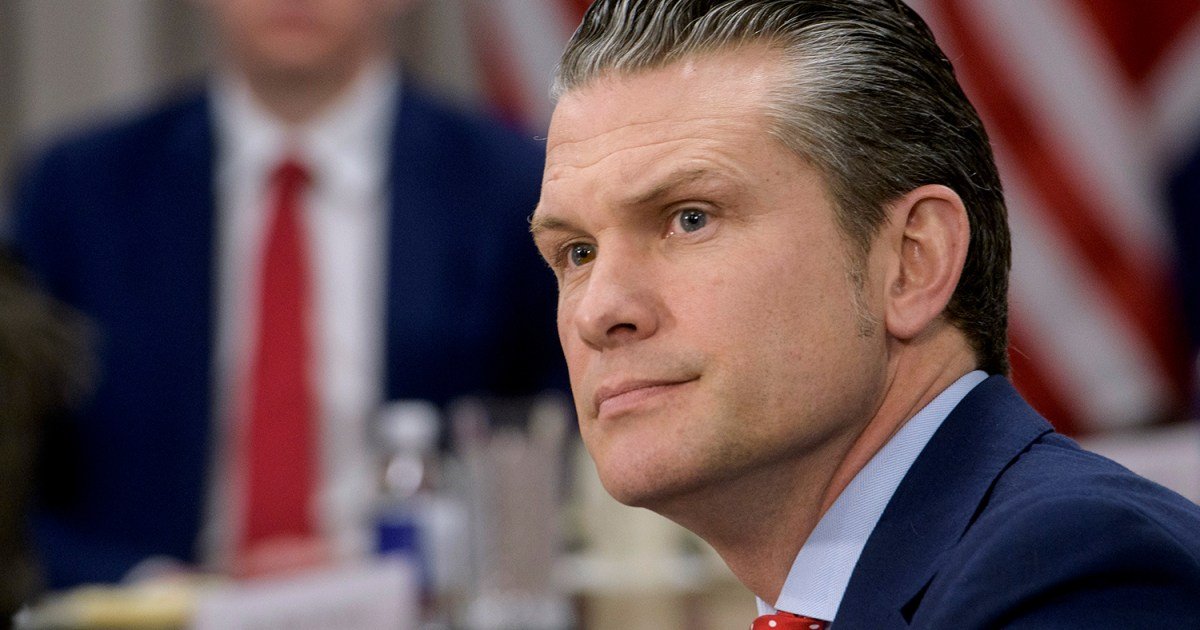
Standing on a Hawaii runway, United States Secretary of Defense Pete Hegseth told a reporter on March 24, “Nobody was texting war plans, and that’s all I have to say about that.” The next day, he repeated the statement.
The Trump administration’s Signal group texts told a different story.
On March 24, The Atlantic magazine editor-in-chief Jeffrey Goldberg detailed how he was accidentally added to a group chat on the messaging app Signal with senior Trump administration officials discussing an impending air strike on US adversaries in Yemen.
In the initial story, Goldberg said the “war plans” he received in the chat mentioned “precise information about weapons packages, targets, and timing”. Goldberg did not include detailed messages about the military strikes because of his concerns about publishing sensitive security information.
The National Security Council confirmed the authenticity of the thread and said it would review how Goldberg’s number was added to the chain.
Following White House and Hegseth denials that “war plans” were discussed, The Atlantic published the full text thread. The messages released on March 26 show Hegseth sent information about when aircraft and drones would launch, when bombs would drop and the expected movement of targets.
When we contacted the White House for comment, a spokesperson pointed us to Press Secretary Karoline Leavitt’s post on X that “no ‘war plans’ were discussed”.
The US struck Houthi fighters on March 15 as part of efforts to take on the group that has repeatedly attacked ships in the Red Sea since the October 2023 start of Israel’s war on Gaza.
After The Atlantic’s second story, National Security Advisor Mike Waltz wrote on X, “No locations. No sources & methods. NO WAR PLANS.” Hegseth made a similar post on X, saying released messages included no names or targets, which meant “those are some really shitty war plans”. Secretary of State Marco Rubio also said, “There was no war plans on there.”
The military doesn’t officially use the term “war plans,” military experts said. The most in-depth military plans are detailed – hundreds or even a thousand pages – and include information about force deployment.
Still, most experts we talked to said that civilians would broadly and rightly consider the kinds of details included in the Signal messages to be specific plans.
After The Atlantic published the messages in their entirety, Michael O’Hanlon, a senior fellow in foreign policy at the Brookings Institution, said, “Short of giving target coordinates, it’s about as specific as it gets.”
What Hegseth shared, and what experts make of it
In the initial article, Goldberg said Hegseth’s messages contained “operational details of forthcoming strikes on Yemen, including information about targets, weapons the US would be deploying, and attack sequencing”.
In an interview with MSNBC host Jen Psaki, the White House spokesperson under former President Joe Biden, after the story’s publication, Goldberg said the messages contained “the specific time of a future attack, specific targets, including human targets meant to be killed in that attack, weapon systems, even weather reports. … He can say that it wasn’t a war plan, but it was a minute-by-minute accounting of what was about to happen.”
The March 26 follow-up article in The Atlantic included these messages from Hegseth:
- “TIME NOW (1144et): Weather is FAVORABLE. Just CONFIRMED w/ CENTCOM we are a GO for mission launch.”
- “1215et: F-18s LAUNCH (1st strike package)”
- “1345: ‘Trigger Based’ F-18 1st Strike Window Starts (Target Terrorist is @ his Known Location so SHOULD BE ON TIME – also, Strike Drones Launch (MQ-9s)”
- “1410: More F-18s LAUNCH (2nd strike package)”
- “1415: Strike Drones on Target (THIS IS WHEN THE FIRST BOMBS WILL DEFINITELY DROP, pending earlier ‘Trigger Based’ targets)”
- “1536 F-18 2nd Strike Starts – also, first sea-based Tomahawks launched.”
- “MORE TO FOLLOW (per timeline)”
- “‘We are currently clean on OPSEC’—that is, operational security.”
- “Godspeed to our Warriors.”
Military experts said the texts do not amount to a full plan but contain alarmingly specific details.
“The phrase ‘war plan’ often (but not always) refers to a more comprehensive planning document, which can run hundreds of pages, with details of how the US military intends to pursue a particular military objective,” said Nora Bensahel, professor of practice at Johns Hopkins School of Advanced International Studies and contributing editor to the War on the Rocks, a website that covers national security.
After seeing the messages, Bensahel said, “These are clear operational plans for the use of military force. I don’t see how the administration can claim these are not war plans, because they are clear plans for war.”
A 2023 Defense Department guide defines an operation plan, also known as an OPLAN, as “a complete and detailed plan containing a full description” and a “timephased force and deployment list.”
“We have OPLANs as a contingency if we have to go to war,” said Ty Seidule, retired US Army brigadier general who served in the US Army for more than three decades and is a Hamilton College visiting professor of history. “Like we had for Iraq in 1990 and 2003. Those run to the thousands of pages and include incredible detail.”
The text messages did not amount to an OPLAN, Seidule said, but rather the “CliffsNotes” version, with “all the important details of a military operation” and “clearly a security breach of the first order.”
The newly revealed texts “amount to operational details from a concept of the operation (CONOP) or, in this case, colloquially, a strike package,” said Heidi A Urben, a Georgetown University professor of practice and former military intelligence officer.
Seidule said Hegseth has a point that the text exchange wasn’t a lengthy war plan, but “what he did use was all the important details of a joint operation against an enemy force, which is worse”.
Thane Clare, who served in the Navy for 25 years and retired as a captain, said since the Defense Department doesn’t use the term “war plan,” that “technically gives Hegseth et al a completely disingenuous out”. Clare is now a senior fellow at the Center for Strategic and Budgetary Assessments, an independent defence analysis source.
However, Clare said, “The Yemen chat is 100 percent sensitive operational information that reveals critical details of imminent operations.”
Military experts saw many security problems with administration officials using Signal to communicate the plans.
“Everyone in the intel-defence community knows that Signal provides PGP, pretty good protection,” said Robert L Deitz, a George Mason University public policy professor who was National Security Agency general counsel and senior counsel to the CIA director. “It is great for kids planning a teenage drinking party. It will keep their parents out of the loop. But no half-way serious intel organisation in the world is blocked by PGP.”
