


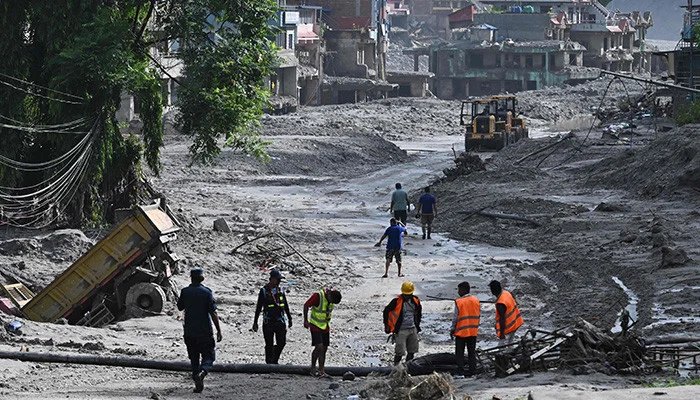
- Overall death toll reaches 750, with 3,044 people still missing.
- China links mudslide to glacier instability caused by global warming.
- Beijing deploys over 2,100 emergency workers for relief efforts.
Devastating floods near the border with China killed at least 734 people in Nepal and 2,498 remain missing, its disaster authority said on Sunday, as rescue efforts entered a fifth day.
Chinese state media had earlier confirmed 16 dead in Tibet and 546 people missing following Wednesday’s disaster.
That takes the overall toll to 750 dead and 3,044 missing.
The number of missing in Nepal rose from the 2,426 recorded in its last update on Saturday evening.
That list included 589 foreigners, an increase from the 517 previously listed as out of contact.
It also included 933 workers on hydropower projects along the river which the torrent crashed through, according to the National Disaster Risk Reduction and Management Authority.
The disaster authority said teams had rescued 8,186 people in total, 227 foreigners.
In India, authorities said they had recovered seven bodies from rivers flowing from Nepal, believed to be flood victims. However, they are not included in the toll.
Foreign nationals missing in Tibet
China said 261 foreign nationals from 23 countries are missing on the Tibetan side of the border with Nepal following a mudslide that swept through the Himalayan region.
The death toll in Tibet has reached 16, according to officials.
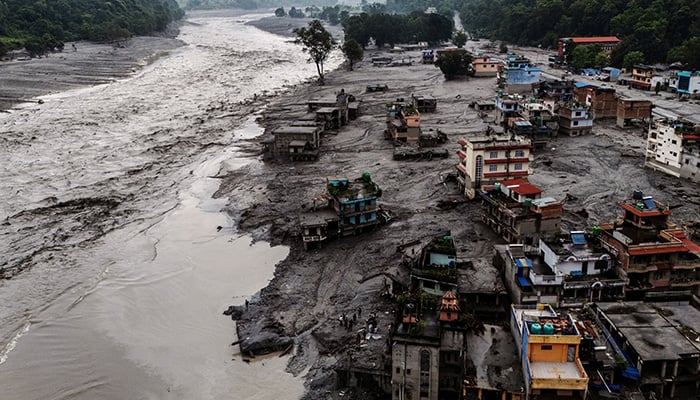
They said at a press conference that the highest number of missing foreigners was from Nepal at 104, while 49 Indians, 33 Latvians, 18 Americans and 15 Britons were also unaccounted for. They said authorities in Beijing have notified foreign missions.
The nationality breakdown was the first from the Chinese side since the collapse of a glacier on Wednesday unleashed a torrent of ice, rock, mud and debris down Himalayan rivers.
Authorities said 16 people had died in Gyirong County as of Saturday evening and that 546 were missing.
Local police told Reuters that residents and rescue workers have moved to higher ground after the water level in the nearby Trishuli River rose over the past few hours, underscoring the risk of further flooding even as rescue efforts continue.
China links disaster to global warming
The disaster was “caused by glacier instability under the long-term effects of global warming”, Chinese state broadcaster CCTV reported on Sunday, saying it is a “new and prominent feature of cryosphere disasters” on the Tibetan plateau.
It took six to seven minutes for the mudslide from the Nepalese side to reach the Gyirong border crossing, CCTV reported, citing the findings of Chinese scientists.
Surveillance footage from the crossing showed torrents of water and debris engulfing buildings while people tried to flee.
China’s Foreign Minister Wang Yi told his Nepalese counterpart in a Saturday telephone call that the mudslide was their “most severe cross-border disaster” in recent years, and that rescue operations were of unprecedented difficulty and complexity, CCTV reported.
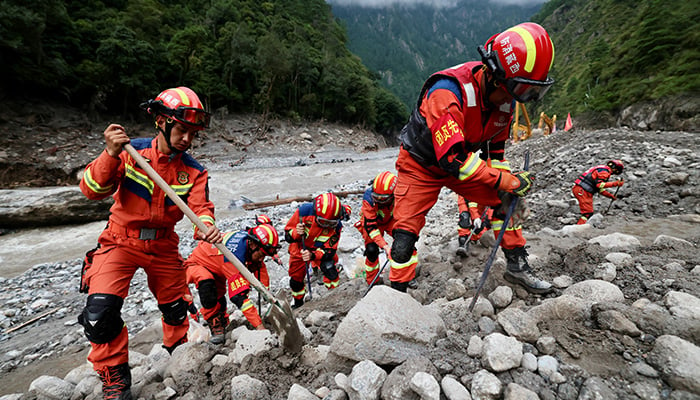
China has mobilised over 2,100 emergency rescue workers and allocated at least 220 million yuan ($32.7 million) to support relief efforts. It is also providing emergency cash aid, disaster relief supplies, satellite and hydrological data and tunnel rescue experts to Nepal, the state broadcaster said.
The countries are working together to identify missing citizens and foreign nationals, as well as strengthening cooperation in disaster prevention and mitigation, and climate-change response, CCTV reported.
More than 90,000 people are likely to have been affected by the disaster, the Red Cross estimated.
