 Pakistan · World · Independent Digital Newsroom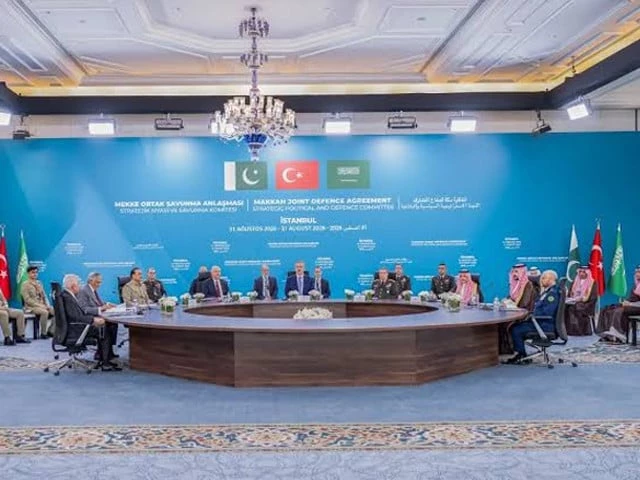
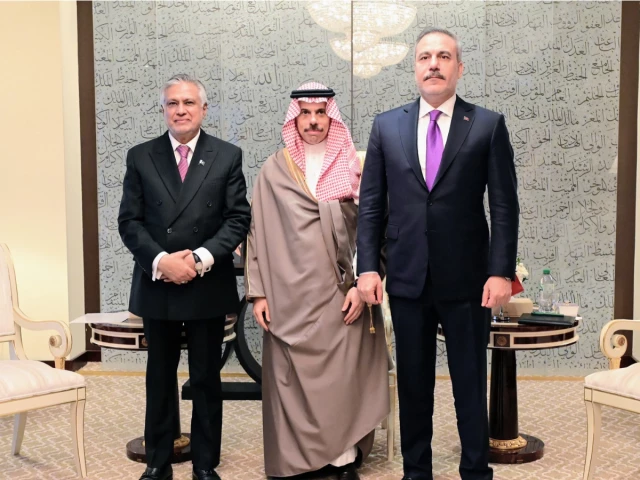
Dar, Saudi Foreign Minister Prince Faisal bin Farhan and Turkish Foreign Minister Hakan Fidan discussed the implementation of the agreement and agreed to convene an urgent meeting of the three countries' military chiefs.The military chiefs subsequently met in Riyadh on September 25, reviewing threats facing Saudi Arabia and discussing intelligence sharing, military coordination and greater integration of defence capabilities.
They reaffirmed their commitment to collective defence and to translating the Makkah agreement into practical military cooperation.The alliance's political and military response has gained urgency following a series of attacks attributed by Saudi Arabia to Yemen's Houthis, including an attack on a power distribution station in Madinah.Pakistan on Friday strongly condemned the attack and reaffirmed its support for Saudi Arabia's sovereignty and the security of the Two Holy Mosques.The Houthis….
Dar described it as an exchange of views between the two foreign ministers and said the question of whether political engagement could replace military action would be considered by the SPDC.The issue is likely to add another layer to Pakistan's already delicate balancing act between its commitments to Saudi Arabia under the new defence pact and its longstanding policy of maintaining dialogue with neighbouring Iran.Pakistan has repeatedly advocated diplomacy and….
Dar spoke with Araghchi on September 19, with the two ministers discussing regional developments, energy supplies and the safe passage of shipping.The emergency meeting will also come as the alliance moves towards establishing a permanent institutional structure.The first SPDC meeting was held in Istanbul on August 31, bringing together the foreign and defence ministers and military chiefs of the three countries.
The meeting agreed to establish a permanent secretariat in Saudi Arabia, initially headed by a Pakistani secretary general for three years.The agreement also envisages defence-industry cooperation, joint technology development and production.Retired Lieutenant General Nauman Mahmood was subsequently appointed as the first secretary general, with the secretariat to be established in Riyadh.Dar told reporters that more than six countries had expressed interest in joining the Makkah agreement.
However, he indicated that membership would not be considered until the alliance's secretariat and institutional mechanisms were fully operational.He also stressed that the agreement was defensive in nature and contained no offensive objective, while allowing other countries to join.
The document itself, he said, is open to other countries provided they agree to the principles laid down by its three founders.He added that any decision on membership would be taken jointly by Pakistan, Saudi Arabia and Türkiye, and Pakistan could not decide alone.He said the prime minister also highlighted terrorism emanating from Afghanistan and the Houthi attacks on Saudi Arabia, and credited Field Marshal Asim Munir, Chief of Defence….
This led to a signing on June 18.On the energy crisis stemming from Hormuz and Bab-el-Mandeb, he said the prime minister had flagged its impact on supply chains and prices, which had almost doubled in Pakistan.
Despite financial constraints and the IMF programme, he said, the government approved a fuel relief scheme, now benefiting millions, for two-wheelers, three-wheelers and small four-wheelers of up to 800cc.Answering a question about the Middle East, he said conflict was not a solution to anything.
Even after the world wars, he noted, the warring countries had to sit down and build institutions.Replying to a question, Dar said Pakistan's stance on Kashmir was "absolutely clear".
The Kashmiri people, he said, must decide their future through a plebiscite under UN Security Council resolutions.
India's actions of August 5, 2019, he added, must be reversed and no demographic change should be allowed in occupied Kashmir.He said after the Pahalgam incident, Pakistan was blamed at once, and India then used the resulting sentiment to take its next steps.This time, he said, the Foreign Office did not let India's narrative take hold internationally and that Pakistan had offered an independent, neutral investigation without delay.
When India claimed strikes at 15 places and the downing of F-16s, Pakistan challenged the claims and asked India to say how many aircraft had fallen.