


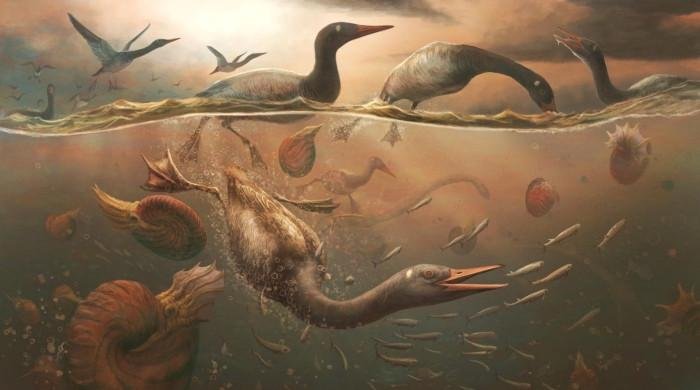
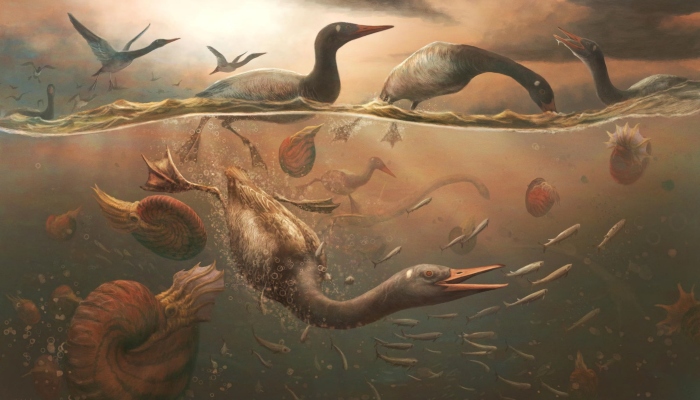
Near the end of the age of dinosaurs, a bird resembling today’s loons and grebes dove for fish and other prey in the perilous waters off Antarctica. Thanks to a nearly complete fossil skull, scientists now have identified this waterfowl as the oldest-known member of the lineage spanning all birds alive today.
The new fossil unearthed on Vega Island near the Antarctic Peninsula of the ancient bird named Vegavis iaai dates to about 69 million years ago, approximately three million years before the asteroid strike at the end of the Cretaceous Period that wiped out the dinosaurs, aside from their avian descendants.
Fossils of Vegavis were first described two decades ago. But without sufficient cranial remains its place on the bird family tree had remained ambiguous. The researchers now were able to diagnose Vegavis as nesting among the anatomically modern birds based on two cranial characteristics – the bones of its upper beak and the shape of its brain.
“Both of those features are observable in the new Vegavis specimen,” said evolutionary biologist Chris Torres of the University of the Pacific in California, lead author of the research published in the journal Nature.
Vegavis was an early waterfowl, a group that also includes ducks and geese. Vegavis appears to have been ecologically specialised to pursue fish and other prey underwater in a shallow marine ecosystem. Antarctica at the time was not the desolate land of snow and ice that it is today, but rather a forested landscape with a temperate climate.
Birds evolved during the Jurassic Period from small feathered dinosaurs. The oldest-known bird, Archaeopteryx, dates to about 150 million years ago. With a mouthful of teeth and long bony tails, the earliest birds were a far cry from modern ones. Vegavis is one of only two modern birds known from the age of dinosaurs. The other one, Asteriornis maastrichtensis, lived about 67 million years ago in what is now Belgium.
Vegavis was the size of a mallard but did not have a bill like a duck. It instead had a spear-shaped beak like a loon.
Its skeletal structure indicates that it dove for its dinner.
“Vegavis almost certainly preyed on fish and small invertebrates that lived in the shallow marine environment near the Antarctic Peninsula, like the diet of certain birds alive today like loons, grebes and even penguins. Exactly how deep it could go and the length of time it could spend underwater is not clear,” said evolutionary biologist and study senior author Patrick O’Connor of Ohio University and the Denver Museum of Nature & Science.
“We know that Vegavis would have shared the marine ecosystem with other birds and an array of different fishes. But unlike today, it would have also shared the water with classic Cretaceous creatures,” O’Connor added, including marine reptiles such as long-necked plesiosaurs and strong-jawed mosasaurs as well as large nautilus-like ammonites.
As preserved, the skull measures about 3 inches (7.6 cm) long, but would have been a bit longer in life because it is incomplete.
“Previous studies noted its body was shaped very similarly to – and thus functioned very similarly to – modern loons and especially grebes. The legs were shifted towards the back of the body, an adaptation to swimming and especially foot-propelled diving, like loons and grebes,” Torres said.
“The new fossil expands that similarity to the skull,” Torres added, showing that Vegavis had a beak suited to fish hunting along with musculature adapted for pursuit diving, like loons and grebes.
Functionally, its skull is similar to that of loons and grebes – birds that snap their jaws closed against the resistive forces of water in pursuit of fish, Torres said.
Noting that waterfowl are a specialised avian form, the researchers suspect that the first anatomically modern birds actually appeared millions of years before Vegavis.
“We predict that there should be even older examples,” O’Connor said. “Whether in Antarctica or elsewhere remains to be seen.”
