


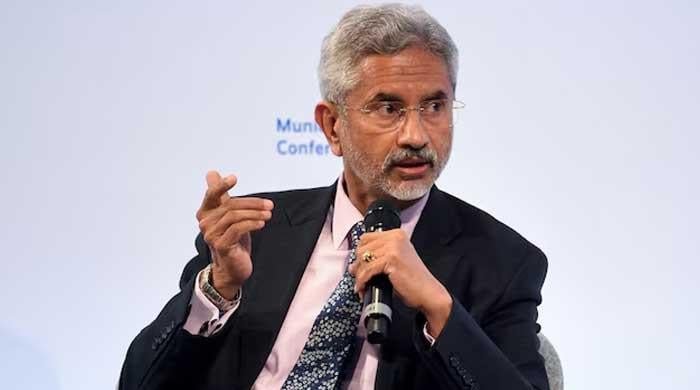

NEW DELHI: India’s External Affairs Minister S Jaishankar once again called out the “double standards” of global democracy during a panel at the Munich Security Conference on Friday.
While addressing a panel of Western leaders, including United States Senator Elissa Slotkin, Jaishankar criticised the West for portraying democracy as a “Western characteristic” while simultaneously supporting “non-democratic forces” in the global south, India Today reported on Friday.
He emphasised that countries in this region often find the Indian experience more relevant to their own societal contexts compared to Western models.
“Indian experience is more transposable to their societies than perhaps to those of others,” said Jaishankar, as he addressed the panel which also included Norway’s Prime Minister Jonas Gahr Store and Warsaw Mayor Rafal Trzaskowsk.
He also urged Western nations to recognise and embrace successful non-Western democratic models to foster genuine democratic values globally.
He said: “There was a time and I would have to say this in all honesty when the West treated democracy as a Western characteristic and was busy encouraging non-democratic forces in the Global South, and it still does.
“I mean in many cases, I can point to some very recent ones where everything that you say you value at home, you don’t practice abroad. So, I do think the rest of the Global South will view the successes, shortcomings and the responses of other countries.”
The Indian foreign minister’s remarks come amid growing calls for a broader understanding of democracy that transcends Western-centric views.
Furthermore, when asked whether countries in the global south still aspire to a democratic system and the model that would attract people, Jaishankar responded: “Look, to an extent, all big countries are unique to an extent. But we would certainly hope, I mean to the extent, we think of democracy as a universal aspiration, ideally a reality.
“India chose a democratic model after independence and it chose a democratic model because we have been fundamentally a consultative pluralistic society.”
Jaishankar said that India has “historically been an open society” and stayed true to being a democratic model despite challenges.
“I would argue in many ways that India has historically been an open society, one very much linked with the world,” he said.
“So, I do think that in our progress as a democracy, the fact that for all the challenges that we have had, even at a low income, we have stayed true to the democratic model. When you look at our part of the world, we are pretty much the only country that has done that,” he added.
He stressed that India’s progress in democracy is “something the West should look at because if you do want democracy eventually to prevail, it is important that the West also embraces the successful models outside the West”.
It may be noted that the the Indian parliament under the BJP-led government had unilaterally abolished the special status of the Indian Illegally Occupied Jammu and Kashmir (IIOJK) as originally enshrined in the Indian Constitution, and downgraded and divided the region into two centrally governed union territories, Ladakh and IIOJK.
Slamming “self-appointed custodians” who questioned the rights and wrongs of a democracy, he said that such people would be challenged eventually.
“To self-appointed custodians who have never fought an election, who have nothing to do with democracy is actually telling the rest of the world what is right and what is wrong in democracy. I think it is, to me, inevitable that it will be challenged,” he said.
“Every country has its own mainstream politics and outliers. If I were to look, for example, like how much Europeans and Westerners reach out to outliers in those societies? If I were to look at what Western ambassadors do in India, if my ambassadors did a fraction of that, you would all be up in arms. I think there are double standards here,” he added.
Additionally, during the discussion, Jaishankar offered a counter-narrative to claims that global democracy is in decline.
Boasting India’s democratic framework, he referenced the nation’s ability to “provide nutritional support to 800 million people.”
He highlighted his own experience by showing off his inked index finger, a symbol of recent vote participation, saying that “for us, democracy is actually delivered”.
“I appeared to be an optimist in what is relatively a pessimistic panel, if not room. I will begin by sticking up my finger and don’t take it badly. It is the index finger. This, the mark you see on my nail, is a mark of a person who has just voted,” he said.
“We just had an election in my state (Delhi). Last year, we had a national election. In Indian elections, roughly two-thirds of the eligible voters vote. At the national elections, the electorate of about 900 million, about 700 million voted. We count the votes in a single day,” he added.
In response to Slotkin’s remark that democracy “doesn’t put food on the table”, Jaishankar reiterated that India gives nutrition support to 800 million people.
He said: “Senator, you said that democracy doesn’t put food on your table. Actually, in my part of the world, it does. Today, since we are a democratic society, we give nutrition support, and food to 800 million people.
“That is a matter of how healthy they are and how full their stomachs are. So, the point I want to make is that different parts of the world are going through different conversations. Please do not assume that this is a kind of universal phenomenon, it is not.”
Jaishankar’s remarks at the conference follow his previous statements where he sharply rejected the West’s criticism of India continuing to buy Russian oil despite Western sanctions amid Russia’s invasion of Ukraine and said it shouldn’t be a concern for others.
He argued that India prevented a surge in global oil prices with its purchase policies, which in turn, prevented potential competition with Europe in the market.
“Is that a problem? Why should that be a problem? If I am smart enough to have multiple options, you should be admiring me,” said Jaishankar, at last year’s conference, in a response to a question about India’s balancing act between its growing ties with the US and continuing trade with Russia.
In recent years, Russia has emerged as India’s largest supplier of oil, accounting for over 35% of the country’s imports.
In December last year, the Indian FM backed the country’s decision to purchase oil from Moscow, questioning whether there was a “better deal” available to meet New Delhi’s energy needs.
His remark came amid criticism from the West regarding India’s economic ties with Russia, especially in light of the Ukrainian conflict.
