 Pakistan · World · Independent Digital Newsroom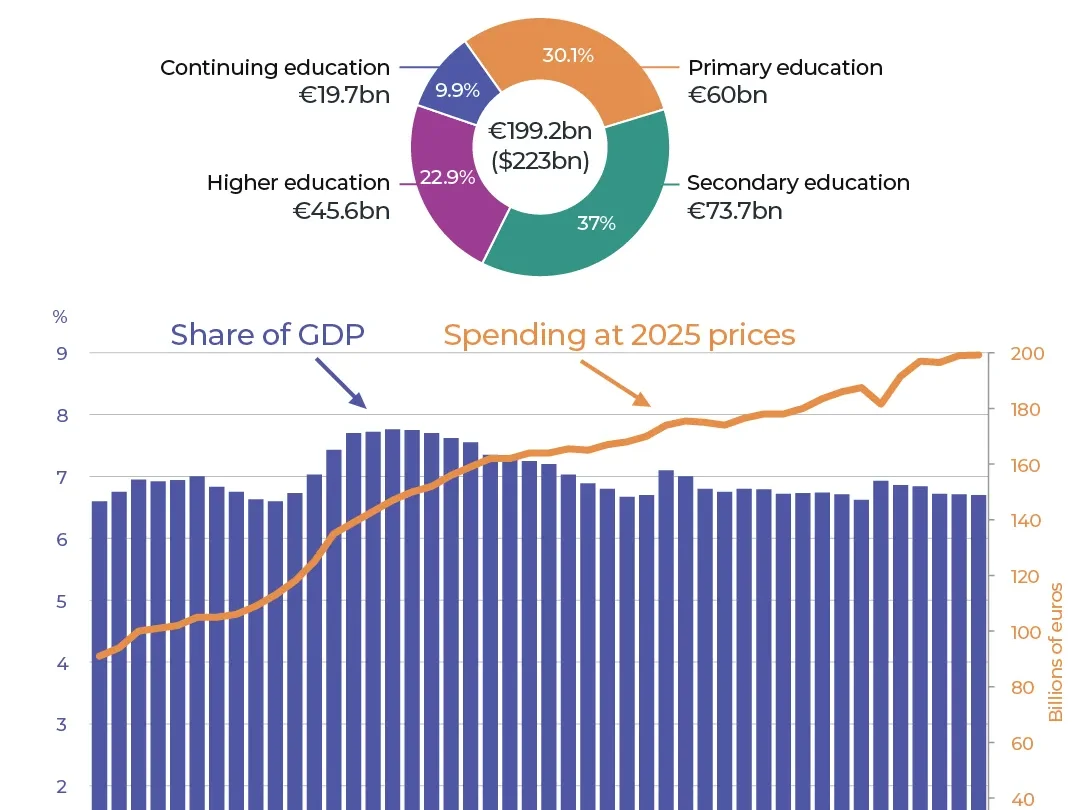
More than 6,100 people have since been arrested.With the government under pressure to rein in spending as its debt rises, Al Jazeera looks at how much France invests in education, how it compares with the rest of Europe and how it measures up against what the country spends on healthcare and defence.According to the latest data from Eurostat, the European Union’s statistics agency, France’s public spending on education amounts to….
That figure does not include private spending, such as school fees paid by families.The French Ministry of National Education uses a broader measure, known as domestic expenditure on education, which counts all the money that goes into education, whether from the state, local authorities, businesses or households.
As well as teaching, it covers adult and continuing training and related costs such as school meals, boarding and transport.By this measure, France spent 199.2 billion euros ($223bn) on education in 2025, equivalent to 6.7 percent of its GDP and 2.4 billion euros more than in 2024, according to provisional ministry figures.Spending has more than doubled since 1980, even after accounting for inflation.
But the economy has grown too, so education spending’s share of GDP is lower today than it was in the mid-1990s.Secondary education accounted for the largest share of spending at 73.7 billion euros (37 percent), followed by primary education at 60 billion euros (30 percent), higher education at 45.6 billion euros (23 percent) and adult and continuing education at 19.7 billion euros (10 percent), according to the National Education Ministry.Among….
Teacher shortages are growing across countries in the Organisation for Economic Co-operation and Development, according to the OECD’s latest Education at a Glance report.Rather than leaving posts empty, many countries are filling them with teachers who lack full qualifications.
In the 2024-2025 school year, 9 percent of primary and secondary teachers across the OECD were not fully qualified.In France, the strain is most visible in secondary schools.
About 11 percent of secondary teachers are not fully qualified, compared with less than 3 percent in primary schools.
Furthermore, lower secondary classes average 26 pupils, compared with 23 across the OECD.That echoes what pupils have been saying during the latest protests: Classes are large, and absent teachers are not being replaced.
Some also described dilapidated buildings, a shortage of tables and chairs and, in some schools, rodent infestations.
The intense heatwaves that hit France this year exacerbated existing problems in neglected buildings, many of which have no air conditioning, students said.Teachers also feel undervalued.
Only 4 percent said their profession is valued in society, the lowest share of any country surveyed and far below the OECD average of 22 percent.Historical UNESCO data showed France’s education spending slipped from 5.5 percent of GDP in 2017 to 5.3 percent in 2022 although it remained the ninth-highest among 29 European countries with data.
A brief rise to 5.7 percent in 2020 reflected the pandemic shrinking the economy, not extra spending.France was one of 14 countries where the share fell.
Norway and Denmark saw the steepest drops while Slovakia, Slovenia, Lithuania and the Czech Republic recorded the biggest rises.The protests have coincided with nationwide public sector strikes over the government’s proposed 2027 budget, which seeks 54 billion euros ($61.3bn) in savings as French President Emmanuel Macron’s government tries to rein in a large public deficit.Unions and public sector workers object in particular to a plan to freeze state employees’ salaries,….