


- Building lacked hydrants, sprinklers and functional alarm system.
- Civil Defence inspection reports 2024-25 flagged same deficiencies.
- KMC audit in 2021 also found fundamental safety failures.
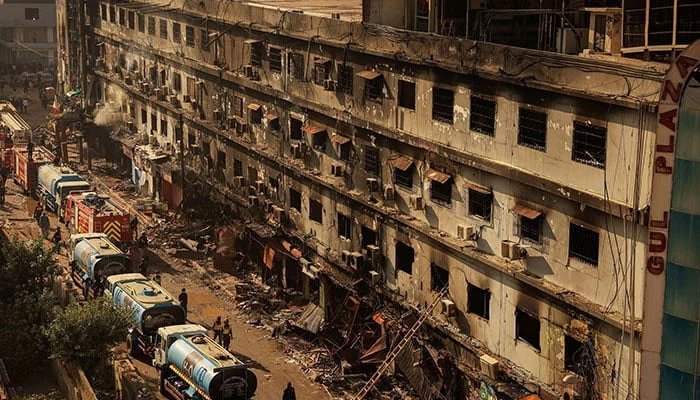
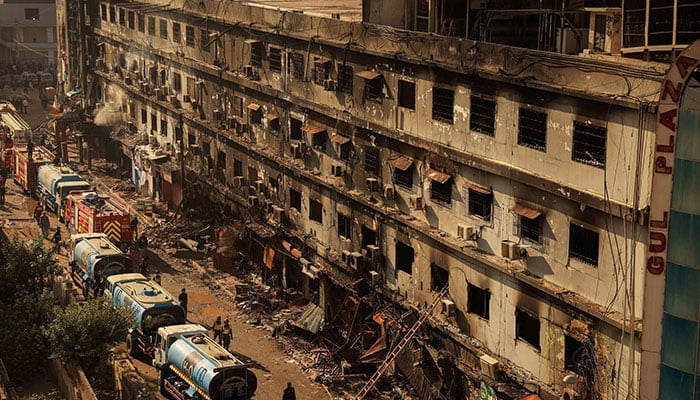
KARACHI: The Commission of Inquiry into the Gul Plaza inferno, which claimed the lives of over 72 people, has observed that the de facto management of the shopping mall was aware of the fire safety deficiencies but failed to take corrective measures.
The Sindh Home Department issued a judicial commission report — a copy of which is available with Geo News — into the incident, which stated that the failure spans all three essential components of fire safety, namely prevention, detection and firefighting, thereby demonstrating the absence of an integrated fire safety system.
“In such circumstances, the occurrence of fire cannot be regarded as an unforeseeable event, but rather as a foreseeable consequence of operating the building in a hazardous condition,” read the report.
The Sindh government on February 4 had constituted a single-member judicial commission to investigate the devastating Gul Plaza fire, following the Sindh High Court’s nomination of Justice Agha Faisal to lead the inquiry and determine its causes.
Karachi’s largest and deadly fire in more than a decade broke out on January 17 and quickly spread through the sprawling three-storey shopping complex, home to nearly 1,200 family-owned shops selling wedding clothes, toys, crockery and other goods along MA Jinnah Road.
In its report, the commission blamed the mall’s management for a lack of fire safety measures, saying that the building was operated without minimum fire safety capacity.
Civil Defence inspection reports for both 2024 and 2025 consistently recorded the absence of essential firefighting systems, including hydrants, hose reels and fire pumps, as well as an unreliable and non-functional alarm system, it stated.
Both audit reports also noted the absence of trained personnel, lack of fire drills and non-availability of rescue equipment.
The report added that the presence of flammable material throughout the premises and the absence of structural safeguards further indicated that the building lacked the capacity to resist and contain the spread of fire.
The commission found these absences constituted a violation of the Civil Defence (Measures for Dealing with Outbreak of Fire) Order, 1987, which mandates that management provide and maintain firefighting apparatus in working condition.
The lack of arrangements to control fire at its initial stage also constituted a violation of Rule 9 of the Civil Defence Rules, 1951.
A KMC Fire Department audit conducted as far back as 2021 had already revealed that the premises lacked fundamental fire safety arrangements. Fire extinguishers were insufficient and poorly maintained, while critical systems such as fire alarms, sprinklers, smoke detectors, hydrants and internal firefighting arrangements were entirely absent.
No trained personnel, evacuation plan or fire drills were in place, emergency lighting and exit signage were deficient, electrical wiring was found to be unsafe, and essential emergency information was not displayed.
Certain violations of the Civil Defence Order and Rules also translated into violations of Chapter 13 of the Karachi Building and Town Planning Regulations, 2002, with the commission particularly noting apparent violations of Regulations 13.3 and 14.8.
