


- No negligence found on part of KMC and fire brigade.
- Police include 87 witnesses in Gul Plaza inferno case.
- Challan notes alleged negligence of Gul Plaza admin.
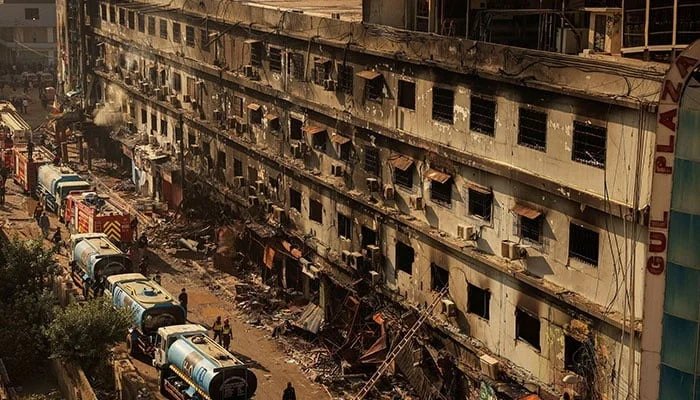
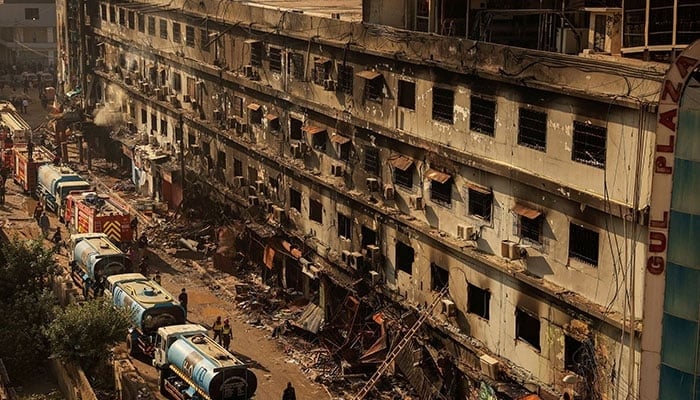
KARACHI: Police on Saturday submitted the charge sheet in the Gul Plaza fire case to a court in Karachi, holding the shopping mall’s association primarily responsible for the deadly inferno.
A deadly fire that ripped through Gul Plaza — a popular three-storey shopping mall in the port city — on January 17 killed more than 70 people and exposed serious safety failures in the country’s largest city.
The building, housing almost 1,200 businesses across its basement, mezzanine and three floors, had a variety of options for Karachiites, such as wedding wear, toys, household items, baby clothes and many more, all of which were turned to ashes as a result of the incident.
According to the charge sheet, police found no negligence on the part of the Karachi Metropolitan Corporation, fire brigade or civil defence.
Police have included 87 witnesses in the case and raised questions over fire safety arrangements at Gul Plaza, it said.
The charge sheet also noted the alleged negligence of the Gul Plaza administration and the safety arrangements available in shops and the building.
Police said that CCTV footage and other evidence were obtained during the investigation and included in the charge sheet.
According to the forensic report, no explosive material was found in the examined items, while no traces of any flammable liquid were detected either.
However, the report identified traces of particles left behind after burning in some items.
Management ‘was aware of flaws’
A Commission of Inquiry into the inferno observed last month that the de facto management of the shopping mall was aware of the fire safety deficiencies but failed to take corrective measures.
According to the judicial commission report issued by the Sindh Home Department, the failure spanned all three essential components of fire safety, namely prevention, detection and firefighting, thereby demonstrating the absence of an integrated fire safety system.
“In such circumstances, the occurrence of fire cannot be regarded as an unforeseeable event, but rather as a foreseeable consequence of operating the building in a hazardous condition,” read the report.
In its report, the commission blamed the mall’s management for a lack of fire safety measures, saying that the building was operated without minimum fire safety capacity.
Civil Defence inspection reports for both 2024 and 2025 consistently recorded the absence of essential firefighting systems, including hydrants, hose reels and fire pumps, as well as an unreliable and non-functional alarm system, it stated.
Both audit reports also noted the absence of trained personnel, lack of fire drills and non-availability of rescue equipment.
