
 Pakistan · World · Independent Digital Newsroom
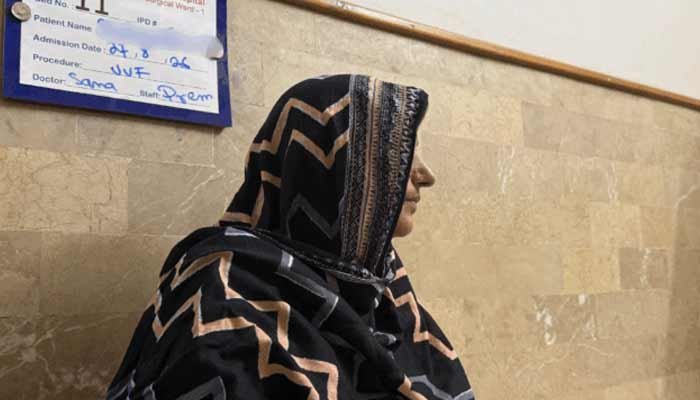
At full term, her obstetrician suspected a complication, for which she underwent a Caesarean section, but the baby was stillborn.
The doctor then told the young couple she would not be able to conceive again.That was not all.
She soon realised she was leaking urine.The doctor assured her it would stop within weeks.
It never did, despite three months in hospital trying to repair the leak.“After spending so much on my operation, being told I could never have children, and then living with the urine leakage, my husband divorced me.
I was damaged goods, a liability, and he didn’t want to spend any more money on me.”She returned to her parents' home and, a few years later, married Ali, twice her age and already married with three daughters.“He knew about my condition but married me because he needed someone to care for his paralysed wife and their three daughters.”But now, her life is beginning to change.She is being treated at….
He describes these as among the “worst and most devastating childbirth injuries” a woman can endure.In 1993, Syed trained at Addis Ababa Fistula Hospital under renowned surgeons Dr Reginald Hamlin and his wife, Dr Catherine Hamlin, who provided free obstetric fistula repair in Ethiopia.
Two years later, as medical superintendent of the government-run Sobhraj Maternity Hospital, he began actively repairing fistulas.Since KGWH began operations in 2007, it has treated “more than 3,200 women and trained 30 master trainers,” said Dr Sajjad Ahmed Siddiqui, its fistula project manager.In 2025, UNFPA’s Asia-Pacific office designated KGWH a Regional Center of Excellence for fistula care after it trained surgeons from Bangladesh, Nepal, and Afghanistan.
It was already the national referral and surgical training hub.“We want to treat 800 women annually while providing psychosocial support, literacy, and skills training to help them reintegrate and become economically empowered,” says Dr Jameel Ahmed, sexual and reproductive health specialist at UNFPA Pakistan. “But with global funding constraints and rising iatrogenic fistula cases, we are unsure how much reintegration support we can provide.”KGWH’s work has also extended beyond its….
That has now ended.Today, there are 11 fistula repair centers across Pakistan equipped with 88 trained surgeons, and in the last decade, these centers have treated over 7,800 women for fistula.Globally, about 50,000–100,000 new cases of vesicovaginal fistula occur each year, with 80% in developing countries, mainly in Asia and Africa, according to UNFPA. “In Pakistan, we estimate that up to 5,000 cases of fistula occur annually; iatrogenic fistula is….
Neonatal mortality declined from 52 to 37.6 deaths per 1,000 live births over the same period, while the stillbirth rate fell from 39.8 per 1,000 births in 2000 to 27.5 in 2024.But Syed remains unimpressed.
Despite these gains, the toll is still “not acceptable” to him.
Every day, 675 babies die before reaching one month of age, and 27 mothers die from preventable complications, amounting to more than 246,300 newborn and 9,800 maternal deaths a year.
Pakistan also records more than 190,000 stillbirths annually, WHO figures show.All these put Pakistan’s achievement of SDG 3 — which deals with sexual and reproductive health — at risk.As Pakistan made progress in tackling obstetric fistula, another form was emerging — one caused not by obstructed labor but by medical intervention itself. “We observed women developing fistulas following Caesarean sections or hysterectomies in health facilities — iatrogenic,” said Ahmed.Syed is….