


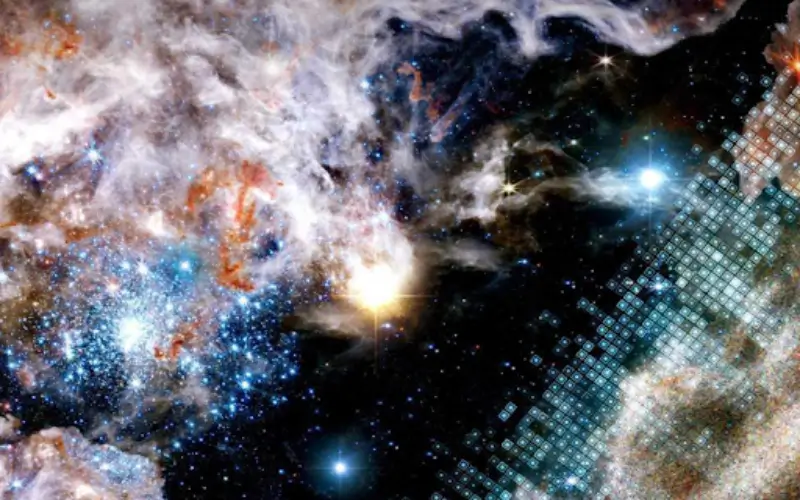
Chinese scientists have created a new artificial intelligence model that greatly improves the way astronomers capture and study images of deep space. The research was carried out by a team from Tsinghua University, which combined expertise in computational optics and AI to develop the model called ASTERIS, short for Astronomical Spatiotemporal Enhancement and Reconstruction for Image Synthesis.
The findings, published in the journal Science, show that the model can detect extremely faint signals from space, identify galaxies located more than 13 billion light-years away, and produce some of the deepest images of the universe ever created.
Studying distant and faint objects in space is essential for understanding how the universe began and how it has evolved over time. However, astronomers face a major difficulty because weak signals from faraway stars and galaxies are often hidden by background sky noise and heat radiation produced by telescopes.
The study explains that when the model’s self-supervised spatiotemporal denoising method was applied to data from the James Webb Space Telescope, it expanded the telescope’s observation range from visible light at about 500 nanometers to mid-infrared light at 5 micrometers. It also improved detection depth by one magnitude, which means the telescope can now detect objects that are 2.5 times fainter than before.
Using ASTERIS, the researchers identified more than 160 possible high-redshift galaxies from the “Cosmic Dawn” period, which took place around 200 to 500 million years after the Big Bang. According to Cai Zheng, an associate professor in Tsinghua’s Department of Astronomy and a member of the research team, this number is three times higher than what was previously discovered using older methods.
The researchers say the AI model can process huge amounts of data from space telescopes and works with different observation systems, making it suitable as a universal platform for enhancing deep-space data.
Traditional noise-reduction methods depend on combining multiple images and assume that noise remains the same or follows a pattern. In reality, noise changes over time and space. ASTERIS solves this problem by rebuilding deep-space images into a three-dimensional structure that includes both space and time.
Through a method called a photometric adaptive screening mechanism, the model can detect small changes in noise and separate them from the extremely faint signals of distant stars and galaxies. One reviewer described the study as highly important and said it could have a significant impact on the field of astronomy.
Dai Qionghai, a professor at Tsinghua’s Department of Automation, said that faint space objects hidden by light noise can now be reconstructed clearly and accurately. In the future, researchers expect this technology to be used in next-generation telescopes to help answer major scientific questions about dark energy, dark matter, the origin of the universe, and the discovery of exoplanets.
