



- Islamic principles to determine child marriages’ validity: IHC
- Orders training of registrars to avoid marriage involving a minor.
- Underage marriages often lead to forced pregnancies, says IHC.
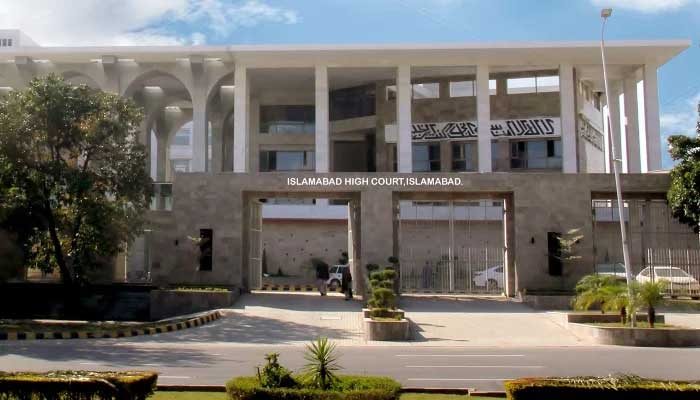
ISLAMABAD: The Islamabad High Court has disposed of a writ petition related to an underage marriage, while also making broad recommendations for legislative reforms regarding child marriages in Pakistan.
Justice Muhammad Azam Khan issued a detailed judgment in a case filed by petitioner Muhammad Riaz, who sought return of his wife, Madiha Bibi, after her family members took her from his home. The couple had married on May 30, 2025, at the Tehsil Courts Complex in Taxila, despite opposition from the woman’s family, The News reported.
The case centered on a factual dispute: the marriage certificate (Nikahnama) recorded Madiha’s age as “almost 18 years,” but a birth certificate registered after the marriage indicated she was born on September 15, 2009, making her only 15 years old. This discrepancy made age a disputed question of fact that would ordinarily require evidence and adjudication by a competent forum.
When produced before the court, Madiha said she had married of her own choice and wished to remain with her husband and declined to return to her parents. Justice Khan allowed her to reside with the petitioner, ruling that the Islamabad Child Restraint Marriage Act of 2025 does not invalidate such marriages, but rather punishes those who facilitate them.
The judgment grapples with a legal contradiction in Pakistani law. Under Islamic jurisprudence, a marriage is considered valid if a person has attained puberty, traditionally presumed at age 15, and gives free consent, regardless of statutory age requirements.
However, under the Islamabad Child Restraint Marriage Act of 2025, any marriage involving a person under 18 is criminalised, with penalties for the adult party and facilitators. The law, however, does not explicitly declare such marriages void.
Justice Khan cited numerous Supreme Court and high court precedents establishing that while child marriages may constitute criminal offenses, they are not rendered invalid under Islamic law.
The judgment quoted the 1970 Supreme Court case of Mauj Ali, which held that since a marriage is valid under Muhammadan Law when a girl has attained puberty and married of her own free will, the husband is her guardian and entitled to her custody, despite potential criminal liability under the Child Marriage Restraint Act.
The court invoked the Enforcement of Shariah Act of 1991, which declares Shariah the supreme law of Pakistan and mandates that laws be interpreted consistently with Islamic principles where multiple interpretations are possible.
Justice Khan argued that in the absence of explicit statutory language declaring child marriages void, Islamic principles must prevail in determining their validity.
The judgment explicitly disagreed with a 2022 Islamabad High Court decision in Mumtaz Bibi, which had held that child marriages are void ab initio as they violate Sections 375 and 377A of the Pakistan Penal Code dealing with rape and sexual abuse.
Justice Khan argued that declaring such marriages void would create severe complications regarding the legitimacy of children born from such unions and recognition of spousal rights, while potentially exposing minors to honor-based violence, family abuse, and social stigma.
The court distinguished consummation within a valid marriage from the exploitative acts that rape laws were designed to penalise, noting that the element of lawful relationship and consent within marriage fundamentally changes the legal analysis.
However, Justice Khan candidly acknowledged the troubling consequences of this legal position. The court recognised that validating child marriages, even while criminalising them, inadvertently weakens the deterrent effect of protective legislation and risks normalising the exploitation of minors.
The judgment noted that early marriages often lead to forced pregnancies, poor reproductive health, domestic violence, denial of education, and lifelong socio-economic marginalisation, particularly for girls in rural and underprivileged communities.
The court emphasised that the real dilemma arises when a child of tender years may have attained puberty but lacks ‘rushd’, or mental maturity to comprehend or withstand the obligations of marital life, and validating such marriages can lead to grave and irreversible consequences, including physical harm, psychological trauma, and exposure to abuse or exploitation.
Recognising these irreconcilable contradictions, Justice Khan issued seven urgent recommendations to the federal government.
Recommendations
The court directed that all Guardian Courts, Family Courts, and courts exercising jurisdiction under Section 491 must engage Child Protection Officers under the Islamabad Child Protection Act of 2018 to conduct statutory welfare assessments before determining custody, care, or marital status of minors.
These assessments should evaluate the attainment of puberty, voluntariness of consent, medical examination to assess bone age, socio-economic background, and character and age differential of the adult party. The court recommended that the federal government urgently undertake a legislative review to harmonise the numerous conflicting age definitions across Pakistani statutes.
The judgment identified discrepancies, noting that the Offence of Zina Ordinance defines adult females as those who have attained 16 years or puberty, the Pakistan Penal Code’s rape definition references age 16 for females, while the Islamabad Child Protection Act, National Commission on Rights of Child Act, and Juvenile Justice System Act all define a child as anyone under 18.
The Majority Act explicitly excludes marriage, divorce, and dower from its age-of-majority provisions, further complicating the matter.
Justice Khan called for the federal government to adopt a clear statutory stance regarding marriages involving minors, even those who have attained puberty and show signs of mental maturity, in order to protect children of tender age and uphold constitutional rights. The court emphasised that statutory clarity is urgently needed to reconcile personal law with child protection obligations.
The judgment directed that district administration and license-issuing authorities must ensure all Nikah Registrars are fully informed about the provisions and penal consequences under the Islamabad Child Restraint Marriage Act of 2025.
Registrars must be trained to strictly avoid solemnising or registering any marriage involving a minor. In the event of violations, the Chief Commissioner, Deputy Commissioner, and Chairman Union Council must immediately revoke the concerned registrar’s license and initiate criminal proceedings against all involved parties.
The court recommended that NADRA and relevant marriage registration authorities must integrate birth registration certificates into their systems, ensuring verification of age before issuing marriage certificates to prevent registration of underage marriages.
If any inconsistency arises regarding age or date of birth, subsequent marriage documents should not be issued without a valid court order or legal verification.
Invoking Articles 35 and 37 of the Constitution, which obligate the State to protect the institution of marriage, the family, the mother and child, and to promote social justice and eradicate social evils, Justice Khan recommended that the federal government launch a sustained and comprehensive awareness campaign to educate citizens, public officials, Nikah Registrars, and community leaders about the harmful consequences and legal implications of child marriages.
The court also referenced Article 12 of the UN Convention on the Rights of the Child, which Pakistan has ratified, requiring that children capable of forming their own views have the right to express them freely in all matters affecting them, with those views given due weight according to the child’s age and maturity.
This international obligation reinforces the principle that children are active rights-holders, not passive subjects, and courts must assess both age and maturity before determining the weight to be given to a child’s opinion.
