


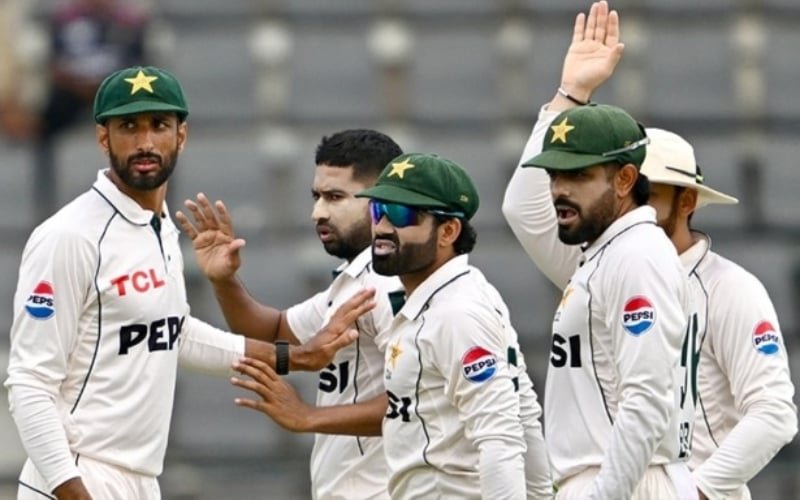
Bangladesh have not only completed a clean sweep against Pakistan in the ongoing series but have also, metaphorically speaking, delivered a heavy blow to Aaqib Javed’s cricketing philosophy.
The so-called “winning formula,” built around a style of cricket that managed to scrape a couple of Test wins, has now pushed the team further into decline.
The strategy of relying on second-tier spinners on “fan-friendly pitches” to dismantle foreign teams has not only darkened the future of Pakistan’s fast bowlers but has also made the batting lineup complacent and technically weak.
Pakistan, once renowned globally for its devastating fast bowling attack featuring legends such as Imran Khan, Wasim Akram, Waqar Younis, and Shoaib Akhtar now finds itself in a situation where no one appears willing to carry forward that legacy, as their style of bowling is no longer even considered necessary.
Domestic series victories on easier, spin-friendly pitches may still flatter the team, but international cricket has exposed their weaknesses, and there is little concern or regret over humiliating defeats abroad.
Bangladesh’s tactical superiority exposed Pakistan’s weak approach
When Bangladesh prepared a green pitch in the first Test, even Australian commentators were surprised. A team traditionally dependent on spin was attempting to challenge Pakistan through fast bowling and in reality, they succeeded.
Players who once dominated Pakistan Super League matches against low-quality bowling attacks, and considered themselves “kings of domestic cricket,” collapsed against Bangladesh’s average pace attack.
Across both Tests, Pakistan’s batting showed no intent, no fighting spirit, and no sense of competitiveness. The lack of skill was so evident that players repeatedly got out to deliveries that should not have resulted in dismissals. Bowling discipline was missing, and poor understanding of pitch conditions allowed Bangladesh to settle into comfortable positions.
Worst captaincy
Pakistan Cricket Board (PCB) and a rigid, almost schoolboy-like stubbornness appear to follow the same mindset. Just as stubbornness is often intense and unyielding in children, PCB has insisted on retaining Shan Masood as captain regardless of results. This insistence has further damaged the team.
Within PCB, cricketing decisions are reportedly heavily influenced by Aaqib Javed, who seems unwilling to consider any advice. Some believe this may be an attempt to settle personal scores from his playing days.
If Bangladesh captain Najmul Hossain Shanto and Shan Masood are compared, the difference is clear. Shanto showed aggressive leadership, made timely decisions, and trusted his judgment. He remained fully aware of the game situation, reviewing each ball carefully and making independent DRS decisions.
In contrast, Shan Masood appeared uncertain and lacked confidence, often relying on teammates for review decisions. His hesitation reflected a lack of leadership clarity.
Even with the bat, Shan Masood failed in most innings except one. Although he scored 71 in the final innings, it came when he was already set and there was no clear match strategy during the chase. Overall, he appeared defeated even before the match was lost.
Ineffective bowling
Pakistan’s bowling across both Tests was ordinary and ineffective. Mohammad Abbas and Khurram Shahzad took wickets but failed to trouble Bangladesh’s batting lineup.
Pakistan’s bowlers lacked pace compared to Bangladesh’s Nahid Rana, who consistently bowled at 146 km/h, while Pakistani pacers struggled to reach even 135 km/h. Mohammad Abbas often bowled around 120 km/h, allowing lower-order batters to settle comfortably.
Despite grass-covered pitches offering seam movement and overcast conditions providing swing, Pakistan failed to exploit early opportunities in both matches. Hassan Ali played a supporting role rather than leading the attack.
Shaheen Shah Afridi, considered one of the world’s best bowlers, also disappointed and failed to deliver in crucial moments. Even when Bangladesh were under pressure in the second innings of the second Test, Pakistan could not finish the job.
Bangladesh’s spinners performed exceptionally well, while Pakistan’s spin department was equally disappointing. Sajid Khan failed to utilize available turn, and Nauman Ali also delivered below expectations.
Disjointed and fragile batting
Pakistan’s batting appeared disorganized and mentally unstable. Although two young players, Azaan Awais and Abdullah Fazal, made their debuts and performed better than most seniors, the rest of the batting lineup failed to deliver.
Azaan Awais batted with confidence and scored a debut century in the first Test, earning praise. However, apart from him, no batter produced a meaningful innings.
Babar Azam, Shan Masood, Salman Agha, and Mohammad Rizwan managed some half-centuries, but the overall batting approach remained inconsistent and ineffective, leading to defeat.
The series once again highlighted that Pakistani batters play for personal milestones rather than match-winning contributions.
Saud Shakeel, who has been consistently out of form for the past year, once again failed, yet continues to escape serious criticism or exclusion. Similarly, Imam-ul-Haq appears to be a “spent force” in international cricket.
Coaching staff invisible in action
PCB appointed two former players, Sarfaraz Ahmed and Asad Shafiq, as coaches for this series. While both were excellent players in their time, they lack coaching experience and tactical understanding.
Neither has coached any domestic club team, yet they were given responsibility for the national side. Their lack of planning and strategy was evident throughout the series.
Most importantly, coaching players who were their teammates just a few years ago raises questions about authority and effectiveness. Sarfaraz Ahmed’s tactical weaknesses further exposed the management gap.
No concern over continuous defeats
After the second Test, Shan Masood’s press conference reflected a worrying lack of concern. When asked about repeated losses, he attributed it to fewer Test matches played, rather than accepting responsibility.
Shan Masood, who is widely considered unfit for both captaincy and even team selection based on performance, became captain due to internal disagreements between Babar Azam and Aaqib Javed.
Despite starting his Test career 13 years ago, he has failed to produce any significant innings. With an average of around 30, his continued leadership is seen by many as a result of external backing rather than merit.
Pakistan has now lost 12 out of 16 Tests under his captaincy, making him one of the most unsuccessful captains in the country’s history.
What Lies Ahead for Pakistan Cricket?
After repeated defeats, it is becoming increasingly difficult to argue that Pakistan cricket is competitive at the highest level. At present, it appears the team may only be capable of competing against lower-ranked sides such as Uganda or Kenya.
No current batter shows the ability to consistently perform against Test-playing nations, and bowlers lack the skill to challenge top-order batters.
Players who dominate weak bowling in the Pakistan Super League struggle significantly at the international level due to lack of exposure to quality attacks.
The performances of Nahid Rana, Taskin Ahmed, and Taijul Islam exposed these weaknesses clearly. It is therefore unrealistic to expect this team to compete successfully against stronger opponents.
PCB urged to reconsider direction
The Pakistan Cricket Board must seriously reconsider the direction of the national team. At this stage, it may be more realistic for Pakistan to play series against teams like Uganda, Kenya, and Nepal, where victories could at least restore some confidence and allow symbolic celebrations.
Currently, the team shows little interest in improving standards or competing at the highest level.
