


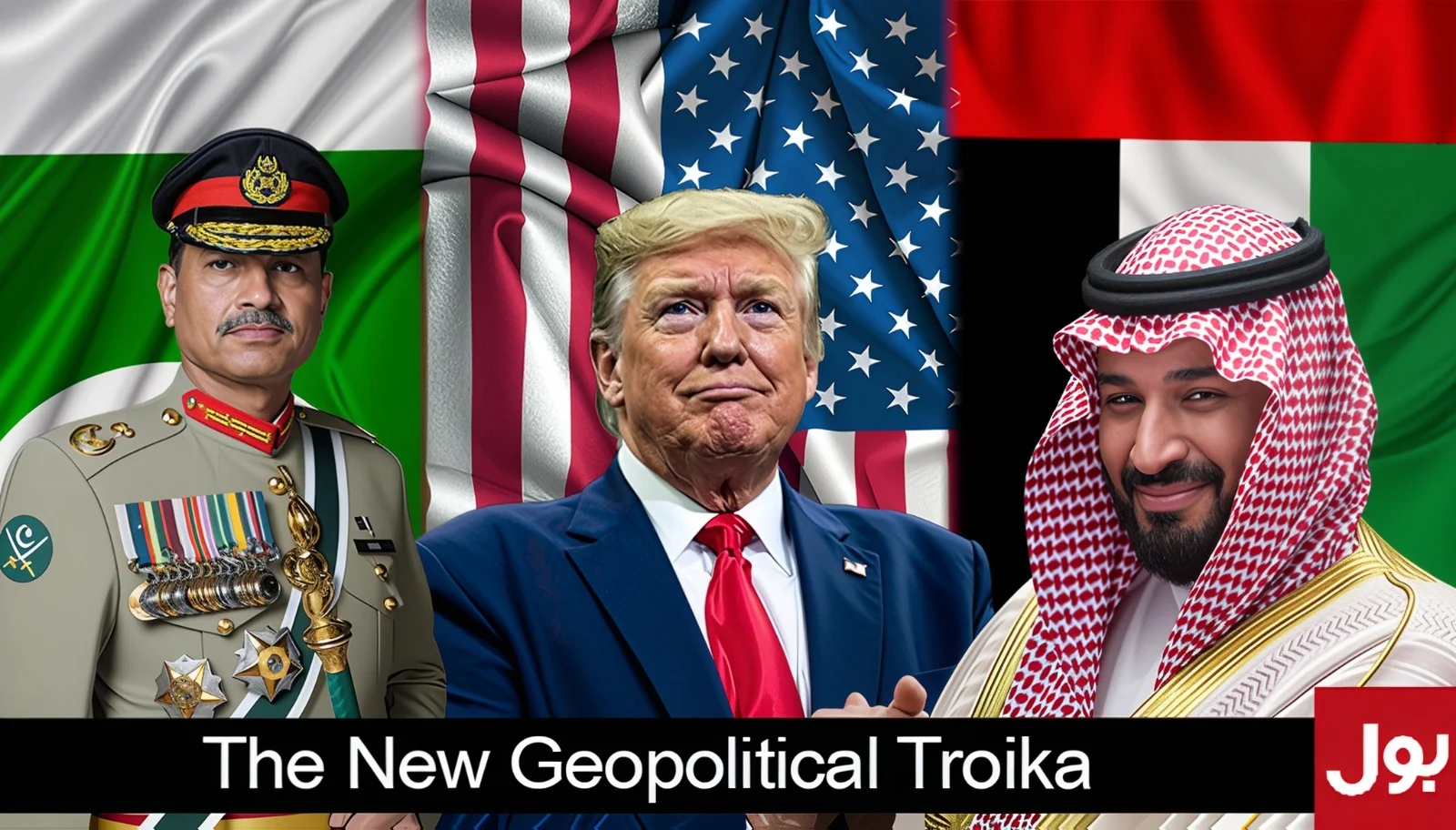
The red-carpet welcome for Saudi Crown Prince Mohammed bin Salman in Washington has ignited global attention, with analysts framing the visit as the possible emergence of a new strategic “triangle” linking the United States, Saudi Arabia and Pakistan. The convergence, led by President Donald Trump, the crown prince, and Pakistan’s Field Marshal Asim Munir, is being portrayed by observers as a transformative moment with implications stretching from defense cooperation to the future of Gaza.
A Spectacle in Washington:
Mohammed bin Salman’s first U.S. trip in eight years began with the kind of reception usually reserved for heads of state during wartime alliances. According to accounts from the visit, U.S. fighter jets performed an aerial salute, ceremonial horse guards lined the approach, and a full honor guard awaited his arrival.
Trump personally greeted the crown prince outside the White House—an honor that invited comparisons to the U.S. president’s warm treatment of Pakistan’s military chief during earlier visits.
For Riyadh and Islamabad, the symbolism was unmistakable: two of Pakistan’s closest partners, once again aligned in Washington.
The Roots of a “Historic Triangle”
Pakistan and Saudi Arabia recently signed what has been described as an “extraordinary” defense pact, further cementing decades of military cooperation. At the same time, Trump’s return to office has reportedly reset U.S.–Saudi relations after years of strain.
Trump announced plans to sell F-35 fighter jets to Saudi Arabia, while Mohammed bin Salman vowed what he called the largest investment commitment in U.S. history. Both leaders also highlighted forthcoming American-Saudi investments in Pakistan’s natural resources sector, signaling Islamabad’s centrality to the emerging alignment.
Trump has repeatedly praised Field Marshal Munir—publicly labeling him his “favorite field marshal”—and expressed similar admiration for the Saudi crown prince. This unusual confluence of personal rapport appears to be shaping diplomatic momentum.
Repairing a Fractured Past:
The shadow of the 2018 killing of journalist Jamal Khashoggi has loomed over U.S.–Saudi relations for years. Visiting Washington this week, Mohammed bin Salman acknowledged the episode as painful, saying Saudi Arabia had conducted an investigation and strengthened safeguards to prevent future abuses.
The crown prince was noticeably more relaxed than in previous visits. Images of him smiling alongside Trump circulated widely, symbolizing what analysts are calling a full thaw.
The Black-Tie Signal to the World:
A high-profile black-tie dinner hosted by Trump gathered elite U.S. business figures—among them Elon Musk, Tim Cook, Jensen Huang, Michael Dell, Lisa Su, Chevron’s Mike Wirth, Citigroup’s Jane Fraser, and Blackstone’s Stephen Schwarzman. The event served as a stage for the crown prince to outline long-term strategic and economic plans and to reaffirm the historical depth of U.S.–Saudi ties.
For Pakistan watchers, the gathering was more than ceremonial. It demonstrated that Islamabad, through Munir’s recent contacts with Trump and MBS, is increasingly woven into conversations about economic corridors, defense architecture and Middle Eastern diplomacy.
Gaza: A Shared Vision for Peace?
The Gaza conflict looms large over the new diplomatic choreography. Pakistan—backed by the Gulf Cooperation Council and a bloc of Muslim nations—supported the recent UN resolution on Gaza. Trump has floated a 20-point peace plan meant to stabilize the territory, with Arab states expected to finance reconstruction. Under this vision, Pakistan could play a major role in a future peacekeeping mission.
The framework reportedly dovetails with Trump’s broader goals stated at the recent Sharm el-Sheikh summit: securing a cease-fire, rebuilding Gaza, and reviving an expanded version of the Abraham Accords.
Abraham Accords 2.0:
During Trump’s first term, the UAE, Bahrain, Morocco and Sudan recognized Israel under the Abraham Accords, joining earlier recognitions by Egypt, Jordan and Turkey. Today, analysts are increasingly discussing Saudi Arabia—and, to a lesser degree, Qatar—as potential candidates for a next stage of normalization.
Yet both Pakistan and Saudi Arabia have reiterated that a two-state solution remains fundamental. Field Marshal Munir has repeatedly emphasized that an independent Palestinian state is the only viable path to lasting peace, a view echoed by Mohammed bin Salman.
Any broadening of the accords, supporters argue, could elevate Trump as a contender for the Nobel Peace Prize—especially if paired with a credible path toward Palestinian statehood.
A New Strategic Geometry?
Across diplomatic circles, think tanks and media outlets, talk is growing of a new geopolitical alignment defined by Washington’s military might, Saudi Arabia’s economic weight, and Pakistan’s strategic position in the Muslim world.
If this U.S.-Saudi-Pakistan “triangle” ultimately plays a decisive role in establishing a sovereign Palestinian state, the partnership could become a model for conflict resolution and long-term regional stability.
For now, the world watches Washington, Riyadh and Islamabad as they navigate this moment of renewed warmth—one that may reshape the future political landscape of the Middle East.
