


Close Menu

    Subscribe to Updates

    Get the latest creative news from FooBar about art, design and business.

    What's Hot

    Lord’s Test: England set Pakistan 389 to win after Abbas’ five-wicket haul

    August 30, 2026

    Taylor Swift becomes major hindrance for Travis Kelce’s career

    August 30, 2026

    Pakistan’s Dar arrives in Turkey after UK visit for regional security talks

    August 30, 2026
    Facebook X (Twitter) Instagram
    • Home
    • Politics
    • News
    • Magazines
    Facebook X (Twitter) Instagram
    Login
    22Media22Media
    Subscribe
    • Home
    • News
      • Pakistan News
      • World News
      • Amazing News
      • Only On 22
    • Sports
    • Bussiness
    • Innovation
      • Health & Sciences
      • Technology
    • Culture
      • Crime & Justice
      • Entertainment
    • Politics
    • Magazines
    • Weather
    • Video
    • Live
    22Media22Media
    Home»News»World News»Half the world faced an extra month of extreme heat due to climate change: study
    World News

    Half the world faced an extra month of extreme heat due to climate change: study

    22febdm@gmail.comBy 22febdm@gmail.comMay 30, 2025No Comments3 Mins Read
    Facebook Twitter Pinterest LinkedIn Tumblr Email
    Share
    Facebook Twitter LinkedIn Pinterest Email

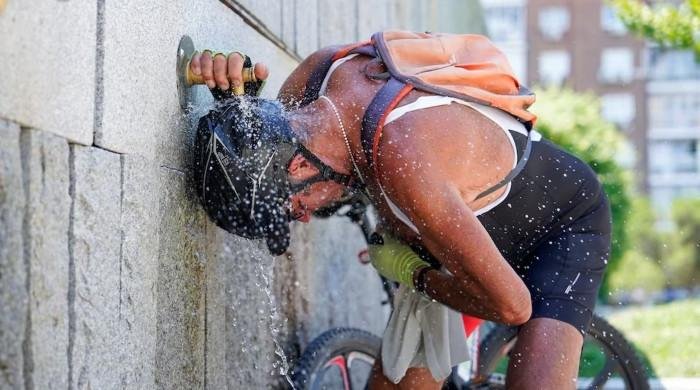
    A cyclist cools off at a fountain at Madrid Rio park during the second day of the heatwave, in Madrid, Spain, July 25, 2024. — Reuters
    A cyclist cools off at a fountain at Madrid Rio park during the second day of the heatwave, in Madrid, Spain, July 25, 2024. — Reuters

    WASHINGTON: Half the global population endured an additional month of extreme heat over the past year because of manmade climate change, a new study found Friday.

    The findings underscore how the continued burning of fossil fuels is harming health and well-being on every continent, with the effects especially under-recognised in developing countries, the authors said.

    “With every barrel of oil burned, every tonne of carbon dioxide released, and every fraction of a degree of warming, heat waves will affect more people,” said Friederike Otto, a climate scientist at Imperial College London and co-author of the report.

    The analysis — conducted by scientists at World Weather Attribution, Climate Central, and the Red Cross Red Crescent Climate Centre — was released ahead of global Heat Action Day on June 2, which this year spotlights the dangers of heat exhaustion and heat stroke.

    To assess the influence of global warming, researchers analysed the period from May 1, 2024 to May 1, 2025.

    They defined “extreme heat days” as those hotter than 90% of temperatures recorded at a given location between 1991 and 2020.

    Using a peer-reviewed modelling approach, they then compared the number of such days to a simulated world without human-caused warming.

    The results were stark: roughly four billion people — 49% of the global population — experienced at least 30 more days of extreme heat than they would have otherwise.

    The team identified 67 extreme heat events during the year and found the fingerprint of climate change on all of them.

    The Caribbean island of Aruba was the worst affected, recording 187 extreme heat days — 45 more than expected in a world without climate change.

    The study follows a year of unprecedented global temperatures. 2024 was the hottest year on record, surpassing 2023, while January 2025 marked the hottest January ever.

    On a five-year average, global temperatures are now 1.3 degrees Celsius above pre-industrial levels — and in 2024 alone, they exceeded 1.5°C, the symbolic ceiling set by the Paris climate accord.

    The report also highlights a critical lack of data on heat-related health impacts in lower-income regions.

    While Europe recorded more than 61,000 heat-related deaths in the summer of 2022, comparable figures are sparse elsewhere, with many heat-related fatalities misattributed to underlying conditions such as heart or lung disease.

    The authors emphasised the need for early warning systems, public education, and heat action plans tailored to cities.

    Better building design — including shading and ventilation — and behavioural adjustments like avoiding strenuous activity during peak heat are also essential.

    Still, adaptation alone will not be enough. The only way to halt the rising severity and frequency of extreme heat, the authors warned, is to rapidly phase out fossil fuels.

    Share. Facebook Twitter Pinterest LinkedIn Tumblr Email
    22febdm@gmail.com
    • Website

    Related Posts

    Iran’s Khamenei calls for Gulf unity as Hormuz tensions persist | US-Israel war on Iran News

    August 30, 2026

    The home front: How Israel, Iran, and US leaders have been hit by the war | US-Israel war on Iran News

    August 30, 2026

    Iran’s Khamenei urges Gulf rulers to confront ‘real enemy’

    August 30, 2026
    Add A Comment
    Leave A Reply Cancel Reply

    Demo
    Our Picks
    • Facebook
    • Twitter
    • Pinterest
    • Instagram
    • YouTube
    • Vimeo
    Don't Miss
    Sports

    Lord’s Test: England set Pakistan 389 to win after Abbas’ five-wicket haul

    By 22febdm@gmail.comAugust 30, 20260

    Pakistan’s Muhammad Abbas celebrates after taking his fifth wicket, that of England’s Ollie Robinson on…

    Taylor Swift becomes major hindrance for Travis Kelce’s career

    August 30, 2026

    Pakistan’s Dar arrives in Turkey after UK visit for regional security talks

    August 30, 2026

    Iran’s Khamenei calls for Gulf unity as Hormuz tensions persist | US-Israel war on Iran News

    August 30, 2026

    Subscribe to Updates

    Get the latest creative news from SmartMag about art & design.

    22Media
    Facebook Instagram YouTube WhatsApp
    • Home
    • Politics
    • News
    • Magazines
    © 2026 22Media. Designed by AleemSoft Hub.

    Type above and press Enter to search. Press Esc to cancel.

    Sign In or Register

    Welcome Back!

    Login to your account below.

    Lost password?