



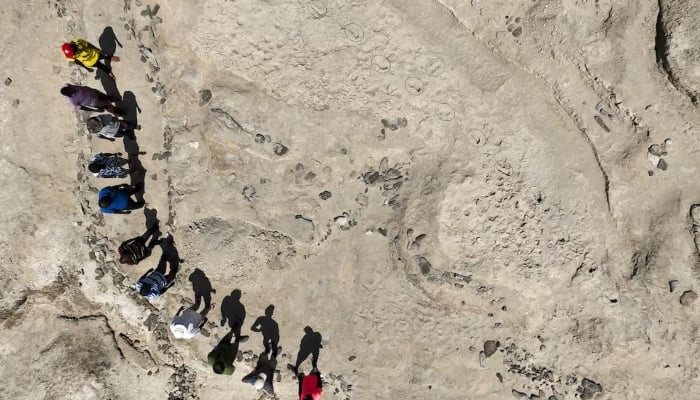
About 1.5 million years ago, individuals of two different species in the human evolutionary lineage trudged on a muddy lakeshore in northern Kenya, leaving behind intersecting trackways alongside the footprints of antelopes, horses, warthogs, giant storks and other animals.
These tracks turned into fossils that scientists have now discovered at a location called Koobi Fora, providing the first evidence that these two species — Paranthropus boisei and Homo erectus — shared the same landscape, literally crossing paths. The discovery raises intriguing questions about the relationship between the two species and any competition for resources.
Paranthropus boisei, the more distantly related to modern humans of the two, lived from about 2.3 to 1.2 million years ago, standing up to about 4 feet 6 inches (137 cm) tall. They had a skull adapted for large chewing muscles, including a cranial crest like those in male gorillas, as well as massive molars. Their feet bore ape-like traits including in the big toe.
Homo erectus, an early member of our evolutionary line with body proportions like those of Homo sapiens, lived from about 1.89 million to 110,000 years ago, ranging from about 4 feet 9 inches to 6 feet 1 inch (145-185 cm) tall. They had large brow ridges and bigger brains than Paranthropus boisei, though smaller than our species.
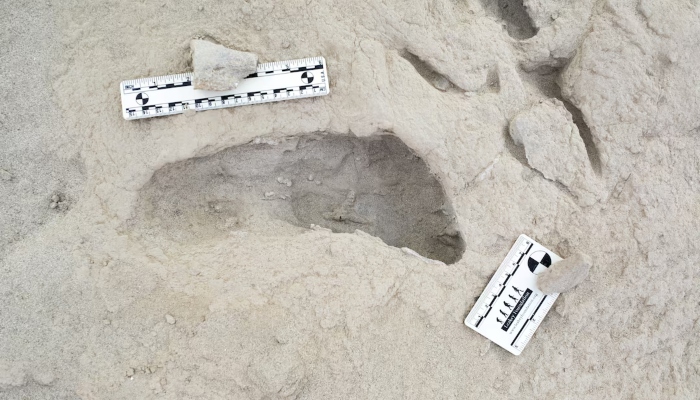
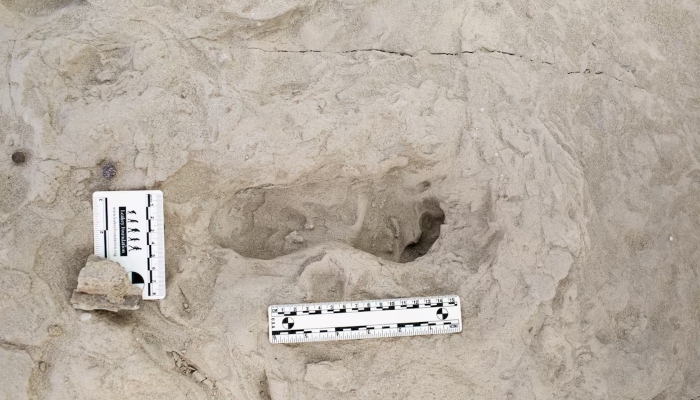
The researchers found the footprints in 2021 in the vicinity of Lake Turkana. They identified one long trackway of 12 footprints, each about 10.25 inches (26 cm) long, attributed to an adult Paranthropus boisei individual based on their shape and the manner of locomotion.
Three isolated footprints, ranging from 8-9.25 inches (20.5-23.5 cm) long and resembling those of modern people, were almost perpendicular to the main trackway. Two were complete enough to attribute to Homo erectus, possibly a juvenile. The third was harder to assign confidently.
The researchers said the trackways appear to have been left within hours or perhaps a couple of days — the mud had never dried and cracked — and the individuals even may have seen each other. There was no evidence of interaction.
“The fossil footprints provide us a clear picture of that instant in time, 1.5 million years ago. The different human ancestors may well have passed by each other, wading in the shallow water, possibly hunting and gathering,” said paleoanthropologist Louise Leakey, director of the Koobi Fora Research Project and co-author of the study published on Thursday in the journal Science, opens new tab.
The researchers reanalysed trackways that were previously discovered nearby, determining that both species were present together on fossilised muddy surfaces over a period spanning roughly 200,000 years.
“It is possible that they competed directly, but also possible that they were not in direct competition and both had access to the resources that they needed on this shared landscape,” said paleoanthropologist and study lead author Kevin Hatala of Chatham University in Pittsburgh.
Dietary differences may have mitigated competition.
“Paranthropus boisei consumed low-quality forage that likely required repetitive chewing. Homo erectus was likely to be omnivorous, using tools to butcher carcasses, and also had meat in its diet,” Leakey said.
The human and chimpanzee evolutionary lineages split roughly 7 million years ago in Africa. Species in the human lineage are called hominins.
Footprints provide information on anatomy, locomotion, behaviour and environments that skeletal fossils or stone tools cannot. The feet of these two species were anatomically distinct, and they had different gaits.
“The tracks we attribute to Homo erectus have a very modern human-like shape with a tall arch of sediment in the middle of the track that indicates a stiff foot and a walking gait that includes pushing off of the toes,” said Harvard University evolutionary biologist and study co-author Neil Roach.
“The Paranthropus tracks lack this tall arch and indicate a more flat-footed walk. Additionally, the Paranthropus tracks show a big toe that is a bit more diverged from the other toes and more mobile. Both of these aspects are more similar to the way a chimpanzee walks, although clearly distinct and intermediate between chimpanzee and human footprints,” Roach said.
Paranthropus boisei disappeared a few hundred thousand years after these footprints, while Homo erectus flourished. Possibly a direct ancestor of Homo sapiens, Homo erectus was the first human species to spread beyond Africa.
The fossil site was a resource-rich lakeshore near the mouth of a river.
“The fact that we consistently see two species of hominins in these landscapes, in spite of the presence of dangerous animals such as hippos and crocodiles, suggests that these environments were important enough to our ancestors to be worth the risk of visiting,” Roach said.
