
 Pakistan · World · Independent Digital Newsroom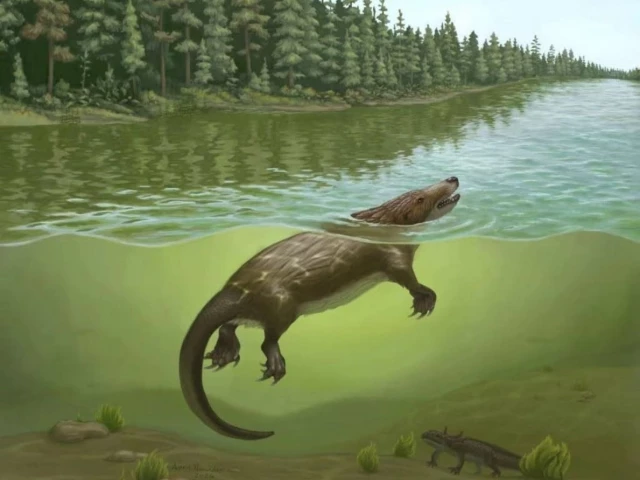
Its fossil specimen, discovered in Ningcheng, north China's Inner Mongolia Autonomous Region, measures roughly 52 centimeters in length and is estimated to have weighed around 2 kilograms, making it the largest known docodont mammaliaform.
Its skull is clearly preserved, its trunk is robust, and its most striking feature is an unusually long, coiled tail.The specimen also retains well-preserved pelvic bones, hind limbs and tail vertebrae, suggesting it was adapted for swimming.
Based on its distinctive teeth, researchers believe it could have hunted small animals living in the same environment, with a lifestyle possibly similar to that of the modern platypus.The study also sheds light on the animal's throat structure.
The bones in its throat are similar to those of modern mammals, suggesting that behaviors such as swallowing, lapping and suckling may have already existed in the early ancestors of mammals, long before modern mammal groups appeared."Mammaliaforms from the Mesozoic are often imagined as tiny creatures under dinosaur feet, but Megacauda sungei clearly raises the size limit of this group," said Li Yikun, an associate professor at Shenyang Normal University….
New large docodont fossil sheds light on Jurassic mammaliaform diversity Xinhua | Updated 18 minutes ago | Scientists discovered Megacauda sungei, the largest known docodont mammaliaform, with a long, coiled tail.