


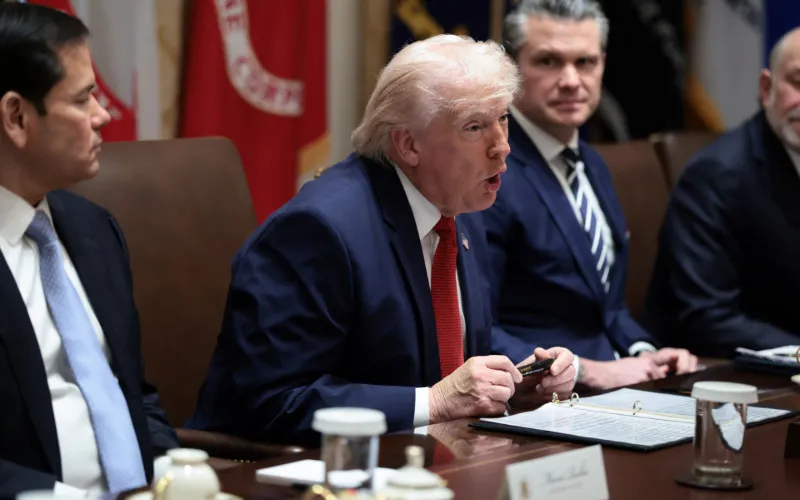
U.S. President Donald Trump said he will extend a temporary pause on attacks targeting Iran’s energy infrastructure into April, expressing optimism that negotiations with Tehran are progressing “very well.” However, an Iranian official dismissed a U.S. proposal to end the conflict as “one-sided and unfair.”
The conflict, now in its fourth week, has expanded across the Middle East, resulting in thousands of casualties and significant economic disruption. Global energy markets have been heavily affected, with oil prices surging by around 40%, liquefied natural gas costs rising sharply, and fertilizer prices increasing by approximately 50%, raising concerns about inflation and food security.
The United States and Israel launched strikes on Iran on February 28 after negotiations over Iran’s nuclear program failed. Since then, both sides have continued military actions despite intermittent pauses.
Trump stated on his platform, Truth Social, that discussions are ongoing and progressing positively, criticizing what he called “erroneous” media reports. In contrast, Iranian officials denied that any direct talks with Washington are taking place.
Earlier, Trump had announced a 10-day halt on strikes against energy facilities, which has now been extended to ten days following what he described as a request from Iran for a longer pause.
Meanwhile, the conflict has disrupted global shipping routes. Iran has effectively blocked fuel exports through the Strait of Hormuz, a critical passage responsible for about 20% of global oil and LNG shipments.
As part of a proposed 15-point peace plan, Trump suggested Iran allow 10 oil tankers to pass through the strait as a goodwill gesture. Iran rejected the proposal, arguing that it primarily benefits U.S. and Israeli interests.
Trump warned that failure to comply with U.S. demands including reopening the strait and dismantling Iran’s nuclear program would lead to severe consequences, stating the U.S. could become Iran’s “worst nightmare.” He also hinted at the possibility of taking control of Iran’s oil resources, though he provided no specifics.
According to The Wall Street Journal, the Pentagon is considering deploying up to 10,000 additional troops and has already introduced unmanned drone speedboats for patrol operations in the region.
Iran, for its part, has taken a firmer stance, demanding guarantees against future attacks, compensation for damages, and formal control over the Strait of Hormuz.
Hostilities continue, with Iran launching multiple missile strikes targeting Israeli cities such as Tel Aviv and Haifa, as well as other areas, including a Palestinian town in central Israel.
15-point plan
Trump’s envoy Steve Witkoff on Thursday confirmed that the White House has sent a 15-point plan to Tehran via Pakistan in an attempt to end the war with Iran.
“I can report to you today that we have, along with your foreign-policy team, presented a 15-point action list that forms the framework for a peace deal. This has been circulated through the Pakistani government, acting as the mediator,” Witkoff told Trump at a cabinet meeting at the White House.
The plan has “resulted in strong and positive messaging and talks,” said Witkoff.
‘Indirect talks underway’
Also on Thursday, Pakistan’s Deputy Prime Minister and Foreign Minister Mohammad Ishaq Dar said that the US-Iran “indirect talks” are taking place through messages being relayed by Pakistan.
“In this context, the United States has shared 15 points, being deliberated upon by Iran, brotherly countries of Türkiye and Egypt, among others, are also extending their support to this initiative,” the minister said in a post on the social media platform X.
There has been unnecessary speculation in the media regarding peace talks to end ongoing conflict in the Middle East. In reality, US-Iran indirect talks are taking place through messages being relayed by Pakistan. In this context, the United States has shared 15 points, being…
— Ishaq Dar (@MIshaqDar50) March 26, 2026
He said that Pakistan remained fully committed to promoting peace and continues to make every effort to ensure stability in the region and beyond.
Gulf hotels
Araghchi warned hotels in Gulf Arab countries against accepting US military personnel, accusing the soldiers of fleeing their bases and using civilian sites as cover.
“From the outset of this war, US soldiers fled military bases in the GCC (Gulf Cooperation Council) to hide in hotels and offices. They use GCC citizens as human shields,” Araghchi wrote on social media platform X.
From outset of this war, U.S. soldiers fled military bases in GCC to hide in hotels and offices. They use GCC citizens as human shield.
Hotels in U.S. deny bookings to officers who may endanger customers. GCC hotels should do same. pic.twitter.com/U2U4je0059
— Seyed Abbas Araghchi (@araghchi) March 26, 2026
He compared the situation to hotels in the United States, which he claimed deny bookings to officers who may endanger customers, and urged Gulf hotels to adopt the same practice.
