


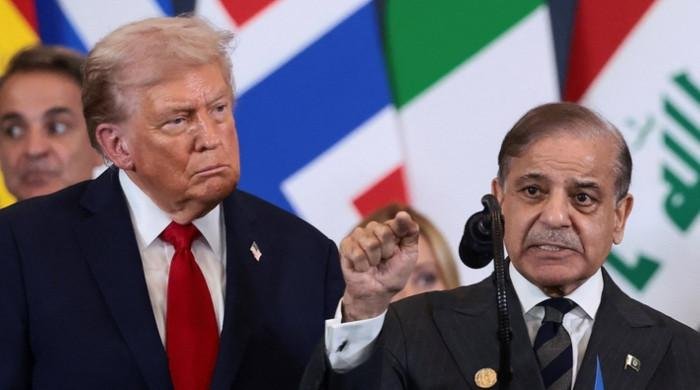
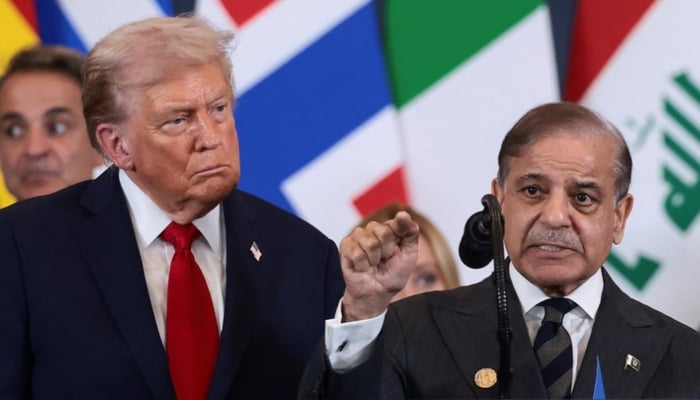
KARACHI: Pakistan’s decision to join US President Donald Trump’s ‘Board of Peace’ has triggered sharply divided reactions across diplomatic, political and security circles. For some, the move reflects necessary realpolitik in an unpredictable global environment; for others, it signals a troubling alignment with a controversial, unilateral initiative.
On Wednesday, Pakistan said it would join US President Donald Trump’s Board of Peace. According to the Foreign Office, the decision has been taken as part of Pakistan’s ongoing efforts to support the implementation of the Gaza Peace Plan under the framework of UNSC Resolution 2803.
The invitation was extended last week after Trump’s administration contacted global figures to join the board. The board was originally conceived to oversee the rebuilding of Gaza, but the charter does not appear to limit its role to the occupied Palestinian territory. The board will be chaired by Trump.
Reaction to Pakistan’s decision has varied from outrage to realpolitik. The News reached out to analysts and former diplomats for their insight into what this move could lead to: is Pakistan tactically navigating a volatile geopolitical moment, or is it compromising its longstanding multilateral principles by joining what some see as a parallel, Trump-centric alternative to the UN?
For senior journalist Zarrar Khuhro, “the primary reason to join the Board of Peace it to mollify and gratify Trump. And that is not insignificant, especially considering how volatile Trump is. You’ve seen how he’s treated allies….”
In Khuhro’s reading, Pakistan’s choice reflects not enthusiasm but compulsion. As he puts it, “given Pakistan’s geopolitical situation, as bitter a pill as this may be, perhaps Pakistan had no real choice here. You can call it Hobson’s choice or a Catch-22, but when we say Pakistan should not have joined, then we also have to evaluate the consequences of Trump’s ire. And that is certainly not something Pakistan can afford at this time”.
Yet even those sympathetic to this logic question whether the board itself is viable. Khuhro is blunt: “I don’t think the board is a viable idea”. His critique cuts at the institutional core of the initiative.
“They’re calling it a parallel UN; I think it is more a parallel subscription-based UN Security Council because you have to pay to unlock premier services (you have to pay one billion after three years). And Trump seems to be the lifetime chairman holding sole veto rights. Does that look like a sustainable model? Especially when we look three years ahead, after which Trump will no longer be in power — unless the American constitution is completely shredded. And if he is not in power, then what authority would the board hold? I would say none at all”.
From this perspective, participation becomes less about endorsement and more about riding out a transient experiment. As Khuhro concludes, “So maybe it’s not a bad idea to play along for a couple of years and let it die a natural death”.
But even if the board proves short-lived, its immediate political and symbolic implications cannot be ignored, especially for Gaza. While Pakistan has framed its participation within the context of UNSC Resolution 2803, sceptics argue that the Gaza justification may be more rhetorical than substantive.
Khuhro warns that “given that this comes out of a UNSC resolution [2803], I think this is a classic Trump bait and switch. It may have started with Gaza, but it’s now very clear that the mandate far exceeds that. And this has been referred to in very general terms, open to interpretation: ‘stability’, ‘governance’. From what I have seen, Gaza reconstruction has not really been mentioned [in the board charter]…”
This concern over mandate-creep is echoed more forcefully by former ambassador to the UN and the US Dr Maleeha Lodhi, who calls Pakistan’s announcement “an unwise decision for many reasons”. She argues that the government has “overlooked the fact that Trump wants states to join the board to secure international support and legitimacy for what are and will be unilateral actions by him”.
For Lodhi, the problem is not only the board’s broad remit, but also its personalisation: Pakistan, she says, has essentially “signed up to an ‘organisation’ which Trump projects as an alternative to the UN — and which is tied to Trump’s person and cannot last beyond his term in government.”
Still, not all assessments are sceptical. Some analysts view the move as a strategic expansion rather than a concession. For Muhammad Faisal, South Asia security researcher at the University of Technology Sydney, Pakistan has made “a smart move” that broadens its foreign policy beyond a traditionally South Asia-centric framework and “enhances relevance”.
In his view, “after decades, Pakistan is implementing a Middle East policy which is crucial for expanding foreign policy space in a fragmenting world”. Crucially, Faisal notes that Pakistan does not carry direct disputes with major powers like the US, China or Russia, “which enables flexibility for expanding role in the Middle East”.
His argument is less about Trump and more about strategic positioning in an increasingly fragmented global order. As Faisal frames it: “As Canadian Prime Minister Mark Carney said at the WEF annual meeting at Davos, ‘if you are not at the table, you are on the menu’. Should Pakistan not be at the table of the Board of Peace?”
A similar, though more restrained, interpretation is offered by journalist and political commentator Nasim Zehra, who sees Pakistan’s participation as exploratory rather than ideological. According to her, “For now, the so-called ‘board’ remains only a Trumpian idea, to which Pakistan, like others, has been invited. Accepting such an invitation means merely checking out — not endorsing — Trump’s fantasy”.
Zehra emphasises that Pakistan’s normative anchors remain intact: its position, she says, “remains anchored in the UN Charter and UN Security Council resolutions”, a stance reflected in Pakistan’s responses ranging from the attack on Iran to Israel’s genocide in Gaza “and in its unwavering commitment to an independent Palestinian state with Jerusalem as its capital”.
From a technical standpoint, former ambassador Asif Durrani adds an important clarification: the Board of Peace, he notes, “is a provision of UN Security Council Resolution 2803, adopted in November 2025.
Therefore, Pakistan’s acceptance of President Trump’s invitation is in accordance with the above resolution”. However, he also flags a major ambiguity — that the “TORs of the Board of Peace are yet to be defined”. For Durrani, the board’s real test will lie not in its rhetoric but in its capacity to “muster financial resources for the reconstruction of Gaza and the rehabilitation of Palestinians”.
Yet the absence of parliamentary debate and public consultation has opened the government to domestic criticism. According to Tehreek-e-Tahaffuz Ayin-e-Pakistan (TTAP) leader Mustafa Khokhar, “Pakistan’s decision to join the Board of Peace without any public debate or input by the parliament smacks of the disregard this regime has of the Pakistani nation”.
Khokhar goes further, branding the board a “colonial enterprise to not only govern Gaza but create a parallel system to the UN”, warning that its charter gives Trump “czarist powers to implement his personal as well as US agenda without any mechanism to prevent such one-sided outcome”.
On the other hand, proponents of Pakistan’s joining the board, as well as security sources, point to the participation of other Muslim countries as validation of Pakistan’s choice, calling it a pragmatic step towards a political solution to the Gaza genocide.
They argue that the move aligns with Pakistan’s tradition of engagement in multilateral forums, reinforcing its image as a country capable of acting as a bridge for peace — particularly since Pakistan is among a handful of states without disputes with any major global power.
Security sources further argue that Pakistan’s participation does not signal any shift in core policy positions including Pakistan’s stance on Gaza and Kashmir.
They also reject comparisons with Pakistan’s role in other security arrangements, noting that on this being likened to joining the ISF, Pakistan has been very clear regarding its engagement in ISF: any engagement in ISF will be in accordance with national interest, UN mandate and per the aspirations of the people of Pakistan and Palestine.
Originally published in The News
