


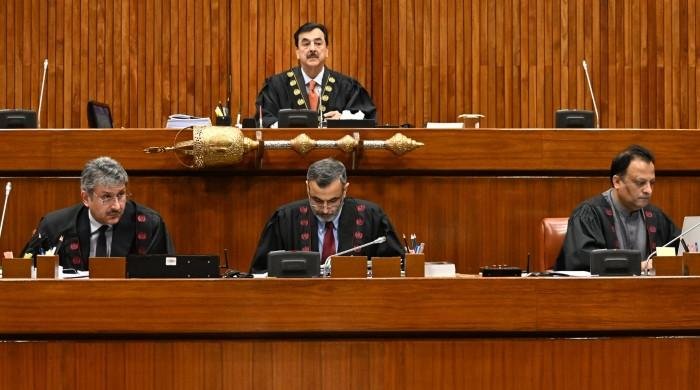
KARACHI: A proposed overhaul of Pakistan’s judicial and command structures has triggered a storm of debate in the country’s legal community. As the government tabled the 27th Constitutional Amendment Bill in the Senate on Saturday, lawyers warned that it could either mark a long-awaited structural reform or the most serious attack on judicial independence.
The amendment proposes the creation of a Federal Constitutional Court (FCC), revises judicial appointments and transfers and alters the structure of military command.
But for many in the legal fraternity, it is less about reform and more about reshaping power. High court advocate Hassan Abdullah Niazi sees the proposed FCC as a recipe for confusion.
“This may prove to be the most serious attack on judicial independence and civilian supremacy since Pakistan’s return to democracy”, he says, adding that the amendment “introduces a Federal Constitutional Court, a model drawn from civil law systems, into a country whose legal tradition is firmly rooted in the common law. The result will not be clarity but confusion”.
According to Niazi, the problem isn’t just structural. It is systemic. Determining which cases involve “substantial questions of constitutional law” will, he says, become “an administrative nightmare”, forcing litigants to shuttle between the Supreme Court and the new FCC.
“Far from improving access to justice, this dual structure will make it slower, costlier and less certain”.
For Supreme Court advocate Basil Nabi Malik, what Niazi calls confusion is really design.
“The 27th Amendment, in essence, completes the executive capture of the judiciary. It completes what the 26th Amendment left to our imagination”, he says.
Malik argues that under the proposed changes, judges can be “transferred without consent”, retired if they resist and reminded “of who’s in charge”.
Both Niazi and Malik see the FCC’s creation — and the executive’s central role in appointing its judges — as the heart of the danger.
“The first chief justice and judges of the FCC would be appointed directly by the prime minister and president”, says Niazi, calling it a deliberate move to “entrench executive control from the outset”. Malik agrees, noting that this will ensure that “control over the judiciary is complete”.
Malik also points to what he calls a punitive dimension: “It allows transfers without consent, retires judges who don’t voluntarily agree to a transfer or appointment, and places the FCC on a higher pedestal than the Supreme Court”.
He adds that “Ironically, the justification for such overreach tends to be grounded in how the judiciary had overreached in the past itself… Clearly, no one has learnt anything. And when they do, they will learn the hard way”.
Barrister Ali Tahir, however, offers a more structural reading of the amendment. He believes it stems directly from the debates around the 26th Amendment.
“While the hearing on the 26th Amendment was never concluded, the arguments made against it have directly shaped the new 27th Amendment draft”, he explains.
“Wherever the constitution previously used the term ‘Supreme Court,’ it now refers instead to the ‘Constitutional Court’”. To Tahir, this is no clerical change but a deliberate shift in judicial supremacy.
“Article 189 has been amended to make [the FCC] the highest court in Pakistan, and Article 184, which defined the Supreme Court’s original jurisdiction, has been omitted entirely,” he says.
“If this amendment holds, the Federal Constitutional Court will become the ultimate judicial body in the country”. Niazi calls that omission catastrophic. “It strips the Supreme Court of its power to interpret the constitution, the very core of its authority”, he says.
Tahir acknowledges that the drafters have attempted some balance — “the chief justices of both the Supreme Court and the FCC are treated as equals”, he notes — but insists the direction is unmistakable: “judicial power is being reorganised under tighter institutional control”
On that point, Rida Hosain agrees. To her, the amendment “seeks to strip the judiciary of its independence and bend it to the will of the executive”. The appointment of the FCC’s chief justice by the prime minister, she says, means “a CJ appointed by the prime minister cannot be expected to decide cases impartially when the government itself is a party”.
Hosain and legal expert Reema Omer both sound the alarm on the amendment’s ‘deemed retirement’ clauses.
Omer, writing on X, warned that judges who refuse transfers or appointments “will ALL be deemed to have retired”, calling it “another way to remove unfavourable judges”.
Hosain elaborates that “a judiciary that fears punitive transfers or forced exits cannot act as a check on the executive’s powers… The bench will live under the shadow of punitive transfers”.
Barrister Tahir agrees that “Article 200 now permits the transfer of high court judges without their consent, and provides that refusal can result in retirement”.
While he notes that the amendment also preserves seniority for transferred judges — perhaps to calm tensions within the Islamabad High Court — he concedes that it gives “federal authorities considerable leverage over the judiciary”.
The amendment’s proposed changes to Article 243, which govern the military command structure, have also drawn significant attention.
Malik warns that the revision “puts too much power in the hands of any one person, no matter how well intentioned they may be”, while Tahir calls it “an innovation not seen in most constitutions” that could “raise future questions about whether lifelong rank and uniform imply continuing command authority”.
Niazi frames it in starker terms, saying the change “would effectively carve out of the executive a fourth pillar of the state”, warning that centralising military authority alongside judicial reforms deepens the risk of concentrated power.
Barrister Hosain adds that the amendment “effectively transforms the military’s de facto power into de jure authority… a single office holding unprecedented authority is a recipe for disaster if unchecked”.
Yet, amid the chorus of criticism, some also lend cautious support. Supreme Court advocate Hafiz Ehsaan Ahmad Khokhar calls the 27th Amendment “a major and long-awaited structural shift in Pakistan’s justice system”.
Unlike his peers, he sees the proposed separation of appellate and constitutional jurisdictions as “a forward-looking reform” that could “align Pakistan’s judicial structure with established democracies”.
“The FCC could bring much-needed stability and depoliticisation within the higher judiciary”, Khokhar argues. He defends the power to transfer judges, saying that “obtaining the prior consent of a judge before such transfer is not a universally established legal principle”.
For him, the key is implementation: “provided judicial independence remains secure, such reforms can strengthen institutions rather than weaken them”.
Khokhar also welcomes the proposed restructuring of the Judicial Commission of Pakistan and Supreme Judicial Council, calling it “a chance to make the process more accountable and reflective of constitutional balance”.
On the defence reforms, he believes Article 243’s changes are “consistent with modern democratic models” and could “enhance national defence management under civilian oversight”.
Between warnings of ‘executive capture’ and promises of ‘institutional coherence’, the reactions to the 27th Amendment till late Saturday night capture the breadth of Pakistan’s constitutional anxieties. As Niazi puts it bluntly: “This amendment does not reform; it regresses” with Khokhar offering the counter: it is a reform that “clarifies and stabilises”.
Originally published in The News
