




KARACHI: A new scientific analysis has warned that climate change is rapidly shrinking the window of “cool days” that allow marathon runners to achieve their best performances, posing an increasing challenge for athletes and organisers of the world’s premier long-distance races.
The report, titled “Running out of cool days: How climate change is decreasing the odds of optimal marathon conditions”, was released by Climate Central ahead of the New York City Marathon.
It examines how rising global temperatures are affecting marathon performance conditions across 221 global races, including all seven Abbott World Marathon Majors.
According to the study, 86% of marathons analysed (190 out of 221) are projected to experience a decline in the odds of ideal running temperatures by 2045. This includes all major races in Tokyo, Boston, Berlin, Chicago, London, New York, and Sydney.
Among the elite male runners, Tokyo currently offers the best odds of ideal race-day conditions, with a 69% chance of hitting the performance “sweet spot”. But that advantage won’t last: the probability is expected to fall by 12 percentage points to 57% by 2045 if emissions continue at current rates.
Elite women, who perform better in warmer temperatures than men, are somewhat more resilient to climate shifts. They currently have a 78% chance of optimal race-day temperatures at Tokyo, rising slightly to 85% by 2045. Still, researchers emphasise that even small changes in average conditions can have significant impacts on elite performance and race safety.
The analysis also found that London offers the most favourable conditions for elite women at present, with an 87% likelihood of optimal temperatures, while Berlin presents one of the least favourable outlooks. By 2045, the odds of ideal conditions for elite female runners in Berlin are expected to drop from 40% to 29%.
The report found that the exceptional heat at the 2025 Tokyo and Berlin Marathons pushed conditions far beyond the optimal range for both recreational and elite runners and that human-caused climate change made those temperatures significantly more likely.
On March 2, 2025, the day of the Tokyo Marathon, the average temperature was 15.2°C (59.4°F), about 8.2°C warmer than normal, reaching a Climate Shift Index (CSI) level of 3, meaning the unusually warm conditions were three times more likely due to climate change.
Similarly, Berlin’s race on September 21, 2025, saw an average temperature of 20.7°C, about 6.7°C warmer than normal, with a CSI level of 2, indicating the heat was twice as likely because of global warming.
“Heat waves are already rewriting race history,” said Climate Central in its release. “For many marathons, what used to be ideal race conditions are becoming the exception rather than the rule”.

Researchers identified precise “sweet spots” for marathon temperatures where runners perform their best. For elite men, that optimal average is 4°C; for elite women, it’s 10°C. Recreational runners perform best at slightly higher temperatures, around 6°C for men and 7°C for women.
The analysis draws from global temperature records, climate model projections, and Climate Central’s proprietary Climate Shift Index to estimate how the probability of ideal temperatures will evolve over time, using future climate scenarios aligned with the SSP3-7.0 pathway.
While the findings show a clear long-term decline in favourable marathon conditions, the report also notes that some adaptations could help mitigate the impacts.
One adaptation measure is to start races earlier in the morning, when daily low temperatures prevail. Researchers found that adjusting race times to sunrise could significantly increase the chances of ideal temperatures for elite men by 44 percentage points in London, 31 points in Tokyo, and 27 points in Boston by 2045.
However, this approach doesn’t benefit all groups equally. Because elite women perform better at slightly higher temperatures, earlier starts could actually reduce their odds of optimal conditions, notably in Tokyo (down 41 points) and Boston (down 18 points).
The Climate Central concludes that reducing fossil fuel pollution remains the only lasting solution to preserve the cool, comfortable race-day conditions that support peak performance and athlete safety.
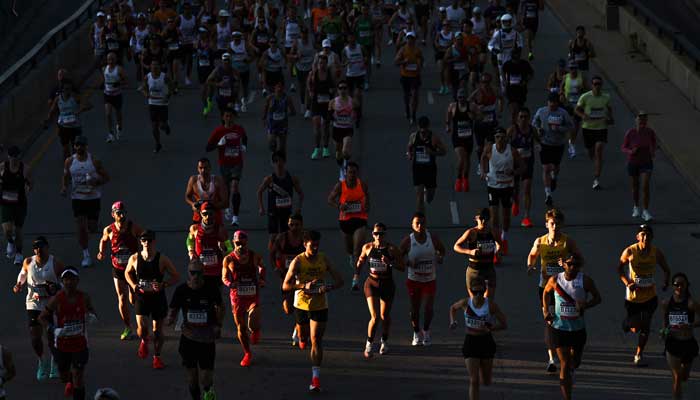
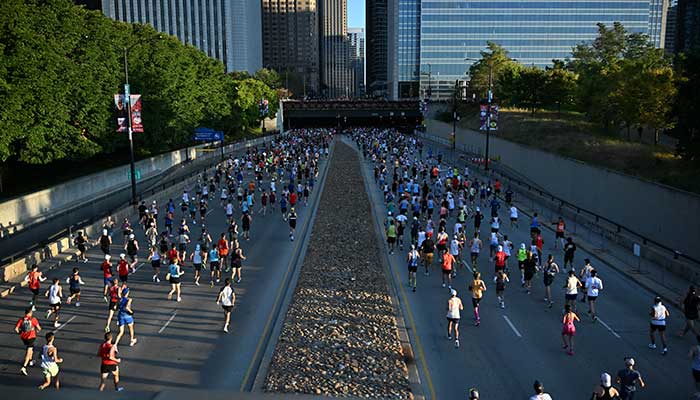
Around 1.1 million people finish a marathon every year, but as the planet warms, the chances of running in optimal weather are rapidly diminishing even for races in traditionally cool climates.
Veteran marathoners and record holders are already seeing the changes firsthand.
“Climate change has altered the marathon,” said Catherine Ndereba, former marathon world record holder and two-time world champion. “Dehydration is a real risk, and simple miscalculations can end a race before it begins. Every step now carries a message that if we don’t take care of our planet, even our strongest strides will fall short”.
Mhairi Maclennan, the fastest British finisher at the 2024 London Marathon, said ideal race conditions are “slipping away”.
“At the elite level, conditions make or break a performance,” she said. “We train day in, day out for years, only for that elusive target to drift further away as ideal temperatures become rarer”.
Kenyan legend Ibrahim Kipkemboi Hussein, the first Kenyan to win both the New York City (1987) and Boston (1988) marathons, described how races have changed with the warming climate.
“The climate is part of the course now,” Hussein said. “Dehydration and exhaustion come faster; a small mistake in pacing or hydration can cost everything. If we don’t protect the planet, the records of the future and the joy of running itself are at risk”.
For Climate Central, the message is clear: marathoners and their races are on the front lines of a warming world.
While earlier starts and logistical adaptations may buy time, the only sustainable path to preserving record-breaking conditions is to curb global emissions and stabilise the planet’s temperature rise.
“The cool, comfortable race-day conditions that make history are running out,” the report warns. “If we fail to act, the world’s great marathons and the runners who define them will be racing against more than the clock”.
