


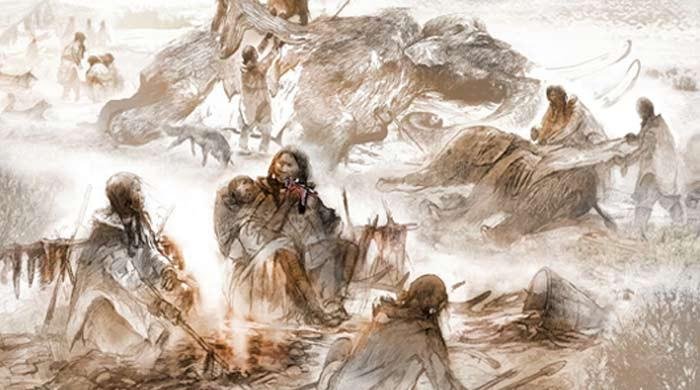
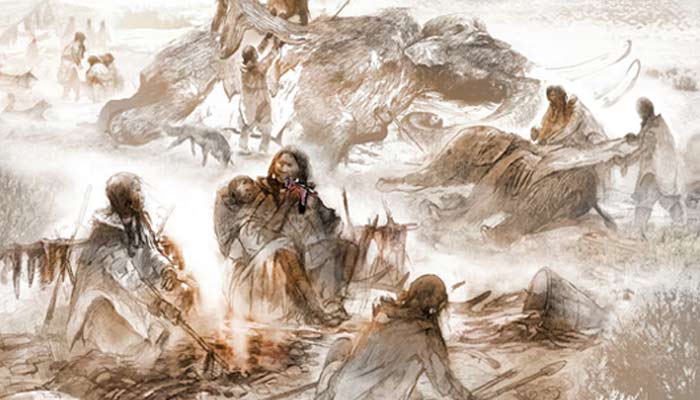
The first humans who spread across North America during the last Ice Age put mammoths at the top of their menu, according to scientists who secured the first direct evidence of the diet of these ancient people.
The researchers deciphered the diet of a woman who lived roughly 12,800 years ago based on chemical clues in the bones of her son, whose remains were found in southern Montana. Because the 18-month-old was still nursing at the time of death, his bones bore the chemical fingerprints of his mother’s diet, passed along through her milk.
They discovered that her diet was mostly meat from megafauna — the largest animals in an ecosystem — with an emphasis on mammoths. Megafauna made up about 96% of her diet, with mammoths comprising about 40%, followed by elk, bison, camels and horses, and a negligible contribution from small mammals and plants.
“Megafauna, particularly the immense Columbian mammoths, provided huge packages of meat and energy-rich fat. One animal could sustain a dependent community of children, care-giving women, and the less mobile elders for days or even weeks while the hunters sought their next kill,” said archeologist James Chatters of Bothell, Washington-based archeological consultancy Applied Paleoscience, co-lead author of the study published on Wednesday in the journal Science Advances.
Columbian mammoths, cousins of today’s elephants, stood up to about 13 feet (4 metres) tall at the shoulder and weighed as much as 11 tonnes.
The mother and child were part of the Clovis culture dating to around 13,000 years ago. These highly mobile and nomadic people are associated with artifacts including large stone spear points suitable for killing massive prey, big stone knives and scraping tools for removing flesh.
The findings buttress the idea that Clovis people, whose forerunners crossed a land bridge from Siberia to Alaska, focused on hunting the largest prey on the landscape instead of foraging for plants and hunting small animals.
This strategy appears to have enabled these people to expand rapidly throughout North America and then into South America — in just a few centuries — as they followed the migrations of prey over vast distances.
“These results also help us understand megafaunal extinctions at the end of the last Ice Age, indicating humans may have played a more important role than is sometimes thought,” said University of Alaska Fairbanks archeologist and study co-lead author Ben Potter.
Clovis people inhabited North America during the twilight of the Ice Age, when a warming climate was reducing habitats for mammoths and other large plant-eaters. These animals were familiar with predators like saber-toothed and scimitar-toothed cats, but had never before encountered human hunters.
“Clovis people were highly sophisticated hunters, with skills refined over more than 10,000 years hunting megafauna in the steppes that stretched from eastern Europe to the Yukon.
Arriving in North America south of glacial ice, they met naive prey under ecological stress. Emphasising megafauna in their diet, these new arrivals added to that stress, increasing the probability for extinction,” said Chatters.
Pieces of skull and other bones from the child, informally called Anzick Boy, were discovered in 1968 in an ancient collapsed rockshelter on a ranch near Wilsall, Montana.
A method called stable isotope analysis was employed to determine the protein portion of his mother’s diet, tracking various forms — isotopes — of the elements carbon and nitrogen, differing only in the number of neutrons in their nuclei.
“We are all made of elements, like carbon and nitrogen, and so is our food,” said isotope paleoecologist and study co-author Mat Wooller, director of the Alaska Stable Isotope facility at University of Alaska Fairbanks.
The mix of isotopes of these elements can provide a chemical signature of a particular food — beef or peas, for instance — that is incorporated into the tissues of the consumer’s body. The researchers estimated the boy’s diet at two-thirds from nursing and one-third from solid food.
They compared the mother’s diet, as revealed by the analysis, to various omnivores and carnivores from the same period, including big cats, bears and wolves. Her diet resembled that of Homotherium, a now-extinct scimitar-toothed cat that hunted mammoths.
The study’s conclusions fit with previous archeological findings.
“We have long known from indirect evidence that Clovis artifacts tend to be associated most often with the bones of megafauna and that those artifacts emphasised kill and processing of large prey,” said Chatters.
