


As the COP30 approaches amid darkening geopolitical clouds — marked by rising rightwing extremism, corporate backtracking, and rising militarism — Ali T Sheikh, Pakistan’s leading expert on sustainable development and climate change, views the world’s largest diplomatic gathering with a mix of apprehension and caution.
Against this complex backdrop, understanding how COPs function — and who gets a seat at the table — becomes even more critical.
COPs (Conferences of the Parties) are decision-making bodies of international agreements, where UN agencies, intergovernmental, and non-governmental organisations participate as accredited observers. The private sector often joins government delegations but holds no official observer status.
In this fragile context, rising global military expenditure adds yet another layer of uncertainty to already strained climate finance commitments.
This increase in military expenditure, said Sheikh, will have far-reaching consequences. In July this year, the NATO countries agreed to increase their defence expenditure by 5% of their gross domestic product. “The axe will fall on climate finance,” feared Sheikh. “It will bring the world upside down and undo 30 years of climate cooperation since the first COP.”
After three consecutive years of oil-producing autocratic states hosting the event, it will be a notable shift to hold climate discussions in Brazil, a country where indigenous rights, forest and biodiversity conservation are traditionally stronger. “Pakistan has much to learn,” said Sheikh, a fiercely independent voice, despite serving on several present and past government task forces on climate change.
But President Donald Trump’s recent 56-minute speech at the United Nations General Assembly on September 23, where he called climate change the “greatest con job ever,” renewable energy a “joke” and “too expensive,” and carbon footprint a “hoax made up by people with evil intentions,” has only worsened matters for countries like Pakistan, which ranks first among the top ten countries on GermanWatch’s Climate Risk Index 2025 mainly because of “exceptionally high relative economic losses.”
“From the perspective of a developing country like Pakistan, statements that dismiss climate change as a ‘con job’ are not just politically charged — they are a profound denial of the lived reality of the people,” said Sheikh
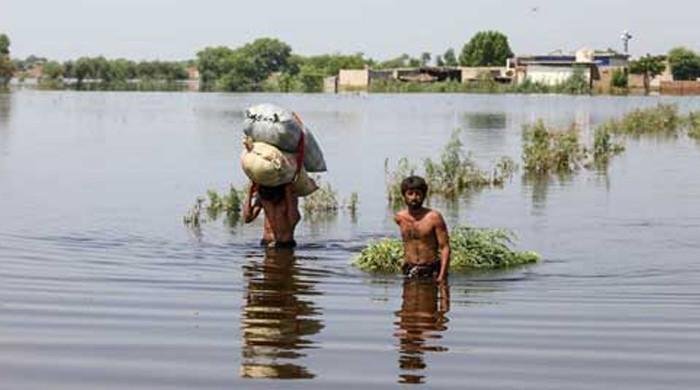
“We are already on the frontline, experiencing its devastating impacts. The catastrophic floods of 2022 and 2025 that submerged one-third of our country and displaced millions are a stark reminder that climate change is not a future threat — it is an immediate and existential one.”
The economic and human cost, he added, is immense. The 2022 flood caused over $30 billion in damages and “set Pakistan back by years.”
Commenting on Trump’s dismissal of green energy, Sheikh said that demonising green energy is to fundamentally misunderstand the situation for countries like Pakistan.
“For us, a transition to cleaner energy and greater climate resilience is not a political choice — it is a matter of national survival and economic stability,” he explained. “It is about protecting our agricultural backbone, which feeds millions from unpredictable monsoon seasons and droughts. It is about safeguarding our urban centres and rural communities from floods and heatwaves.”
While strongly criticising Trump’s remarks, Sheikh stressed that Pakistan’s response must move beyond protest and toward forward-looking engagement.
He said, when Pakistan goes to Brazil, it should not go there “to ask, instead offer a partnership.”
“We have a lot to offer and several successful projects to showcase, one of them being the Sindh province’s housing project for the flood-affected. Even in the current floods, we were able to evacuate over 3 million people, not a mean feat.”
At the same time, he emphasised that Pakistan must clearly articulate its priorities to secure timely support from the global platform. Among them should be improved construction standards for resilient housing and infrastructure — leveraging AI.
Alongside setting clear priorities, he also urged the official delegation to adopt a more strategic approach.
“Our pavilions at COPs are often set up in a way that we end up speaking only to ourselves,” he noted. “Instead, look for opportunities to present Pakistan’s case at other countries’ or organisations’ pavilions—where the audiences are broader, more diverse, and more influential.”
He also noted that Brazil’s hosting of COP30 presented a valuable opportunity to advance regional climate cooperation — something Pakistan should actively pursue.
“All of Pakistan’s climate challenges are regional, whether it’s heatwaves, glacial lake outburst floods in the Himalayas, cloudbursts, or tropical storms in the Arabian Sea,” he said, adding that India and Pakistan must find a way to talk. “Even a modest conversation between the two neighbours could mark a critical first step.”
Referring to the Indus Waters Treaty, which India has held in abeyance since the Pahalgam attack in Indian Illegally Occupied Jammu and Kashmir this April, he said the shrinking space for bilateral dialogue demanded finding alternative diplomatic pathways.
In this context, an international platform like COP could serve as a neutral space to initiate cooperation on transboundary water management — beginning, at the very least, with the timely and transparent exchange of monsoon rainfall data.
Shifting from diplomacy to the broader challenge of climate finance, he emphasized the need for a change in perspective.
“Rather than viewing climate investment as a burden,” he said to him, it was an “essential investment in the future, especially for countries like mine, which are striving to implement adaptation and mitigation strategies despite their limited resources”.
But the absence of major players like the US in this COP raises questions about global commitment. “It [US] wasn’t there in Azerbaijan either,” Sheikh added, referring to COP29. “That didn’t stop it from influencing and affecting negotiations behind the scenes — through its alliances and financial commitments.
The largest tropical forest in the world, which stores vast amounts of planet-warming greenhouse gases, gives the COP “a chance to redeem its past glory,” he said. At the same time, he acknowledged the growing criticism that such events have increasingly become “all about empty promises and inaction,” with the last three conferences even accused of being tainted by oil money.
But when 50,000 or so visitors (including 150 heads of state) arrive at the gateway to the Amazon River, between November 10-21, instead of the rainforest, they will be greeted with an impoverished, crime-riddled port city of 2.5 million, where most live in informal settlements.
“It may lead to diverting the global conversation not on criticizing the deniers but, instead, on a crisis of justice for the nations most impacted by a problem they did not create,” hoped Sheikh.
Admitting that there was a need to “shake things up a bit” and inject more energy, Sheikh pointed out that COP30 faced a much higher bar.
Countries will be submitting their updated nationally determined contributions to reduce emissions, while developing nations will expect stronger action on adaptation, loss and damage, and mitigation and access to climate finance — issues that are most difficult to negotiate. Being held in Belem, people are expecting Brazil to show leadership on issues like deforestation, biodiversity, indigenous rights, and climate justice.
Yet, delivering on these expectations may prove challenging.
With deforestation and new oil drilling happening in the country, it may be difficult for Brazil to meet that high bar. Along with geopolitical tensions, Sheikh said the finance architecture continues to remain a bottleneck. “We still have to sort out who pays, who delivers, and how quickly.”
Even so, dismissing COPs as ineffective would be short-sighted.
“To say that nothing ever happens and it’s a waste of everyone’s time is a simplistic view,” says Sheikh, who has attended numerous COPs—both officially as part of Pakistan’s delegation and independently—“starting the day without breakfast, speaking or rushing to attend countless events, going from one hall to the other, standing in long queues for coffee and returning to the hotel exhausted and hungry.”
While all eyes will be focused on the host country’s role in leading negotiations, building consensus and securing climate finance commitments, Sheikh said much of the real action happens outside the plenary halls.
He was referring to the behind-the-scenes deal-making between sessions, informal pledges, the role of private sector actors and how like-minded nations and interest groups quietly build coalitions.
According to Sheikh, this off-stage diplomacy is often more dynamic and arguably more consequential than what unfolds on the official record—and far more compelling to observe from the gallery.
Zofeen Ebrahim is an independent journalist. She posts on X @zofeen28
This article was originally published in the Inter Press Service news agency’s UN Bureau. It has been reproduced on Geo.tv with permission.
