 Pakistan · World · Independent Digital Newsroom
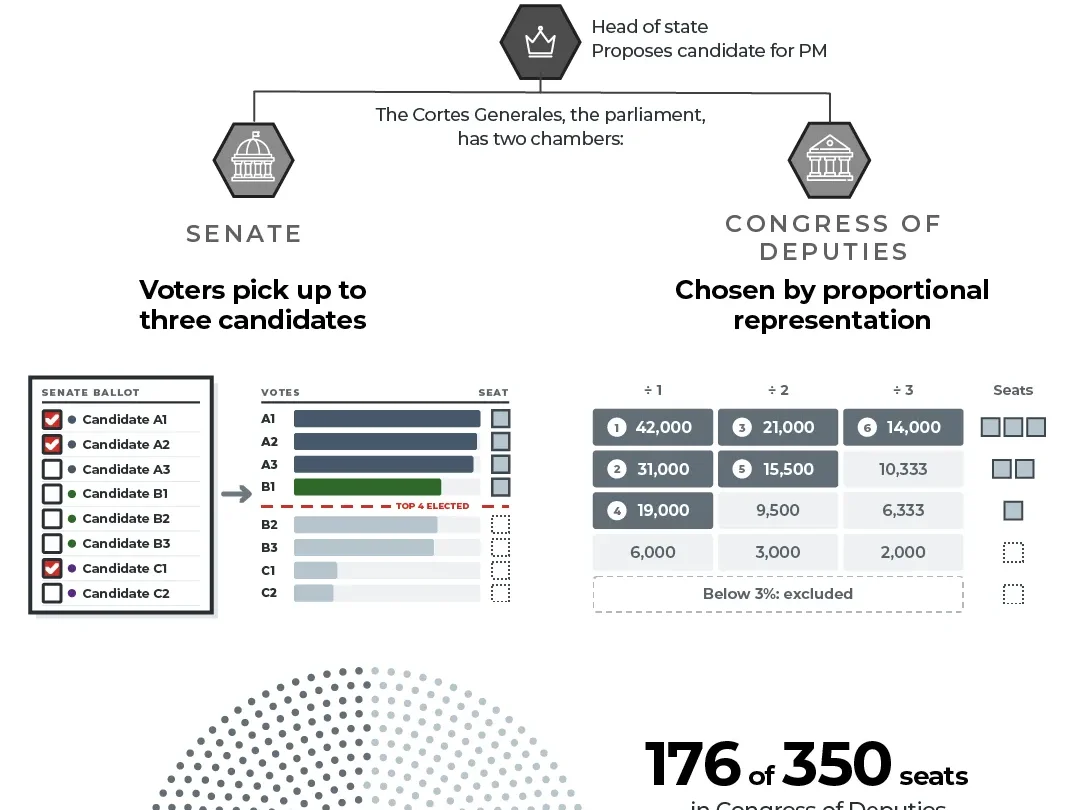
Voters will also elect 208 members of the Senate.About 38.7 million people aged 18 and above are eligible to vote, according to Spain’s National Statistics Institute (INE).Polling stations across Spain will be open on November 29 at 9am local time (08:00 GMT) and close at 8pm (19:00 GMT).Spain is a parliamentary monarchy.
King Felipe VI is head of state, while the government is led by a prime minister who answers to the Cortes Generales, a parliament made up of two houses: the Congress of Deputies and the Senate.The 350 members of the lower house, the Congress of Deputies, are elected in 52 constituencies by proportional representation.
Rather than choosing individual candidates, voters pick a party, and each party puts forward a ranked list of candidates in every constituency.Every province is guaranteed at least two seats and the autonomous cities of Ceuta and Melilla in North Africa get one each.
The rest are distributed by population, which is why Madrid and Barcelona elect far more deputies than smaller provinces.Within each constituency, seats are divided according to each party’s share of the vote and go to the candidates at the top of each list.
A party needs at least 3 percent of the vote in a constituency to qualify for any seats there.A party needs 176 of the 350 seats for a majority.
If no party reaches that number, parties must form coalitions or strike deals to govern.
After consulting party leaders, the king proposes a candidate for prime minister, who must then win an investiture vote in Congress.Most members of the upper house, the Senate, are elected directly, with voters choosing individual candidates by name.
In most provinces, each voter can back up to three candidates and the four with the most votes are elected.
The remaining senators are appointed by Spain’s regional parliaments.Provisional results from the Interior Ministry will start coming in straight away, with the overall picture clear before midnight on Sunday.In 2023, about 99 percent of votes had been counted by 11:45pm.Prime Minister Pedro Sanchez leads a minority coalition government made up of the Spanish Socialist Workers’ Party (PSOE) and the left-wing Sumar alliance.
The 22-member cabinet comprises Sanchez, three deputy prime ministers and 18 other ministers.The three deputy prime ministers each oversee a major policy area: Carlos Cuerpo oversees the economy, Yolanda Diaz labour and the social economy and Sara Aagesen the ecological transition.
Cuerpo is also acting transport minister after Oscar Puente resigned after last month’s train crash that killed 69 people.Thirteen cabinet members belong to the PSOE and five to Sumar, while four are independents appointed by the PSOE.According to a YouGov poll published on October 30 , the main issues according to the Spanish public are: Spaniards vote on November 29 in a snap general election.
Here is how the system works, the parties and the key issues.