


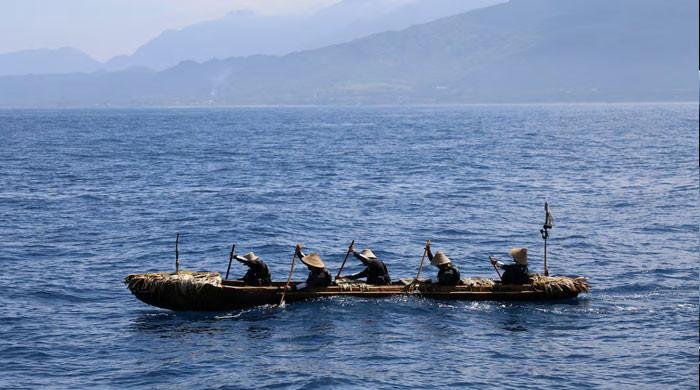
In a groundbreaking experiment to better understand the migration of early humans, a team of scientists has completed a voyage across the East China Sea in a hand-carved dugout canoe.
The journey, which retraced a possible prehistoric sea route from Taiwan to Japan’s Yonaguni Island, aimed to show how humans with only rudimentary tools and seafaring skills may have conquered vast ocean distances as far back as 30,000 years ago.
The researchers simulated methods Palaeolithic people would have used and employed replicas of tools from that prehistoric period, such as an axe and a cutting implement called an adze, in fashioning the 25-foot-long (7.5-metre) canoe, named Sugime, from a Japanese cedar tree chopped down at Japan’s Noto Peninsula.
A crew of four men and one woman paddled the canoe on a voyage lasting more than 45 hours, travelling roughly 140 miles (225 km) across the open sea and battling one of the world’s strongest ocean currents, the Kuroshio. The crew endured extreme fatigue and took a break for several hours while the canoe drifted at sea, but managed to complete a safe crossing to Yonaguni.
Just as prehistoric people would have, the voyagers navigated by the sun and stars, as well as the direction of the ocean swells, though for safety’s sake, they were accompanied by two escort craft. Yonaguni is part of the Ryukyu chain of islands stretching from Kyushu, the southernmost of Japan’s four main islands, down to Taiwan.
The researchers previously failed with attempted crossings using reed rafts and then bamboo rafts, finding that they were too slow, insufficiently durable and unable to overcome the strong ocean current.
“Through the project with many failures, we have learned the difficulties of crossing the ocean, and this experience gave us a deep respect for our Palaeolithic ancestors,” said University of Tokyo anthropologist Yousuke Kaifu, lead author of the study published on Wednesday in the journal Science Advances.
“We found that the Palaeolithic people could cross the sea with the strong ocean current if they had dugout canoes and were skilful, experienced paddlers and navigators. They had to face the risk of being swept by the strong ocean current and the possibility that they would never be able to come back to their homeland,” added Kaifu, who was aboard one of the escort boats.
Archaeological evidence indicates that people approximately 30,000 years ago first crossed from Taiwan to some of the Ryukyu islands, which include Okinawa. But scientists had puzzled over how they could do this with the rudimentary technology of the time – no maps, no metal tools and only primitive vessels. And the Kuroshio current, comparable in strength to the Gulf Stream off Mexico, presented a particular challenge.
The research was in the vein of the famous 1947 Kon-Tiki expedition in which Norwegian explorer Thor Heyerdahl carried out a much longer journey by raft from South America across the Pacific to the Polynesian islands. Heyerdahl aimed to show how prehistoric people from the Americas could have colonised Polynesia.
“His theory is now countered by a series of pieces of evidence, but it was a great trial at the time. Compared to the time of the Kon-Tiki, we have more archaeological and other evidence to build realistic models” of prehistoric voyages, Kaifu said.
The researchers in a companion study published in the same journal used simulations of sea conditions between Taiwan and Yonaguni 30,000 years ago to examine whether such a crossing was attainable at a time when the Kuroshio was even more powerful than today.
“As our palaeo-ocean model simulation showed, crossing the Kuroshio was possible in ancient times, so I believe they achieved it,” said physical oceanographer and study lead author Yu-Lin Chang of the Japan Agency for Marine-Earth Science and Technology.
“However, ocean conditions were highly variable. Thus, ancient people may have encountered unpredictable weather conditions during their journey, which could have led to failure,” Chang added.
