


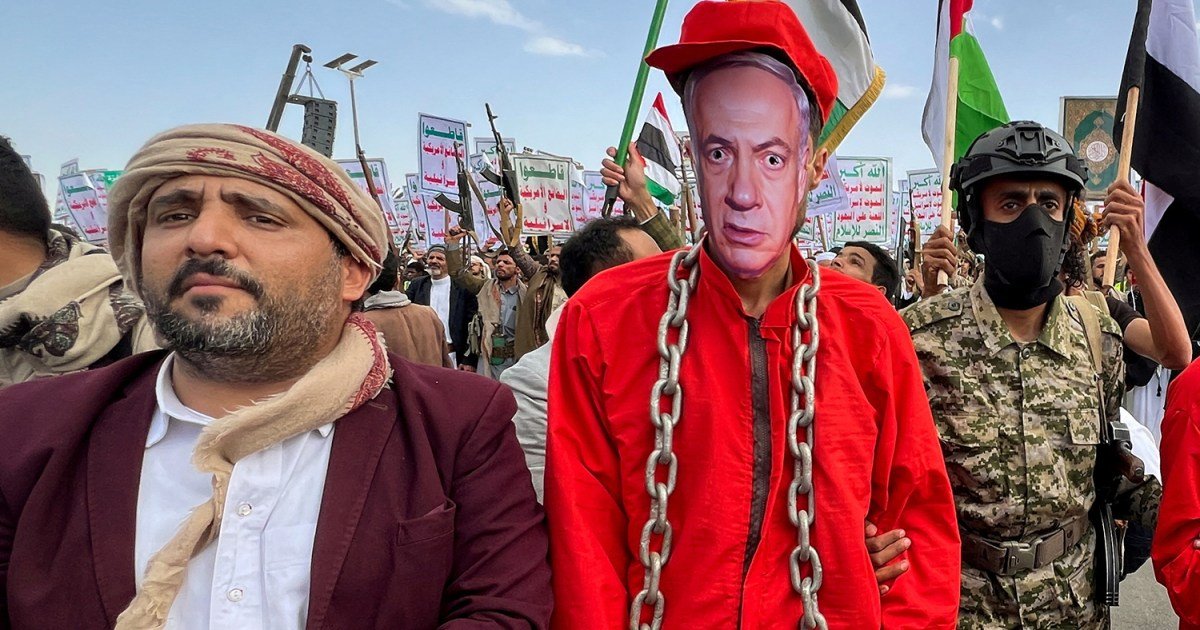
Amid ferocious Israeli attacks on Yemen, ostensibly in response to Houthi attacks on Israel, surprising news from the United States seemed to shake matters briefly.
US President Donald Trump said on Tuesday that a ceasefire had been agreed between his country and the Houthis, claiming the Houthis had bent the knee and this was a victory for the US.
He also praised the Houthis for their bravery and resilience.
This meant the US would no longer be bombing Yemen, and the Houthis would stop firing at ships in the Red Sea in support of the Palestinians in Gaza.
There was no mention of Israel in Trump’s announcement – a sign, to many, of a possible chill between Trump and Israeli Prime Minister Benjamin Netanyahu.
The Houthis, for their part, made it clear that the deal does not extend to Israel and they would continue their attacks until Israel allowed aid into Gaza, ending the starvation it is imposing on the people there.
Israel left out?
Israel has been launching attacks on Yemen, claiming it wants to deter the Houthis, who took control of Sanaa in 2014 and already fought a years-long war against the internationally recognised Yemeni government.
Israel’s most recent attack, on Sunday, bore an eerie resemblance to how it has operated when bombing the trapped population of Gaza, issuing “warnings” to people in three Yemeni ports in Hodeidah governorate to flee, with less than an hour’s notice.
Whether this escalation is a reaction to the announced US ceasefire remains to be seen, but many analysts have spoken of a widening rift between Netanyahu and Trump.
Netanyahu has reportedly expressed his frustration with Trump’s Middle East policy in private conversations.
He has been publicly against the US administration’s talks with Iran, claiming there is no diplomatic way to resolve differences with Tehran, yet Iran and the US have continued their talks.
He went on to blame Iran for the Houthis’ attacks, claiming Israel’s attacks are a message to the “Houthis’ sponsors”.
Trump, for his part, has seemed unconcerned.
“It’s worth noting Trump didn’t say anything about [Houthi] attacks on Israel, which seem to be continuing amid this escalation,” Nicholas Brumfield, a Yemen analyst, told Al Jazeera.
“In [this] case, it’s a US drawdown because the Houthis haven’t been attacking international shipping,” Brumfield said. “They’ve been attacking Israel. The US has been doing its thing, and the Houthis have been targeting US ships.”
After Israeli attacks on Monday and Tuesday, which killed at least three people and wounded 35 others and damaged Hodeidah Port and Sanaa Airport, the Houthis promised retaliation.
The attacks “will not go unanswered”, the Houthi political bureau said in a statement.

That kind of statement is typical of the Houthis, who have managed to weather more than a decade of attacks by forces with far superior military capabilities.
Air strikes by the US and United Kingdom on Yemen in early 2024 were unable to stop the Houthis’ attacks on Red Sea traffic.
Years of air strikes by a Saudi-led coalition supporting Yemen’s internationally recognised government taught the Houthis to keep their military infrastructure agile, analysts told Al Jazeera.
A senior US government official, speaking on condition of anonymity, told Al Jazeera that recent US attacks on the Houthis have pushed leaders underground after the killing of some key military commanders.
However, unlike under US President Joe Biden’s administration, the attacks under Trump have been indiscriminate and have led to more civilian deaths. More than 250 people have been killed by US attacks on Yemen since mid-March, including at least 68 people at a centre housing detained African refugees and migrants in late April.
Experts told Al Jazeera that despite the increased ferocity of those attacks, the Houthis have not been deterred.
“The Houthis aren’t going to stop,” Brumfield said.
Israel still striking
The Houthis have made their stance clear vis-à-vis the agreement with the US and the continuation of attacks on Israel, which has also made clear that it plans to keep attacking.
“The stated aim is to deter [the Houthis] or deplete their military capabilities to the point that the Houthis cannot target Israel any more, but these are both very unrealistic goals,” Hannah Porter, an independent Yemen analyst, told Al Jazeera.
Israel already considers that it has diminished the capabilities of two of its biggest foes, Hezbollah in Lebanon and Hamas in Gaza, over the past 19 months.
But trying something like that on the Houthis would be a vastly different challenge, she said.
“Israel has probably not gathered the amount of intel on the Houthis that they have on Hamas or Hezbollah, so tracking and targeting leaders will be harder,” Porter said.
“More importantly, the geographic area is much larger in northern Yemen, meaning that there are far more potential targets.”
“The terrain is a factor, too,” she added. “Northern Yemen is very mountainous with plenty of places to hide people and weapons.”
For now, Israel and the Houthis seem intent on continuing their exchange of attacks. And the first to suffer will be the people of Yemen.
Israel struck numerous targets in recent days in Yemen, including Sanaa’s airport and the port in Hodeidah, which experts said is likely to exacerbate Yemen’s dire humanitarian situation.
Israel destroyed at least three civilian planes in the attacks.

Yemen is already suffering one of the world’s worst humanitarian crises. More than 18.2 million people require humanitarian assistance and protection services, according to the United Nations.
More than 17.1 million Yemenis suffer acute food shortages, and about five million are on the brink of famine.
While analysts said Israel’s attacks on ports will not be a “knockout blow”, they are among a matrix of factors that leave many Yemenis in an increasingly precarious position.
“The humanitarian situation will just get worse,” Raiman Al-Hamdani, a Yemen researcher with the international development company ARK, told Al Jazeera.
“Destroying the two main ports of northern Yemen, where the majority of the population lives, coupled with the FTO [“foreign terrorist organisation”] designation with cuts to the aid system around the world and the deteriorating economy … is a recipe for [unprecedented] humanitarian disaster.”
“[Israel’s attacks] are a continuation of its strategy. It’s out of spite, targets civil infrastructure and the policy of creating human suffering,” Al-Hamdani said.
Both sides seem unwilling to stop, however.
“I cannot see anything quite good coming out of this unless the war Israel is waging on Gaza comes to some form of truce,” Al-Hamdani said.
