


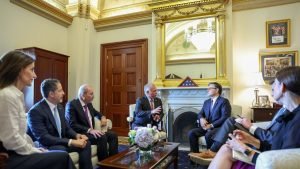
AMMAN, JORDAN — King Abdullah II’s visit to Washington, D.C., and Texas — his second trip to the United States in just three months — highlights Jordan’s vital role in Middle Eastern geopolitics and its enduring partnership with the U.S.
Strategically timed just days ahead of President Donald J. Trump’s forthcoming “Arabian Gulf” tour, from May 13 through 16, the trip underscores Jordan’s commitment to regional stability and its proactive efforts to strengthen economic and security ties with the U.S.

Although this visit focuses mainly on economic cooperation, the King’s previous trip remains vivid in public memory — especially when the U.S. media questioned him about the potential for Jordan to accept Gaza’s refugees.
His Majesty’s response: “I’ll do whatever is in the interest of my country.”
A ‘Calculated Diplomatic Outreach’
Now, as the third phase of Israel’s military operation in Gaza looms and the displacement of some Gazans begins — albeit hesitantly and voluntarily — the critical question persists:
At what point will Arab and Muslim leaders publicly say, “Providing a safe haven for our Gazan brethren — a collective obligation for Arab and Muslim nations — is in the interest of our countries”?
The King’s scheduled meeting with Secretary of State Marco Rubio reflects a calculated diplomatic outreach.
This is especially relevant given the outspoken criticism of Israel by Jordanian Foreign Minister Ayman Safadi — rhetoric that has reportedly irritated some U.S. lawmakers.
As the possibility of a final-stage Israeli military escalation in Gaza grows, and Washington’s pro-Israel stance remains firm, the contrast between King Abdullah’s pragmatism and Safadi’s bluntness may indicate a necessary and timely recalibration in Jordanian diplomacy.
Jordan Must Urgently Strengthen Its Economy
Another key objective of the King’s visit was to urgently strengthen economic cooperation with the United States.
Despite recent cuts in U.S. foreign aid globally, Jordan has secured assurances that its annual aid package of $1.45 billion will remain intact.
This includes $850 million in direct American budgetary support and significant military aid, demonstrating the U.S.’s recognition of Jordan’s strategic importance in the volatile region.
King Abdullah also met with bipartisan members of Congress — including current Speaker of the House Mike Johnson and former Speaker Nancy Pelosi — to express his gratitude for their continued support and to advocate for extending the current seven-year aid agreement, which is set to expire in two years.
These talks are crucial for sustaining Jordan’s economic reforms and security efforts, especially in light of rising instability in southern Syria and the haunting threat of a re-emergent ISIS.

Why Did the King Go to Texas?
The King’s itinerary also included meetings with business leaders and state officials to attract investment into Jordan.
In Texas, for example, he met with Governor Greg Abbott and key business figures to discuss potential ventures in energy, technology, and infrastructure.
These efforts aim to leverage Jordan’s strategic location and relative stability to spur economic growth and job creation — an urgent priority given recent internal developments, including the official ban on the Muslim Brotherhood.
The group’s pro-Hamas rhetoric has gained unprecedented popularity on Jordanian streets, making economic uplift vital for national solidarity and political stability.
In Texas, His Majesty “spoke about Jordan’s advantages as an investment destination, including low manufacturing costs, supportive legislation, a skilled labour force, and free trade agreements that allow products to reach a large number of global markets,” reported the official Petra News Agency.
“Texas is the eighth-largest economy in the world with a GDP of $2.7 trillion, and is a leader in many industries and exports.”
The King “highlighted promising opportunities for investment in a number of mega infrastructure projects, as well as healthcare, tourism, and education projects.”
One meeting “included representatives from Chevron Phillips Chemical, Eco Power Crypto, Cirrus Logic, Exela Technologies, Advanced Micro Devices, Texas Venture Alliance, Arbisoft, Hillwood – a Perot Company, Big Sky Medical, Hylio, Bell Flight, Saronic Technologies, Wheatly Consulting, and Raytheon Technologies,” Petra reported.
What Was the King’s Message?
In Washington, “King Abdullah called for an immediate ceasefire and the resumption of aid to the [Gaza] Strip,” the Jordanian embassy in Washington said on Tuesday.
King Abdullah continues to be one of the region’s most sound and trustworthy voices.
He advocates for a future rooted not in population transfers or political coercion, but in stability, investment, and principled diplomacy — even if that diplomacy, at times, must be shaped by realpolitik.
