


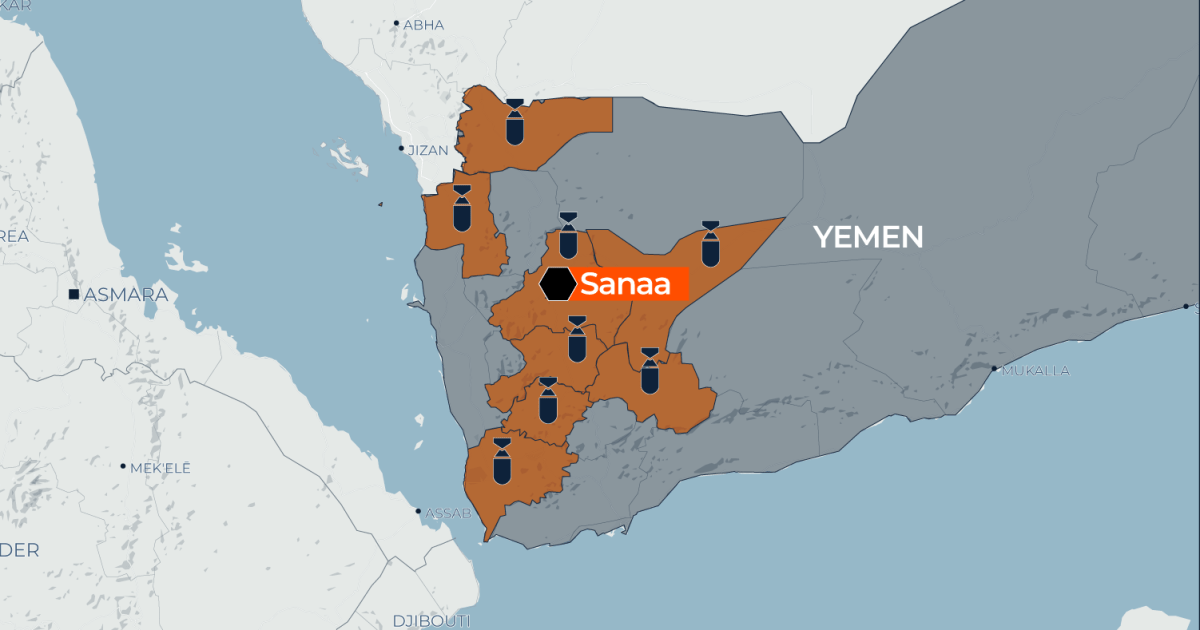
At least 40 US air raids in Yemen have killed at least 32 people and injured 101, most of them women and children.
United States air attacks on Yemen have killed at least 32 people and injured 101, most of them women and children. The strikes began on Saturday and extended into the early hours of Sunday.
US President Donald Trump ordered a series of large-scale attacks on Yemen’s Houthi rebels after the group threatened to resume strikes on Israeli-linked ships in the Red Sea in response to Israel’s ongoing blockade of Gaza.
There have been 40 raids reported so far, most of them targeting Saada province, north of the capital Sanaa.

According to Yemeni media, US forces launched attacks on the following locations:
- Saada – Some 12 raids were reported in Saada. One strike on a power station in the town of Dahyan caused a blackout, according to Al Masirah TV. Dahyan is known as a frequent meeting place for Abdel-Malik al-Houthi, the reclusive leader of the Houthis.
- Ibb governorate – The deadliest attack occurred in the district of Kahza in the Ibb governorate, where US warplanes targeted two residential buildings, killing at least 15 people, according to Houthi media.
- Sanaa – In the capital, at least eight raids were reported, including one that struck a residential area, killing at least 15 people and wounding nine others. “The explosions were violent and shook the neighbourhood like an earthquake,” said Abdullah Yahia, a resident of the Yemeni capital, speaking to Reuters.
- Al Bayda governorate also faced eight raids, while air strikes hit Al-Majzah in Marib, Ans in Dhamar, and the district of Main in the Hajjah governorate.
- Taiz – In Yemen’s southwest, strikes also targeted Houthi military sites in Taiz, according to two local witnesses.
Who are the Houthis?
The Houthis, also known as Ansar Allah (supporters of God), are a rebel group that controls most of Yemen, including the capital, Sanaa, and some of the western and northern areas close to Saudi Arabia.
The Houthis emerged in the 1990s but rose to prominence in 2014, when the group rebelled against Yemen’s government, causing it to step down and sparking a crippling humanitarian crisis.
The group then spent years, with Iran’s backing, fighting a military coalition led by Saudi Arabia. Analysts say the Shia group should not be seen as an Iranian proxy. It has its own base, its own interests – and its own ambitions.
The Houthis control the northwestern regions of Yemen, including the capital Sanaa, while the Yemeni government controls the south and east, with Aden acting as its temporary capital.

Why is the US attacking Yemen?
The attacks come after the Yemeni rebel group threatened to resume attacks on Israel-linked ships in the Red Sea over Israel’s total blockade of the Gaza Strip, which is now in its third week.
However, the Houthis have yet to attack any ships despite threatening to do so last week.
Since November 2023, the Houthis launched numerous attacks on ships off Yemen’s coast. The group claims these attacks are an act of solidarity with Palestinians amid Israel’s war on Gaza.
A Pentagon spokesperson reported that, since 2023, the Houthis have attacked US warships 174 times and commercial vessels 145 times.
The US Central Command, which oversees American operations in the Middle East, described Saturday’s strikes as the “beginning of a large-scale offensive across Yemen”. According to officials, the strikes were partially carried out by fighter jets from the Harry S Truman aircraft carrier stationed in the Red Sea.
During the previous administration of US President Joe Biden, the US and United Kingdom carried out several attacks on Houthi-controlled regions of Yemen, claiming they were targeting anti-ship missiles. Israel has also on several occasions attacked Yemen’s infrastructure, including Sanaa International Airport, seaports and power stations.

Why is the Red Sea important?
The Red Sea is a strategically vital maritime trade route, with 12 percent of global trade passing through its waters.
The Suez Canal and the Bab al-Mandeb Strait are crucial chokepoints for energy shipments from the Gulf, facilitating the transport of 12 percent of total seaborne-traded oil and 8 percent of the world’s liquefied natural gas (LNG) trade.
In 2023, the Bab al-Mandeb Strait alone handled 8.8 million barrels per day (bpd) of oil and 4.1 billion cubic feet per day (cf/d) of LNG, making it essential for global energy security and economic stability.
The main alternative to the Red Sea route is sailing around the Cape of Good Hope at the southern tip of Africa. This detour is significantly longer and costlier for global trade, especially for energy shipments from the Gulf to Europe and North America.

