


- Hyderabad ranked second among least resilient cities.
- Multan ranked third, Lahore fifth, Karachi eighth.
- India’s Ahmedabad topped least resilient cities list.
Five Pakistani cities rank among the world’s least resilient to climate risks, according to a new report, highlighting the country’s vulnerability to the impacts of climate change.
Hyderabad, Multan, Lahore, Faisalabad, and Karachi featured among the 10 least resilient cities to climate risk in a new assessment of 72 major cities worldwide.
The report, by geospatial analytics company AlphaGeo, analyses 72 of the world’s largest cities. It separates raw physical exposure from resilience-adjusted risk (RAJ) to reveal which cities are genuinely protected and which face a dangerous gap between their risk profile and their adaptive capacity.
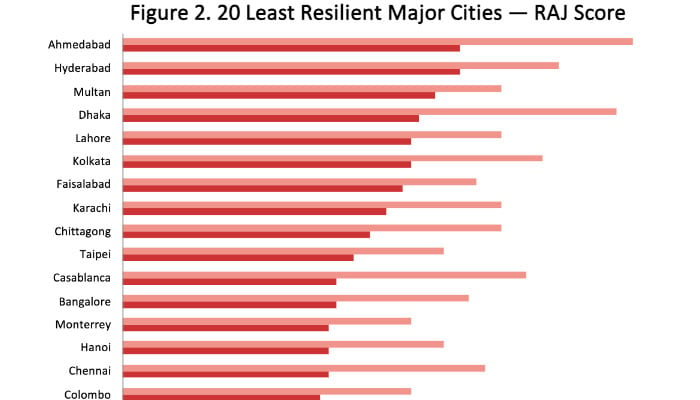
According to the ranking, Hyderabad ranked second least resilient, Multan third, Lahore fifth, Faisalabad seventh and Karachi eighth.
India’s Ahmedabad topped the list of cities deemed least resilient.
“The 6 highest-risk major cities globally are all in South Asia: Ahmedabad (41), Hyderabad, Pakistan (41), Multan (38), Dhaka (36), Kolkata (35), and Lahore (35), driven largely by heat exposure. These cities have adaptation rates that remain relatively low given the scale of physical risk,” said the report.
It further said that Dhaka is the most physically exposed city in this analysis. With a physical risk score of 60, it carries the highest raw exposure of any major city in this dataset and despite a meaningful adaptation delta of 24 points, the residual RAJ of 36 remains among the highest of any large city.
For real asset investors, a RAJ score at this level warrants close scrutiny of exposure to property value deterioration, infrastructure lifespan, and operational continuity.
Countries whose largest cities carry high RAJ scores without improving adaptation rates face growing contingent liabilities from disaster response, infrastructure repair, and population displacement, it added.
The report further said that Bangladesh and Pakistan warrant particular attention given the combination of high urban RAJ scores and limited capacity to close the adaptation gap at the pace the physical risk profile demands.
