


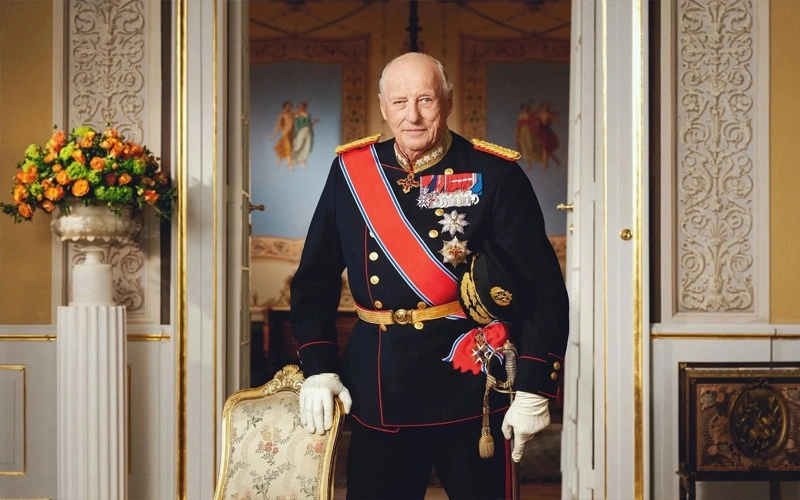
OSLO: Norway’s King Harald V, the country’s longest-serving monarch in modern times and a symbol of national unity, died Friday at 89 after a period of declining health.
The Royal Palace said Harald died peacefully at Oslo University Hospital at 6:35 a.m. local time. He had been hospitalized since Aug. 17 after a medical examination and was receiving treatment for hemolytic anemia, a condition in which red blood cells are destroyed faster than the body can replace them. He later developed a bacterial infection in his bloodstream.
The palace announced Thursday that his condition had become “extremely serious,” prompting members of his family to rush to his bedside. Crown Prince Haakon, his only son, reportedly remained with him overnight.
The royal flag at the palace in Oslo was lowered to half-staff following the announcement as members of the public gathered outside to lay flowers and pay tribute to the king.
Harald ascended the throne on Jan. 17, 1991, following the death of his father, King Olav V. His reign lasted more than 35 years, making him one of Europe’s longest-serving monarchs and its oldest reigning king at the time of his death.
Under Norway’s constitutional system, Crown Prince Haakon, 53, immediately succeeds his father as king. The new monarch is expected to meet the government during an extraordinary Council of State at the Royal Palace, where his royal name will be announced. He will also be required to take an oath before Parliament. Norway does not hold coronation ceremonies.
A modern royal figure
Harald gradually established his own identity as monarch, moving beyond the shadow of his popular father and helping shape a more informal and inclusive image of the Norwegian monarchy.
Although the king’s constitutional role is largely ceremonial, Harald became an important national figure during moments of tragedy. After far-right extremist Anders Behring Breivik killed 77 people in Oslo and on the island of Utøya in 2011, Harald addressed the nation in a televised speech, saying that “freedom is stronger than fear.”
He was also known for visiting communities affected by floods, storms and other disasters, often choosing practical clothing over formal royal attire and speaking directly with residents.
Harald was outspoken about tolerance and diversity. In a 2016 speech, he said Norwegians could have different backgrounds, beliefs and sexual orientations, reflecting his broader effort to present the monarchy as part of a changing society.
Read More: King Harald V battling blood disorder and infection in Oslo Hospital
His approach to royal tradition was also evident in his 1968 marriage to Sonja Haraldsen, a commoner. The couple faced years of opposition before his father approved the marriage. Harald and Sonja remained together for more than five decades and became one of Norway’s most recognizable royal couples.
A childhood shaped by war
Born Feb. 21, 1937, Harald was the first Norwegian royal heir to be born in Norway in nearly 570 years.
His childhood was disrupted by World War II. When Nazi Germany invaded Norway in 1940, his grandfather, King Haakon VII, and father, then-Crown Prince Olav, fled to Britain, where they led the Norwegian government-in-exile.
Harald, then 3, left Norway with his mother, Crown Princess Märtha. The family initially went to Sweden before traveling to the United States, where Harald spent part of his childhood in the Washington area.
He met regularly with President Franklin D. Roosevelt, whom he later described as being like a grandfather to him.
After returning to Norway in 1945, Harald attended public schools, departing from the private education traditionally given to royal heirs. He later completed military training and studied social sciences, history and economics at Oxford University.
A king devoted to his duties
Harald’s later years were marked by recurring health problems. In 2024, he was hospitalized with an infection while vacationing in Malaysia and received a temporary pacemaker there. He was later flown back to Norway by the Norwegian armed forces and eventually received a permanent pacemaker.
Despite his health issues, Harald repeatedly rejected calls to abdicate. In 2024, he said he intended to remain king for life, citing the oath he had taken before Parliament.
The monarchy itself faced fluctuating public support during his final year. A Norstat poll published by Norwegian public broadcaster NRK put support for the institution at 60% in February 2026, down from 70% the previous month. Support rose to 64% in May.
Harald personally remained highly popular. In the February poll, he received a 9.2 rating out of 10 for representing the Norwegian royal family.
A royal family under pressure
Harald’s death comes at a challenging time for the Norwegian royal family.
Crown Princess Mette-Marit, Haakon’s wife, has faced scrutiny over her past friendship with convicted sex offender Jeffrey Epstein, a relationship for which she has apologized.
Her son, Marius Borg Høiby, was convicted in June of two counts of rape and one count of domestic violence and sentenced to four years in prison. Both Høiby and prosecutors have appealed the sentence.
The palace also announced that Mette-Marit had undergone a successful lung transplant. She later returned home and celebrated her silver wedding anniversary with Haakon in August.
Despite the controversies, Harald remained a respected figure and was often seen as the royal family member who best represented the institution.
A life beyond the throne
Outside his official duties, Harald was an accomplished sailor and sports enthusiast. He competed in several Olympic Games and captained Norway’s boat to a world championship title.
He also shared his father’s interest in automobiles and was known to drive himself to informal events.
Environmental conservation was another longstanding interest. At age 76, Harald traveled deep into Brazil’s Amazon rainforest, where he spent four days with the Yanomami people and slept in a hammock, fulfilling a lifelong ambition.
Harald was also a great-great-grandchild of Britain’s Queen Victoria, linking him to several European royal families. Yet his reign was defined less by royal tradition than by his effort to make the monarchy approachable and relevant to modern Norway.
For many Norwegians, his most enduring legacy will be the role he played during moments of national grief and celebration. He offered continuity while gradually adapting the monarchy to a more open and egalitarian society.
With his death, Norway enters a new royal era under Haakon, who becomes the country’s fourth king since it gained independence from Sweden in 1905.
