


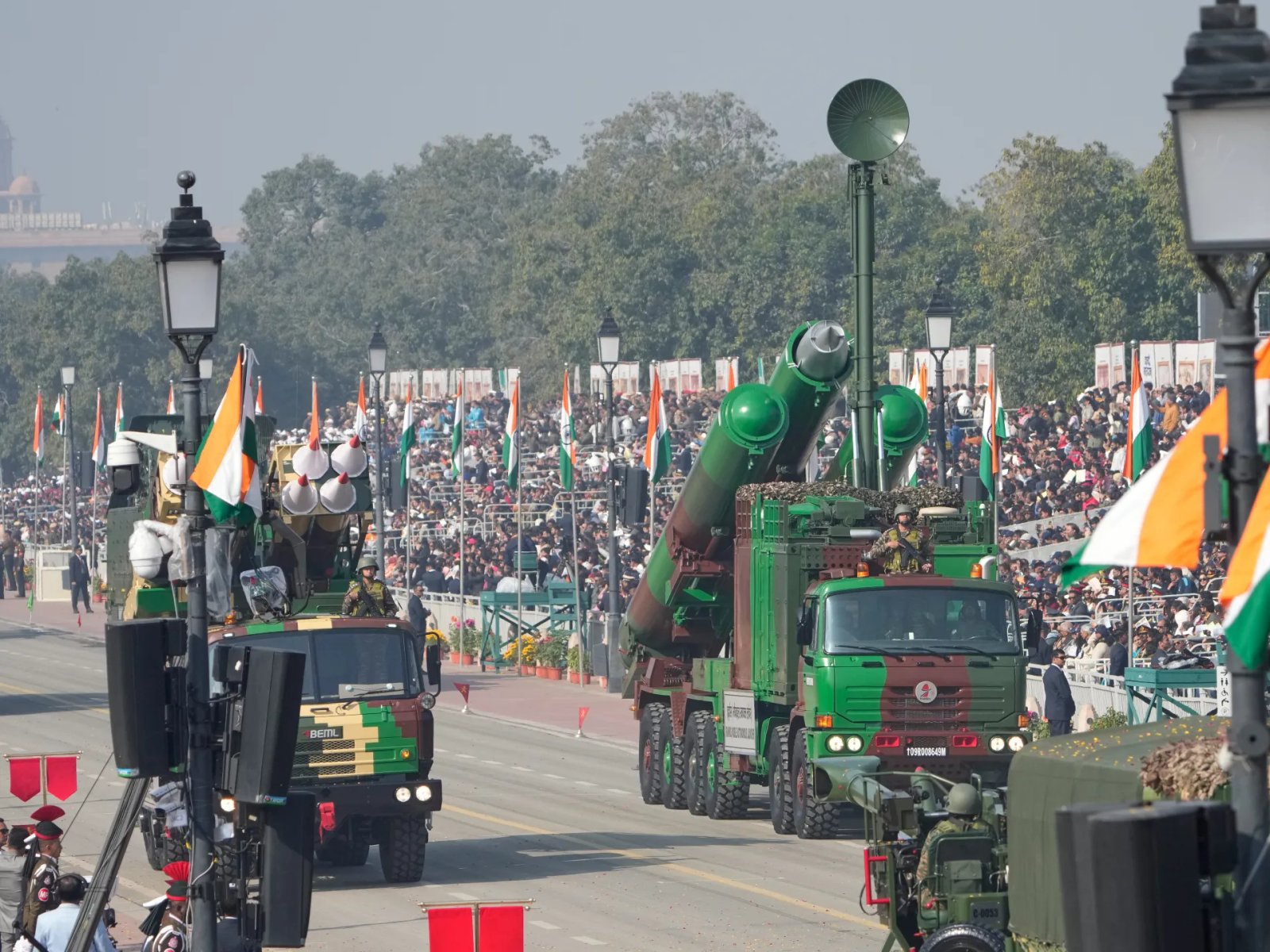
India has taken a major step towards opening one of its most sensitive areas of defence production to private companies.
Defence Minister Rajnath Singh approved the transfer of technologies developed by the state-run Defence Research and Development Organisation (DRDO) for all conventional missile systems to Indian industry for domestic production, the country’s Ministry of Defence said on Tuesday.
Recommended Stories
list of 3 itemsend of list
The move marks a significant shift for the sector dominated by government-run firms and research laboratories. Private companies will be able to compete for the technology and production rights, subject to technical qualifications, certifications and other regulatory requirements, the ministry said.
The Narendra Modi-led government says the aim is to move missiles from development into mass production faster, increase domestic manufacturing and reduce India’s dependence on imports.
So, does India’s private defence industry have the capacity to manufacture sophisticated missile systems at the scale and reliability the military needs, is the country moving towards developing its own military-industrial complex, and are there security risks involved?
What did the government announce?
India’s Defence Ministry said Singh had approved the transfer of DRDO-developed technology for all conventional missile systems to Indian defence companies for production inside the country.
“The objective is to enhance domestic manufacturing capabilities, strengthen the defence industrial base, and create opportunities for the participation of Indian MSMEs (micro, small and medium-sized enterprises) and other technology partners in the supply chain,” the ministry said in a statement.
The measure would enable the “successful transition of missile system development to industrial production” and create opportunities for MSMEs and other technology partners, the ministry added.
“DRDO remains committed to working closely with Indian industry to facilitate the transfer and absorption of advanced defence technologies and to further strengthen the country’s indigenous defence capabilities.”
The announcement spans a wide range of missiles, said Aditya Ramanathan, a research fellow with the Bengaluru-based Takshashila Institution.
“It will include surface-to-air missiles, air-to-air missiles, anti-radiation missiles, antitank systems, and so on. It will also include more heavy-duty hardware like land-attack cruise missiles,” he told Al Jazeera.

Why is India doing this?
India has traditionally relied heavily on state-owned defence companies to turn weapons developed by DRDO into large-scale production. Bharat Dynamics, one such state-owned company, has long held a monopoly in missile production.
Tuesday’s announcement is a “big change” because it ends that monopoly, said Ramanathan.
“Private companies have been making missile components for years, but what this decision does is allow them to move up the value chain and become prime integrators for these systems,” he said.
While India largely relies on domestically made missiles, it also imports missiles — especially from Russia and Israel, two key weapons suppliers to the country.
But under Modi, India has attempted to both encourage self-reliance in defence — a concept that the government calls Atmanirbhar Bharat or self-reliant India — and prod foreign defence majors to manufacture in India.
At a time when geopolitical allegiances are changing fast, and India faces uncertainties on both major borders — with rivals Pakistan and China — the country under Modi has more than doubled its defence budget, from $38bn in 2014 to $86bn in the current financial year.
The brief four-day conflict with nuclear-armed rival and neighbour Pakistan last year has injected fresh urgency into India’s defence preparedness plans. This year’s defence budget is 16 percent higher than the previous year’s.
Other geopolitical events have forced the government’s hand too, suggested Ramanathan.
“I don’t think this move would have happened as soon as it did if not for the experience of recent wars. Indian decision-makers have been looking at Ukraine, they’ve been looking at the US war with Iran, and of course they’ve been imbibing the lessons of operations from last year,” he said.
“One reason you’re going to need large stockpiles is that, as we’ve seen recently, you’re going to burn through your inventory pretty quickly. The other reason is that your adversary could also degrade your stockpiles using their own precision-strike systems.”
China, he said, was a major factor in India’s calculations.
“India believes that to deter China, which is its most capable adversary, it will need to demonstrate that it can both inflict and absorb really punishing attrition over weeks of gruelling warfare,” Ramanathan said.
To that end, India is also creating a tri-services conventional missile force. “To be a viable and effective force, it’s going to require serious magazine depth, and this cannot be achieved without the active involvement of the private sector,” he added.
What is India’s defence industry already manufacturing?
In June, India announced that it was preparing to spend more than $2bn on military drones from domestic manufacturers, reflecting the rapid expansion of the country’s private defence industry.
More than 600 companies were involved in India’s drone industry, including major groups such as Adani, Larsen & Toubro, and Tata Advanced Systems, as well as startups.
In July, India also approved the purchase of a range of military equipment for its defence forces worth $5.46bn, including missiles, electronic warfare systems and Kamikaze drones.
India is also pushing to rapidly modernise its navy with an eye on Beijing’s growing influence in key Indian Ocean shipping lanes. In December, New Delhi announced plans to procure at least 75 ships and submarines, with most expected to be constructed domestically.
At the same time, India is trying to diversify the foreign sources of its weapons. Over the past decade, New Delhi has worked to move away from its longstanding reliance on Russia for military hardware, expanding defence ties with countries such as the United States, France and — increasingly — Israel.
Does the private sector have the capacity to build missiles?
Private arms manufacturers in India have been increasing spending on bolstering military production in the past few years.
Major conglomerates have invested heavily in ammunition, drones, aerospace and military electronics. Of late, they have started to invest in facilities that aim to manufacture missiles.
Adani Defence & Aerospace, owned by business tycoon Gautam Adani, a close associate of Indian Prime Minister Modi, announced plans in 2024 to invest more than 30 billion rupees ($315m) in ammunition and missile manufacturing facilities in Uttar Pradesh.
The facilities would include capabilities for handling explosives used in missiles and precision munitions.
But commitments and intent don’t build missiles.
“Ultimately, I think the success or failure of this move will depend on how the Indian government places orders,” Ramanathan said. “Making missiles is an incredibly complex and costly affair, and companies are going to have to invest a lot in infrastructure, technology and people. These sorts of investments will only pay off if the government places large enough orders to justify them and also, hopefully, leave these companies with some profits that they can pour back into research and development.”

What missiles does India have?
India has a range of cruise and ballistic missiles, several of which are also capable of carrying nuclear warheads.
In May, on the anniversary of the 2025 war with Pakistan, India successfully test-fired the Agni-V, its most advanced nuclear-capable intercontinental ballistic missile that can reach a distance of 5,500km (3,418 miles) — a range that covers all of China, the Middle East and even parts of Europe.
Its other ballistic missiles have ranges from as little as the Prithvi-1 (150km or 93 miles) to the Agni-IV (4,000km or 2,485 miles), again covering everything from border skirmishes with Pakistan to India’s extended neighbourhood.
It also has powerful cruise missiles, like the BrahMos, co-developed with Russia, which has a range of up to 500km (311 miles), and was used in last year’s war with Pakistan.
Is India also exporting missiles and other weapons?
India has dramatically ramped up its military exports in recent years, from just $72m in 2014-15 — when Modi came to power — to $4bn in 2025-2016.
Paras Defence, one of India’s fast-growing defence manufacturers, said this month it expects its exports to more than double in the 2026–27 financial year, up to $14m, driven partly by increased demand linked to conflicts in the Middle East.
Indian arms makers have also been involved in joint ventures with companies abroad. Adani Defence, in partnership with Elbit Systems – Israel’s largest weapons manufacturer – produces the large Hermes 900 armed drone systems.
A 2024 investigation by Al Jazeera exposed how India was exporting rocket parts and ammunition to Israel, even as the Modi government was publicly calling for diplomacy to end the war on Gaza.
In June 2026, Amnesty International said in a report that India’s weapons exports to Israel made it complicit in the genocide in Gaza.
But it isn’t just Israel that has sought and received weapons from Indian manufacturers. Nor is it just bullets and weapons parts that India is exporting today — complete missiles are in demand, too.
In 2022, the Philippines bought three batteries of the BrahMos missiles from India. Since then, Vietnam and Indonesia have signed deals with India for the purchase of these missiles. And India has submitted a proposal to the United Arab Emirates offering to supply the Gulf country these missiles, too.
Is the latest move a step towards building a military-industrial complex?
That appears to be the intention.
While Tuesday’s announcement marks the first time that India’s state-run research and manufacturing facilities will transfer missile technology to the private sector, the government earlier this year shortlisted private firms to manufacture the country’s next-generation fighter jets.
Tata Advanced Systems, a subsidiary of Tata Sons, and Bharat Forge are among companies to be shortlisted, and are emerging as major makers of artillery systems, ammunition and aerospace systems. India has its homegrown jets, but imports the most cutting-edge planes in its arsenal, including the Rafale fighters from France. The Indian Air Force also relies heavily on Soviet-era jets.
Still, while India “wants to build a wider defence industrial base”, said Ramanathan, “it is very far from developing the sort of military-industrial complex that [former US President Dwight] Eisenhower worried about. Power in India still resides overwhelmingly with the government.”

What about India’s military imports?
Despite the surge in domestic manufacturing and exports of specific weapons systems and parts, India on the whole remains a major military importer.
India was the world’s second-largest importer of weapons between 2021 and 2025, according to the Stockholm International Peace Research Institute (SIPRI): Russia was its biggest source, accounting for 40 percent of India’s imported weapons.
Are there risks in transferring sensitive technology to the private sector?
As the US and Israel bombed Iran in March this year, a group of Iranian hackers claimed it broke into the servers of major US defence manufacturer Lockheed Martin, stealing blueprints of components used in the F-35 fighter jets.
The alleged data breach exposed the risks of private companies — which often have lower security standards and oversight than top-secret government laboratories — holding sensitive information.
But Ramanathan pointed out that in India’s case, “the companies that are most likely to get the missile contracts are all old hands”.
“They’ve been involved in the defence sector in some capacity for decades, and they have experience in dealing with confidentiality and secrecy,” he said.
The Indian government, on its part, also “doesn’t want the technology or its missile secrets to go to its adversaries, and it also wants to abide by its commitments to the Missile Technology Control Regime, which gives India several advantages,” he said, referring to one of the world’s major export-control regimes.
“So India has good reasons, in its own self-interest, to ensure that missile technology doesn’t leak.”
