


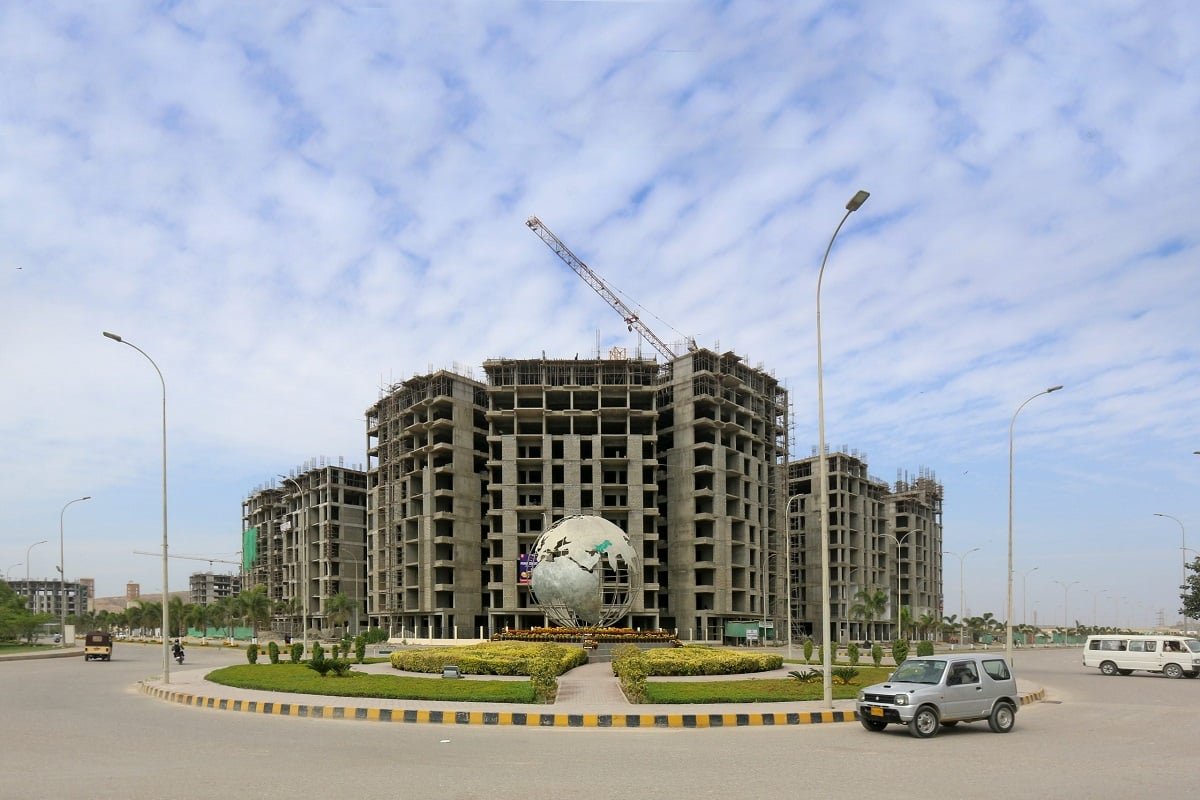
KARACHI: Pakistan’s primary equity market extended its most active stretch in years Tuesday, as the Securities and Exchange Commission of Pakistan approved the offer-for-sale prospectus of Naya Nazimabad Apartments REIT, clearing the way for the real estate trust to list on the Pakistan Stock Exchange.
The approval marks the 13th public offering cleared by the regulator in 2026, the SECP said in a press release, underscoring what officials describe as sustained momentum in a primary market that has drawn companies from manufacturing, technology, energy, food, agriculture and real estate.
Under the offering, Naya Nazimabad Apartments REIT will sell 44.06 million units, equal to 15% of the REIT Scheme’s total units, through a book-building process. Institutional investors and high-net-worth individuals will be allocated 75% of the offering, while the remaining 25% is reserved for retail investors, according to the SECP.
The scheme is a closed-end Developmental REIT established under Pakistan’s Real Estate Investment Trust Regulations of 2022. It is developing acquired land into commercial, retail and residential units, with returns to unit holders to be generated through the sale of completed properties.
Pakistan currently has 29 registered REIT schemes, of which six are listed on the PSX. Naya Nazimabad Apartments REIT will become the seventh REIT to list once its offering is completed, further expanding the country’s regulated real estate investment options.
SECP Chairman Dr. Kabir Ahmed Sidhu said the rising number of public offerings reflects greater use of the capital market as a financing tool for businesses. A strong primary market channels savings into productive investment and gives companies alternative, long-term sources of financing, he said.
Sidhu added that the SECP is working to cut the time and cost of raising capital, improve transparency and price discovery, and widen participation among both issuers and investors.
A Record Year for PSX Listings
The Naya Nazimabad approval caps a fiscal year that market participants and brokerages have called a two-decade high for new listings on the exchange. Pakistan’s fiscal year runs from July through June, meaning FY2026 covers July 2025 to June 2026.
According to PSX data reported by Mettis Global, 11 companies raised a combined Rs18.39 billion through main-board initial public offerings during FY2026, making it the exchange’s most active primary-market year in recent memory.
Other tallies, including one from the Express Tribune citing Topline Securities, put the number of new listings during the fiscal year at 10, with the same combined Rs18.39 billion raised, a discrepancy that reflects differing methods of counting main-board listings versus total approved offerings, some of which spanned fiscal-year boundaries.
Service Long March Tyres Limited, a tyre manufacturer, was the year’s largest issuer, raising roughly Rs7.78 billion, more than 42% of total capital raised, through a listing on June 15, 2026, with a 10% public float, the smallest of any FY2026 issuer.
Ghani Dairies Limited followed with about Rs3.44 billion raised, becoming Pakistan’s first listed corporate dairy farm, while Sitara Petroleum Service Limited raised roughly Rs3.18 billion to Rs4.83 billion depending on the reporting source. Together, the three largest issuers accounted for more than three-quarters of all capital raised on the main board during the year, Mettis Global reported.
Other notable offerings during the fiscal year included Wahdat Poultry, which raised nearly Rs1 billion for expansion; Pak-Qatar General Takaful, the country’s first listed non-life takaful company, whose offering drew institutional demand exceeding 21 times the shares on offer and attracted more than 13,000 retail investors, according to the SECP; and Pakistan’s first special-purpose acquisition company listing, LSE SPAC-I. Signature Residency REIT and JS Rental REIT also listed during the period, alongside Select Technologies.
Topline Securities Director of Research Shankar Talreja called the listing count a two-decade high for the exchange, according to the Express Tribune, and said the wave has been driven by attractive valuations that make it easier for companies to justify going public.
KSE-100 Outperforms
The listings boom coincided with a sharp rally in the benchmark KSE-100 Index, which closed FY2026 at 180,302 points, up from 125,627 at the end of FY2025, a gain of about 44% in rupee terms and roughly 46% in U.S. dollar terms, according to figures reported by Business Recorder and the Mettis Global news service. Market capitalization on the index rose to roughly Rs5.16 trillion by the end of June 2026.
The rally marked the third consecutive fiscal year in which the KSE-100 outperformed other major domestic asset classes, according to Arif Habib Limited and AKD Research, brokerages cited by Profit by Pakistan Today.
Over the three fiscal years spanning FY2024 through FY2026, the index recorded a cumulative gain of about 335% in rupee terms, or roughly 347% in dollar terms, Business Recorder reported, citing Topline Securities.
Performance was uneven across the year. The index returned about 39% in the first half of FY2026, aided by improving economic indicators despite flooding in July and August 2025, before slowing to a roughly 4% gain in the second half amid volatility tied to the Iran-Israel-U.S. conflict and higher petroleum prices, according to Business Recorder.
The KSE-100 swung between an intraday low of 146,480 points on March 9, 2026, and a high of 189,167 points on January 23, 2026, a variance of about 29%, before recovering on the back of a preliminary U.S.-Iran agreement and record monthly remittances of $4.3 billion in May 2026.
Automobile parts was the best-performing sector for the year, gaining roughly 278%, followed by woollen, fertilizer, synthetic and tobacco stocks. Cable and electrical goods, food, and vanaspati sectors lagged.
Bank of Punjab led individual stock gainers, while foreign corporate investors remained net sellers, offloading roughly $895 million during the fiscal year, Business Recorder reported.
Analysts attributed the rally to policy continuity, macroeconomic stabilization, record trading volumes, credit-rating upgrades and Pakistan’s return to international debt markets.
Brokerages including Topline Securities and AKD Research have projected further gains for the index heading into FY2027, forecasting levels between roughly 203,000 and 263,800 points by the end of calendar 2026.
The SECP said it expects the primary-market momentum to continue, noting that the first initial public offering of fiscal year 2026-27, for credit bureau Tasdeeq Information Services Limited, was cleared shortly after the new fiscal year began, following procedural changes introduced by regulatory leadership that took office in February 2026.
