


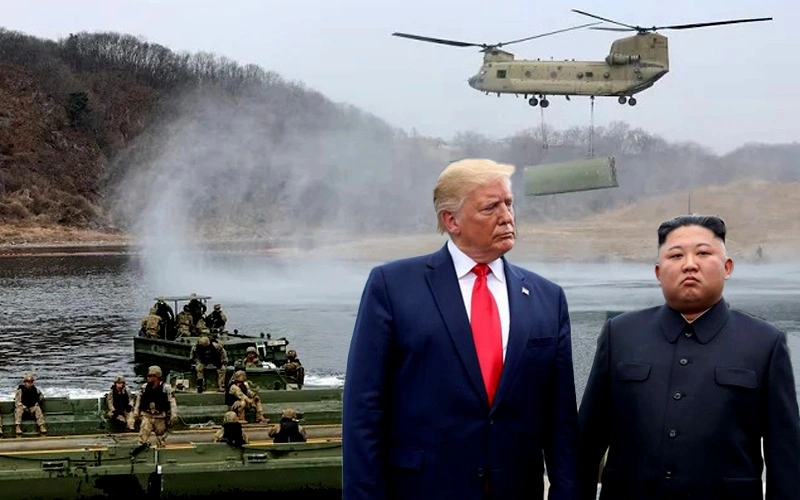
WASHINGTON: President Donald Trump has put the future of a major U.S.-South Korea military exercise in question, ordering the Pentagon on Sunday to substantially scale back the drills just hours before they were scheduled to begin, while citing tensions with Iran and his improved relationship with North Korean leader Kim Jong Un.
Trump said it was too late to cancel the annual exercises entirely but that he was “not happy” the United States had agreed to hold them. The decision came as Washington and Seoul prepared to launch the Ulchi Freedom Shield exercise, a key test of the allies’ combined defense readiness.
“Based on the fact that it is too late to cancel, I have instructed Secretary of War, Pete Hegseth, to substantially reduce the Joint Military Exercises!” Trump wrote on Truth Social.
The exercises are scheduled for Aug. 17-27 and involve about 18,000 South Korean military personnel. The training is designed to improve the allies’ ability to respond to a range of security threats, including North Korea’s growing use of drones, cyberattacks and electronic warfare.
Trump said the exercises were costly and sent an inappropriate and hostile message to North Korea, pointing to what he described as his “very good relationship” with Kim.
“These exercises are not only costly … but send a signal that is totally inappropriate and hostile to a country that, as long as Donald Trump has been President, has been unthreatening and respectful,” Trump wrote.
North Korea routinely condemns the annual U.S.-South Korea drills as preparations for an invasion. Washington and Seoul reject that characterization, saying the exercises are defensive and intended to strengthen the alliance’s ability to respond to potential threats.
It remained unclear what a scaled-back version of the exercises would look like. The White House and Pentagon did not immediately provide details on Trump’s order.
Read More: JD Vance outlines Washington’s priorities in Iran conflict
Trump also cited South Korea’s refusal to participate in U.S. efforts related to Iran, linking Seoul’s position to his decision to reduce the military exercises.
“While somewhat unrelated (?), I recently asked the President of South Korea if they would like to join us in the Denuclearization of the Islamic Republic of Iran, and they said, ‘No thanks!’” Trump wrote.
The comments come as the United States remains engaged in the conflict with Iran, adding a new dimension to Washington’s security relationship with Seoul.
South Korea has not agreed to participate in U.S. military action against Iran, while its alliance with Washington remains focused primarily on deterring threats from North Korea.
Despite Trump’s announcement, South Korea’s Defense Ministry said Monday that the Ulchi Freedom Shield exercises were “proceeding as planned.”
The statement left open questions about whether the U.S. military would alter parts of the training or reduce its participation while the exercise continues through Aug. 27.
The drills include scenarios involving drone attacks, GPS disruption and cyber operations, reflecting changes in North Korea’s military capabilities and the growing importance of emerging technologies on modern battlefields.
The exercises also involve coordination among military and government agencies to strengthen the allies’ combined defense posture and improve their ability to respond to a range of security threats.
Trump’s announcement came days after North Korea launched a ballistic missile from its eastern coast toward the Sea of Japan, according to South Korean and Japanese officials.
The launch followed another short-range ballistic missile test on Aug. 6, underscoring the continuing military tensions on the Korean Peninsula despite Trump’s efforts to maintain a dialogue with Kim.
U.S. military officials have also said North Korean troops fighting alongside Russian forces in Ukraine have gained battlefield experience, including in the use of unmanned systems, electronic warfare and cyber operations.
Ukraine said last week that North Korean-made missiles were used in a Russian ballistic missile attack on a steel plant in Zaporizhzhia that killed seven workers and forced a production halt. Ukrainian officials also said Russia used Zircon hypersonic missiles in the attack.
Trump’s decision comes as Washington is also adjusting its military posture in other regions. The USS George Washington has been sent to the Persian Gulf to replace the USS Abraham Lincoln, which had been operating in the broader Asia-Pacific region.
The move comes as the United States remains focused on the conflict with Iran and could further raise questions about how Washington is balancing its military commitments in the Middle East and Asia.
For South Korea, the annual drills remain a central element of its military coordination with the United States. For North Korea, any change in the exercises could affect the broader security environment on the peninsula.
Trump’s order now leaves the allies facing uncertainty over the scope of this year’s drills, even as Seoul maintains that the exercise is proceeding as scheduled.
